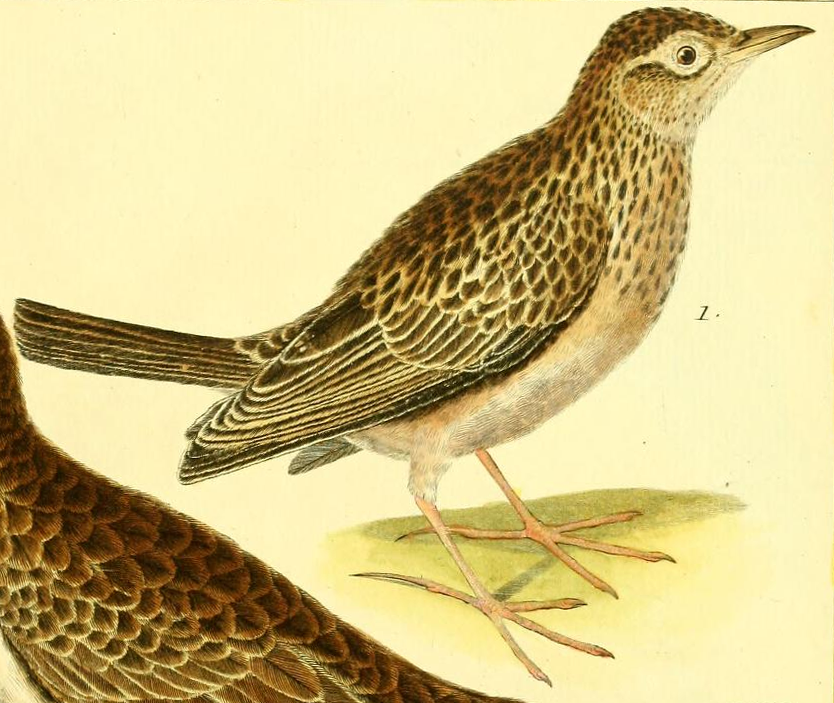
Object Status:
Extant
Accession Date:
By 1799
Primary Source Reference:
Charles Willson Peale, Lecture on Natural History 31. (ca. 1799). Academy of Natural Sciences of Drexel University Archives, coll. 40. / https://ansp.org/research/library/archives/0000-0099/coll0040/
Additional Source Text:
Charles Willson Peale (1741-1827) wrote, in his 31st Lecture (ca. 1799): "No. 1236. Sky-Lark. The length of this species is about […] inches. The general colour brown, stryped with […]-sallow white, light on the throat & under the breast. It is said that this and the Wood lark are the only birds, in England, that sing as they fly; [thus] raising its note as it soars, and lowering it till it quite dies away as it descends." (Academy of Natural Sciences of Drexel University Archives, coll. 40)
Peale continued: "Mr. Pennant says: 'It will often soar to such a height, that we are charmed with the music when we loose sight of the songster; it also begins its song before the earliest dawn. Milton, in his Allegro, most beautifully expresses these circumstances: and Bishop Newton observes, that the beautifull scene that Milton exhibits of rural cheerfulness, at the same time gives us a fine picture of the regularity of his life and the innocency of his own mond; thus he describes himself as in a situation: 'To hear the lark begin his flight / And singing startle the dull night / From his watch tower in the skies / 'Till the dappled dawn doth rise.' It continues its harmony several months, beginning early in the spring, on pairing. In the winter they assemble in England in vast flocks, grow very fat, and are taken in great numbers for their tables. They build their nest on the ground, beneath some clod; dry fibres, &c. and lay 4 or 5 eggs.' Here [in the Museum] is such a nest, with 4 eggs." (ANSP Archives, coll. 40)
Peale continued: "Mr. Pennant further says: 'The place these birds are taken in the greatest quantity, is the neighborhood of Dunstable: the season begins about the 14th of Sepr., and ends the 25th of Feby.; and during that space, about 4000 Dozen are caught, which supply the markets of the meteropolis. Those caught in the day are taken in class-nets of 15 yards length, and two and a half in breadth; and are enticed within their reach by means of bits of looking-glass, fixed in a piece of wood, and placed in the middle of the nets, which are put in a quick whirling motion, by a string the larker commands; he also makes use of a decoy lark. These nets are used only till the 14th of November, for the larks will not dare, or frolick in the air except in fine sunny weather; and of course cannot be inveigled into the snare. When the weather grows gloomy, the larker changes his engine, and makes use of a trammel net 27 or 20 feet long, and 5 broad; which is put on two poles 18 feet long and carried by men under each arm, who pass over the fields and quarter the ground as a setting dog; when they hear or feel a lark hit the net, they drop it down and so the birds are taken'." (ANSP Archives, coll. 40)
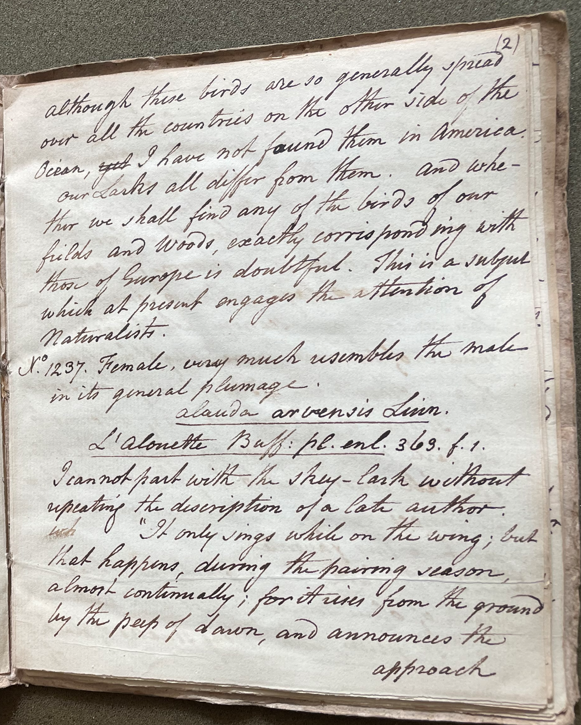
Peale continued: "This species of lark is found in Norway, Sweden, Germany, France, Italy, Greece, and at the cape of Good-hope. Also very common in Russia and Sibiria, even as far as Kamtschatka. Although these birds are so generally spread over all the countries of the other side of the Ocean, yet I have not found them in America. Our Larks all differ from them. And whether we shall find any of the birds of our fields and woods, exactly corrisponding with those of Europe is doubtful. This is a subject which at present engages the attention of naturalists." (ANSP Archives, coll. 40)
Peale also described a female: "No. 1237. Female, very much resembles the male in its general plumage … I cannot part with the Sky-lark without repeating the description of a late author: 'It only sings while on the wing; but that happens during the pairing season, almost continually; for it rises from the ground by the peep of dawn, and announces the approach of day to the whole of animated nature. When it first leaves the earth, its notes are feeble and interrupted. As it rises, however, they gradually swell to their fill tone; and the brid, long after it has soard to a height where it is lost to the eye, still continues to charm the ear with its melodious lays. There is something in the concomitant scenery, which renders the music of the lark more delightful than that of any other bird. The pleasing landscape, the silence of all nature, as if listening to its early call, the rising sun, and the gilded sky, all contribute to heighten our relish for its innocent lays, and increase our attachment to this favorite'." (ANSP Archives, coll. 40)
In "A Walk Through the Philad[elphi]a Museum" (1805–1806), Peale repeated much of this information verbatim. (Historical Society of Pennsylvania, coll. 0481)
An undated list of 21 bird specimens in Peale's handwriting includes one "Sky [Lark]" (American Philosophical Society Library, Mss.B.P31).
An unmounted specimen of "Alauda arvensis (Sky Lark)" was listed in "A Catalogue of Duplicate Specimens...", May 1822. [unpublished] APS Library (Mss.B.P31).
Notes:
Many years after the closing of his museum, Peale's specimen of A. arvensis (unlocated) was mentioned in an article in the Boston Evening Transcript on 13 April 1900, which read: “At the rooms of the Appalachian Mountain Club this afternoon and evening, Walter B. Davis exhibits his collection.… Two of the most valuable birds in the collection are an English Skylark, from the old Charles Wilson Peale collection made in 1784 in Philadelphia, and a golden pheasant presented to Mr. Peale by George Washington. These specimens have recently been discovered by [Charles] J. Maynard [1845-1929] of Newtonville, after having been lost for over fifty years. When the Peale Museum was sold a portion of the remainder was purchased by Moses Kimball of the Boston Museum, and its identity became lost. When this museum was broken up a few years since, the collection as given to the Boston Natural History Society, who sold the birds to Mr. Maynard, not knowing their origin. Many of Alexander Wilson’s types are in the collection.” (transcribed from photocopy in the American Philosophical Society Library, Mss.Ms.Coll.3)
Specimen Type:
Dead/preserved
Current Common Name:
Eurasian Skylark
Current Scientific Name
Alaudidae | Alauda arvensis