Object Status:
Extant
Accession Date:
By 1799
Primary Source Reference:
Charles Willson Peale, Lecture on Natural History 22. (ca. 1799). Academy of Natural Sciences of Drexel University Archives, coll. 40. / https://ansp.org/research/library/archives/0000-0099/coll0040/
Additional Source Text:
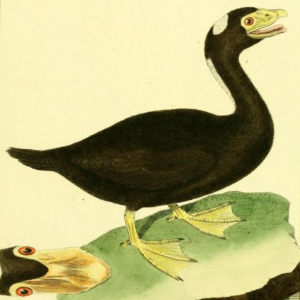
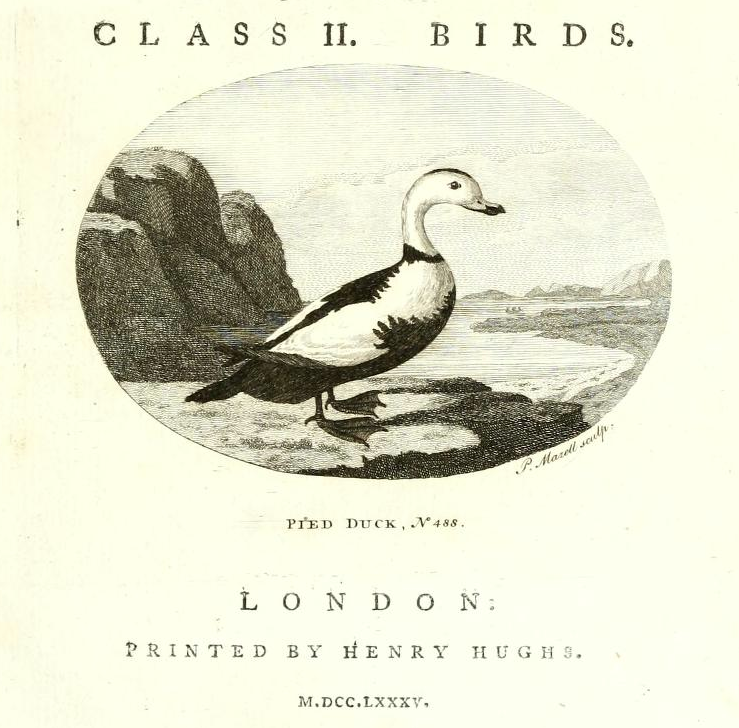
Charles Willson Peale (1741-1827) wrote, in his 22nd Lecture (ca. 1799): "501. Pied Duck. commonly called Sandshoal duck. The lower part of the bill black, the upper part: on the summit of the head is an oblong black spot: forehead, cheeks, rest of the head, and neck white; the lower part circled with black: scaplars and coverts of wings white: back, breast & primaries, black: tail cuneiform, and dusky: feet black. Anas Labradoria Linn. Pied Duck Latham No. 46. Pennant No. 488. The frontishpiece [sic] of Pennant Voll: 11d. is [a] good likeness. 540. The female has the bill like the male: general plumage on the upper parts a dirty mottled brown: on the wings a spot of barred with white; legs black. Inhabits the coast of Labrador, from whence a pair came in the possession of Sir Joseph Banks. That described in the Arctic Zoology, was sent from Connecticut in New England to Mr. Pennant. These [specimens] I found in our market and is a rare bird, brought from Egg Harbour [New Jersey]. They are rare." (Academy of Natural Sciences of Drexel University Archives, coll. 40)
An undated scrap of paper tucked into Peale's 21st lecture manuscript contains a scribbled list of duck specimens, including: "Pied D. (Labradoria)" found at New York. (ANSP Archives, coll. 40)
Peale wrote, in "A Walk Through the Philad[elphi]a Museum" (1805–1806): "The pied Duck (a. Labradoria) deserves our notice as a rare Duck; or not much known even to Naturalists. They are brought some times to our Market from Egg-harbour." (Historical Society of Pennsylvania, coll. 0481)
Alexander Wilson (1766-1813) described this species under the name "Pied Duck / Anas labradora" in American Ornithology vol. 8, published posthumously (Pl. 69), where "Peale's Museum, No. 2858" was listed among the synonyms (Wilson 1814: 91). / https://www.biodiversitylibrary.org/item/175758#page/109/mode/1up (text) / https://www.biodiversitylibrary.org/item/175758#page/96/mode/1up (plate)
Notes:
The specimens described in Peale's lecture (ca. 1799) were "brought from Egg Harbour". This may be the only record of this extinct species in New Jersey.
Witmer Stone (1866-1939) was apparently unaware of the extent of Peale's collection when preparing his classic work, Bird studies at Old Cape May, Philadelphia: Delaware Valley Ornithological Club). In his first volume, in his account of the Labrador Duck, Stone (1937: 239) wrote: "[We] have practically no information as to its habits nor any definite records of its occurrence on the New Jersey shore. Wilson says that 'it is called by some gunners the sand shoal duck from its habit of frequenting sand bars and that early in the month of March a few are observed in our [Philadelphia] market'; [but] he apparently never met with it in life ... A female and immature male in the collection of the Academy of Natural Sciences were probably obtained on the New Jersey coast, perhaps in the [1850s], as they resemble in preparation other specimens from the collection of John Krider [1813-1886], but this is merely supposition."
Specimen Type:
Dead/preserved
Current Common Name:
Labrador Duck
Current Scientific Name
Anatidae | Camptorhynchus labradorius