Object Status:
Extant
Accession Date:
By 1799
Primary Source Reference:
Charles Willson Peale, Lecture on Natural History 25. (ca. 1799). Academy of Natural Sciences of Drexel University Archives, coll. 40. / https://ansp.org/research/library/archives/0000-0099/coll0040/
Additional Source Text:
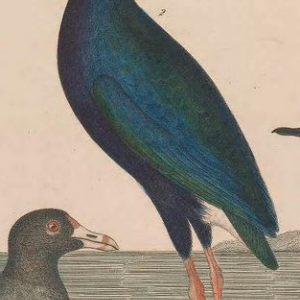
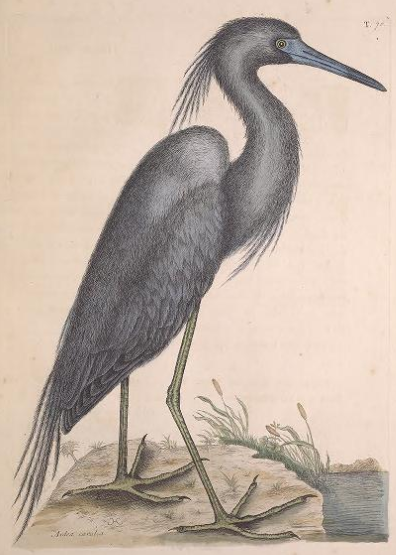
Charles Willson Peale (1741-1827) wrote, in his 25th Lecture (ca. 1799): "732. Blue Heron. with a blue bill, dusky at the point; head and neck of changeable purple; the first adorned with a beautiful crest of long slender feathers; the remainder of the plumage entirely of a fine deep blue; from the breast descend several long feathers; the back has the sort of longe feathers extending beyond the tail; of a silky appearance; the legs green; iris yellow. Ardea caerula Linn. Heron bleueâtre de Cayenne. Buff. pl. enl. 349. Blue Heron Latham No. 45. Pennant No. 351. Crested Bittern Catesby I tab 79." (Academy of Natural Sciences of Drexel University Archives, coll. 40)
Peale continued: "I found them on the Island near Cape May where they breed. they migrate to the southward during the winter. Latham says they are also in Jamaca & the other West India Islands in the winter season. and that it has been met with at [Otahuita], and other Islands of the South seas, where it is much respected. They have a superstition regard for Herons and Kingfishers almost like that which is paid to the Stork, the Robin red Breast, Swallow, and other harmless familiar birds in England." (ANSP Archives, coll. 40)
Peale also described two juveniles, in the same lecture, which he assumed were an undescribed species, or else juveniles of the Great Egret (Ardea alba): "No. 738. Demi crested Heron. Plumage intirely white; legs & feet green; base of the upper mandible white; irides yellow, as is also a naked skin from the eyes to the bill. This small White Heron, may be a young of the [Great] Egret in the first year's groath, yet we find them very common at some seasons on the Schoolkill [River] in small flocks and none of the Egrets with them, a circumstance that leads me to immagine that they are not the same bird. They are not described. 739. Is another variety, without the demi crest, and some black on the ends of the wing quills. also found in our Rivers." (ANSP Archives, coll. 40)
Alexander Wilson (1766-1813) described this species under the name "Blue Crane, or Heron / Ardea caerulea" in American Ornithology vol. 7 (Pl. 62), where "Peale's Museum, No. 3782" was cited (Wilson (1813: 117). https://www.biodiversitylibrary.org/item/175507#page/137/mode/1up (text) / https://www.biodiversitylibrary.org/item/175507#page/128/mode/1up (plate)
An unmounted specimen of "Ardea canae (Ash Coloured Heron)" from Florida, which likely refered to this species, was listed in "A Catalogue of Duplicate Specimens...", May 1822. [unpublished] American Philosophical Society Library (Mss.B.P31).
Notes:
Peale erred in citing plate 79 in Catesby (1731, The natural history of Carolina, Florida and the Bahama Islands...), which depicts a Yellow-crowned Night-Heron (Nyctanassa violacea).
Peale's comment, that "[he] found them on the Island near Cape May where they breed," is a notable nesting record. Witmer Stone, 1937, Bird studies at Old Cape May, vol. 1, p. 129 (Philadelphia: Delaware Valley Ornithological Club) wrote: "Our experience with this Little Blues at Cape May is largely limited to the white [immature] phase of plumage and mainly to the months of August and September ... the first Little Blue Herons are not usually seen about Cape May until July 15 or even August 1 ... In former years, probably up to 1880, the Little Blue Heron bred on some of the island beaches of Cape May County which have now been almost entirely converted into summer resorts."
It appears that, while preparing this work, Witmer Stone (1866-1939) was unaware of the extent of Peale's collecting activities at Cape May.
Specimen Type:
Dead/preserved
Current Common Name:
Little Blue Heron
Current Scientific Name
Ardeidae | Egretta caerulea