Object Status:
Extant
Accession Date:
By 1799
Primary Source Reference:
Charles Willson Peale, Lecture on Natural History 25. (ca. 1799). Academy of Natural Sciences of Drexel University Archives, coll. 40. / https://ansp.org/research/library/archives/0000-0099/coll0040/
Additional Source Text:
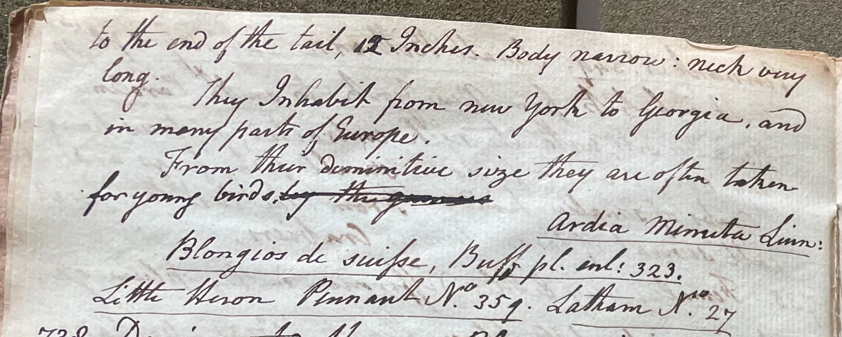
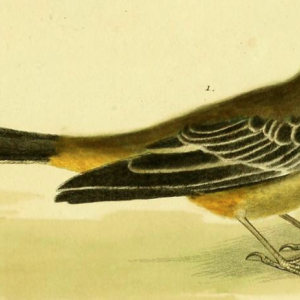
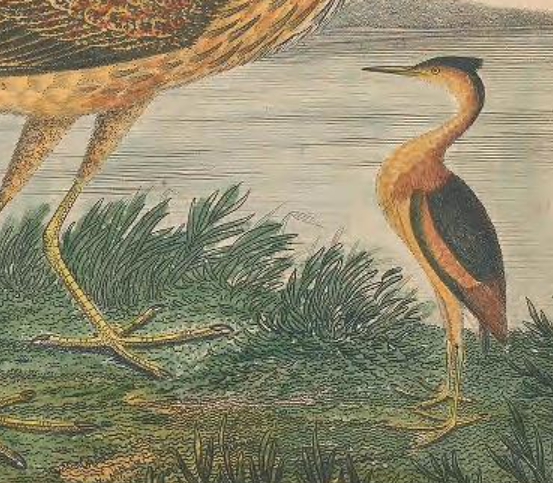
Charles Willson Peale (1741-1827) wrote, in his 25th Lecture (ca. 1799): "No. 737. Little Heron. has a smooth head, Black on the top; hind part of the neck and cheek ferruginous; coverts on the ridge of the wing and ends of the greater [coverts], of a bright bay; the rest of the coverts of a pale clay colour; primaries and secondaries dusky with ferruginous tips; lower side of the neck and belly under parts of the body of a yellowish white; breast crossed with a band of black; tail black; feet of a dusky green; length, to the end of the tail, 12 Inches. Body narrow; neck very long. They Inhabit from New York to Georgia, and in many parts of Europe. From their diminutive size they are often taken for young birds by the gunners. Ardia Minuta Linn. Blongios de Suisse, Buff. pl. enl. 323. Little Heron Pennant No. 359. Latham No. 27." (Academy of Natural Sciences of Drexel University Archives, coll. 40)
A slip of loose paper, tucked into Peale's 36th lecture, contains a list of waterbirds with the following entry: "Little Heron (minuta)" (ANSP Archives, coll. 40).
Peale wrote, in "A Walk Through the Philad[elphi]a Museum" (1805–1806): "The little Heron (a. Minuta) is so small that sportsmen mistake them for young birds — It inhabits from New York to Georgia and in many parts of Europe" (Historical Society of Pennsylvania, coll. 0481).
Alexander Wilson (1766-1813) described this species under the name "Least Bittern / Ardea exilis" in American Ornithology vol. 8, published posthumously (Pl. 65), where "Peale's Museum, No. 3814" was cited (Wilson 1814: 37). / https://www.biodiversitylibrary.org/item/175758#page/47/mode/1up (text) / https://www.biodiversitylibrary.org/item/175758#page/35/mode/1up (plate)
Specimen Type:
Dead/preserved
Current Common Name:
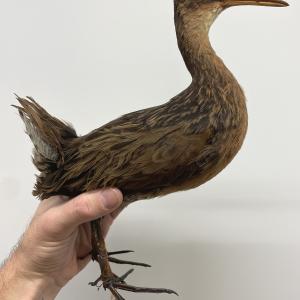
Least Bittern
Current Scientific Name
Ardeidae | Ixobrychus exilis