Object Status:
Extant
Accession Date:
By 1799
Primary Source Reference:
Charles Willson Peale, Lecture on Natural History 18. (ca. 1799). Academy of Natural Sciences of Drexel University Archives, coll. 40. / https://ansp.org/research/library/archives/0000-0099/coll0040/
Additional Source Text:
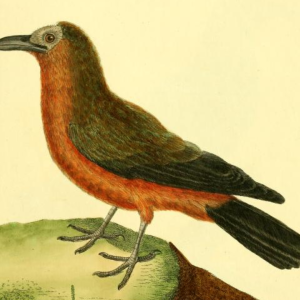
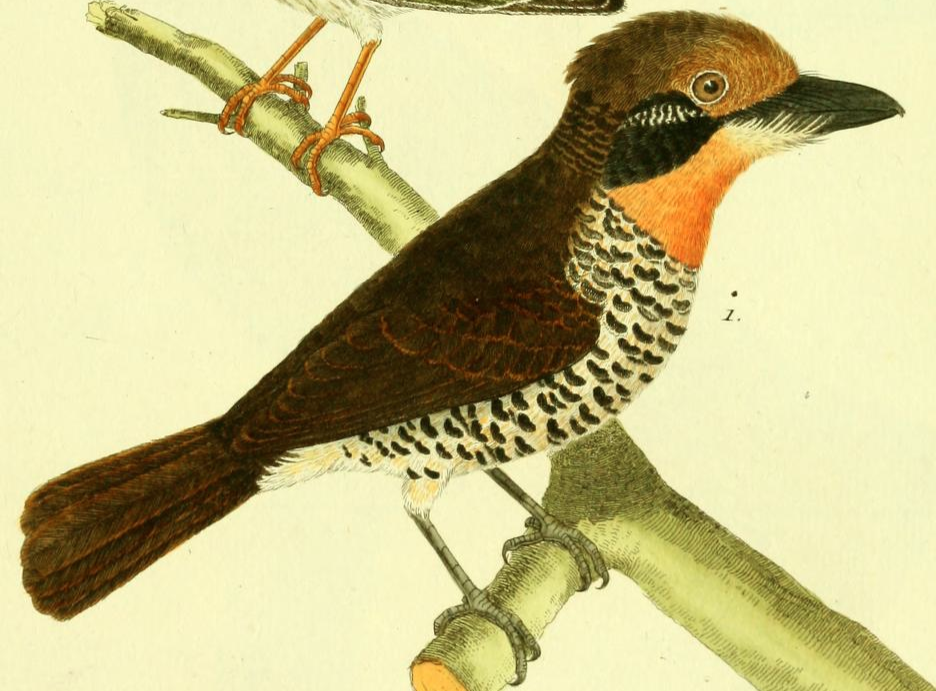
Charles Willson Peale (1741-1827) wrote, in his 18th Lecture (ca. 1799): "No. 177 250. Spotted belly Barbet. The bill is black, bending downward at the point. The forehead and throat are of a bright red; the hinder part of the crown of the head is yellow with some black inter-mixed; all the upper parts are a dark dusy colours and the feathers edged with olive with olive green; the breast and belly yellowish white, with black oval spots. Bucco Tamatia Linn. Barbu à ventre tacheté a Cayenne Buff. 746. not quite correct, Edwards better. This Bird is met with both at Cayenne and Brazil." (Academy of Natural Sciences of Drexel University Archives, coll. 40)
Peale continued: "The habits corrispond with that of the whole family. It is a clumsy, ill made bird according to Mr. Latham's opinion, but why he or Buffon should call it ill made, or ill formed, is unaccountable to me. It is not a tall slender form of a Bird, yet it may be perfectly well made for its particular mode of living, as ordained at the creation. They say its manners exactly suit its shape, being a solitary, pensive, silent animal, affecting only such places as are farthest from habitations; being found chiefly in the woods, where it chooses some low branch well covered with twigs and foliage; in this it perches, with its large head resting between its shoulders, for a long time togather, and, as its disposition to action is very little, may be easily killed, as it will suffer itself to be shot at several times before it attemps to make its escape. Its common food is Insects, particularly large Beetles; the flesh does not prove good for eating." (ANSP Archives, coll. 40)
Peale wrote, in "A Walk Through the Philad[elphi]a Museum" (1805–1806): "… according to Latham & Buffon, it is a stupid, clumsy, ill made, or ill formed bird. Strange language for naturalists! Its food is large Beetles. The general shape of the bird as its strength of Bill, fits it well for such prey, and no doubt it needed not much cunning to subsist in the thick woods of hot Climates where inumerable insects breed. The spotted Belly Barbet (B. Tamatia) of Cayanne & Brazil." (Historical Society of Pennsylvania, coll. 0481)
Notes:
In his lecture, C. W. Peale did not specify the origin of his specimen. It may have come from Cayenne, French Guiana, where Raphaelle Peale (1774-1825) travelled in 1793, to collect specimens for Peale's Museum. However, to the editor's (MRH) knowledge, there is no detailed inventory of the specimens Raphaelle brought back to Philadelphia, and there are many examples of specimens from northern South America that were donated by other people. For more discussion about Raphaelle's travels, see Lillian B. Miller, 1993, "Father and Son: The Relationship of Charles Willson Peale and Raphaelle Peale", The American Art Journal 25: 4-161. / https://doi.org/10.2307/1594599
Specimen Type:
Dead/preserved
Current Common Name:
Spotted Puffbird
Current Scientific Name
Bucconidae | Bucco tamatia