Object Status:
Extant
Accession Date:
By 1799
Primary Source Reference:
Charles Willson Peale, Lecture on Natural History 33. (ca. 1799). Academy of Natural Sciences of Drexel University Archives, coll. 40. / https://ansp.org/research/library/archives/0000-0099/coll0040/
Additional Source Text:
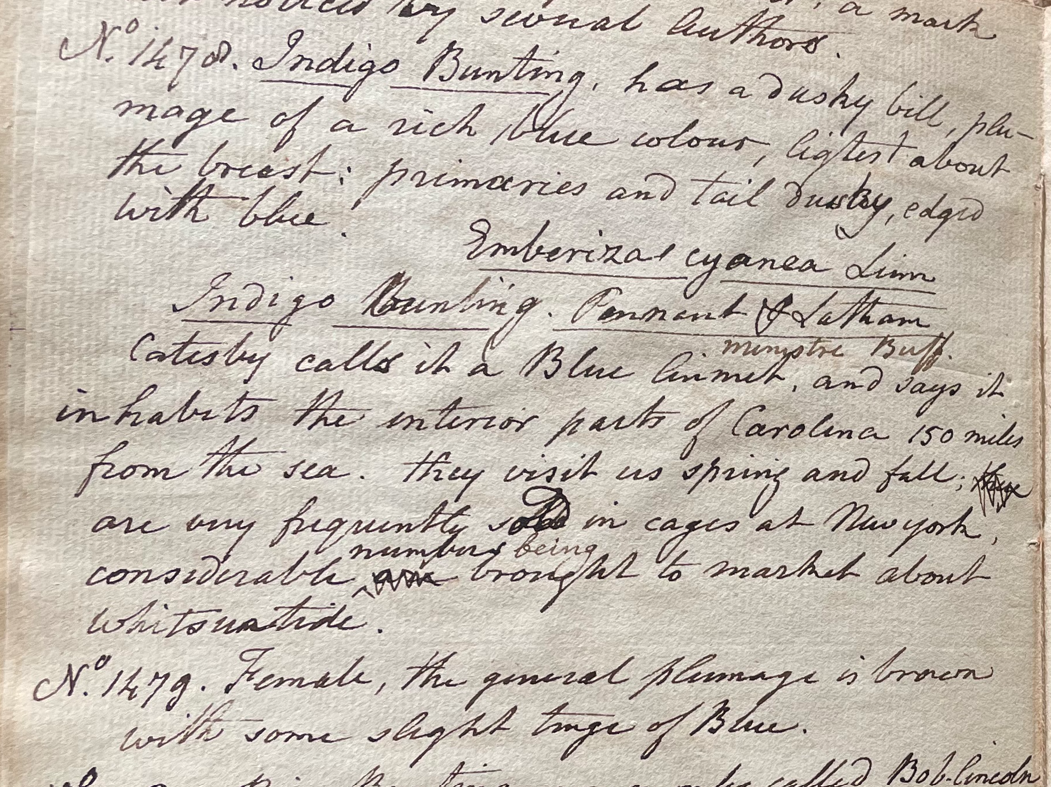
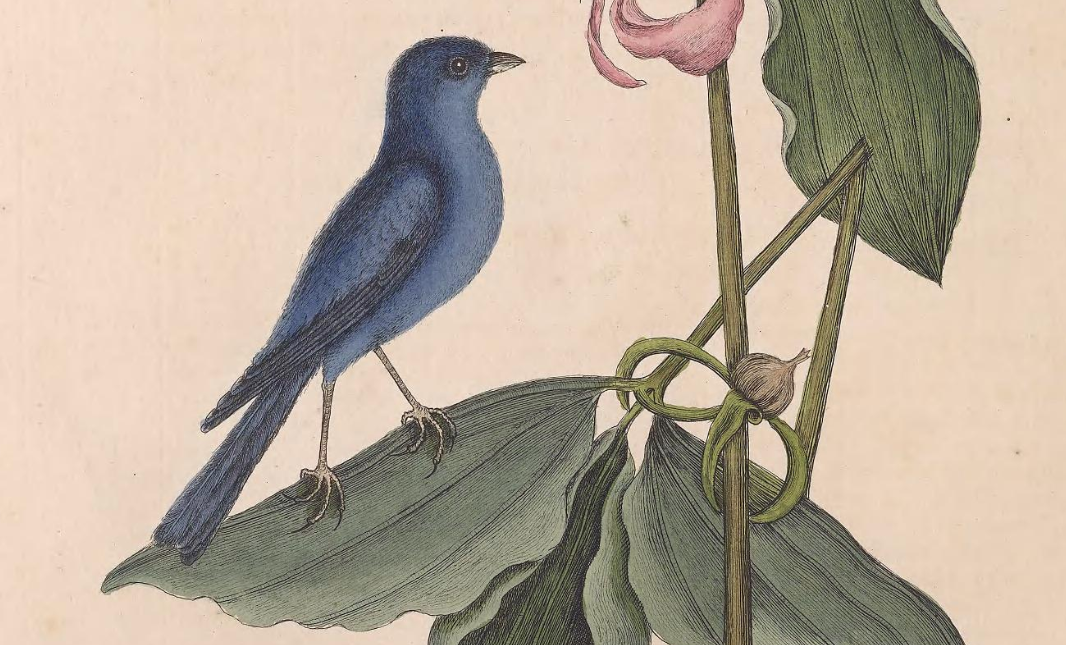
Charles Willson Peale (1741-1827) wrote, in his 33rd Lecture (ca. 1799): "No. 1478. Indigo Bunting. has a dusky bill, plumage of a rich blue colour, lightest about the breast; primaries and tail dusky, edged with blue. Emberiza cyanea Linn. Indigo Bunting. Pennant & Latham. Ministre Buff. Catesby calls it a Blue Linnet, and says it inhabits the interior parts of Carolina, 150 miles from the sea. they visit us spring and fall; are very frequently in cages at New York, considerable numbers being brought to market about Whitsuntide [June 5]. No. 1479. Female, the general plumage is brown with some slight tinge of Blue." (Academy of Natural Sciences of Drexel University Archives, coll. 40)
Peale wrote, in "A Walk Through the Philad[elphi]a Museum" (1805–1806): "The Indigo Bunting (E. Cyanea) and the Black throated Bunting (E. Americana) or as some call it the Grass Sparrow, are among the handsomest that the middle [United] States possess." (Historical Society of Pennsylvania, coll. 0481)
Alexander Wilson (1766-1813) described an adult male under the name "Indigo Bird / Fringilla cyanea" in American Ornithology vol. 1 (Pl. 6), where "Peale's Museum No. 6002" was cited (Wilson 1808: 100). / https://www.biodiversitylibrary.org/item/175530#page/124/mode/1up (text) / https://www.biodiversitylibrary.org/item/175530#page/111/mode/1up (plate)
Wilson deposited "A female Indigo Bunting in the winter dress, (nearly brown &c.)" in October 1811, according to the Peale Museum Accessions Book, p. 56 (Historical Society of Pennsylvania, coll. 0481).
Two unmounted specimens of "Emberiza cyanea (Indigo Bunting)" were listed in "A Catalogue of Duplicate Specimens...", May 1822. [unpublished] American Philosophical Society Library (Mss.B.P31). One of these may have been Wilson's specimen.
Charles Lucien Bonaparte (1803-1857) described this species under the name "Indigo Finch / Fringilla cyanea" in his continuation of American Ornithology, vol. 2 (Pl. 15), where "Peale's Museum, No. 6002, Male; [and] 6003, Female" were cited (Bonaparte 1828: 91). His plate (15) depicting the adult female was based on a drawing by Alexander Rider, engraved by Alexander Lawson (ca.1772-1846). / https://search.library.wisc.edu/digital/AFKPEJIASN54OC8L/pages/AIAWVGQI… (text) / https://search.library.wisc.edu/digital/AFKPEJIASN54OC8L/pages/ATIEYCCT… (plate)
Specimen Type:
Dead/preserved
Current Common Name:
Indigo Bunting
Current Scientific Name
Cardinalidae | Passerina cyanea