Object Status:
Extant
Accession Date:
By 1799
Primary Source Reference:
Charles Willson Peale, Lecture on Natural History 33. (ca. 1799). Academy of Natural Sciences of Drexel University Archives, coll. 40. / https://ansp.org/research/library/archives/0000-0099/coll0040/
Additional Source Text:
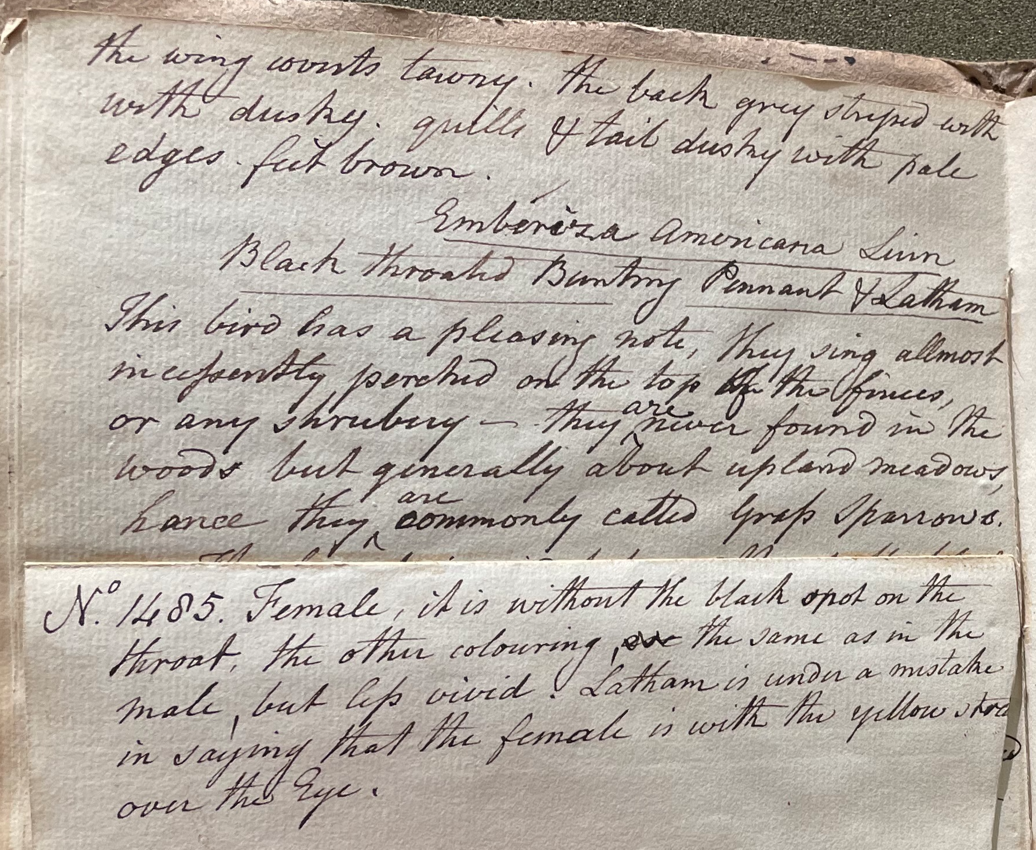
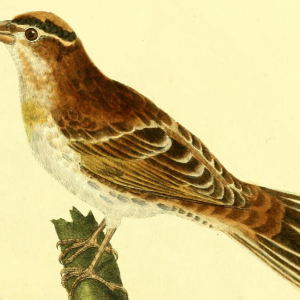
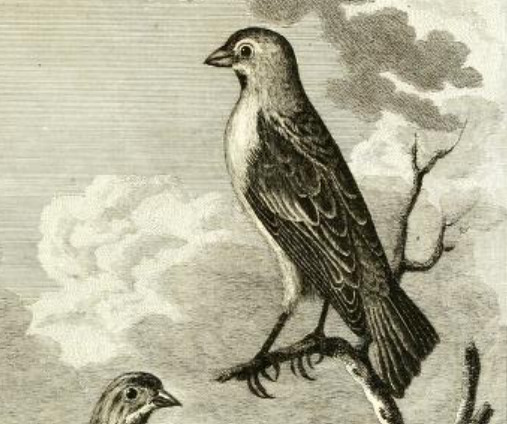
Charles Willson Peale (1741-1827) wrote, in his 33rd Lecture (ca. 1799): "No. 1484.Black Throated Bunting. the bill is thick, top of the head yellowish green; above each eye a line of rich yellow, at the corner of the mouth another; chin white; on the throat a large triangular spot of black; breast yellow, lower down white; the wing coverts tawny; the back grey striped with dusky; quills & tail dusky with pale edges; feet brown. Emberiza Americana Linn. Black throated Bunting Pennant & Latham. This bird has a pleasing note, they sing almost incessantly perched on the top of the fences, or any shrubbery. They are never found in the woods but generally about upland meadows, hence they are commonly called grass sparrows." (Academy of Natural Sciences of Drexel University Archives, coll. 40)
A slip of paper was subsequenty attached to the manuscript, which read: "No. 1485. Female, it is without the black spot on the throat, the other colouring the same as in the male, but less vivid. Latham is under a mistake in saying that the female is with the yellow streak over the Eye." (ANSP Archives, coll. 40)
Peale wrote, in "A Walk Through the Philad[elphi]a Museum" (1805–1806): "The Indigo Bunting (E. Cyanea) and the Black throated Bunting (E. Americana) or as some call it the Grass Sparrow, are among the handsomest that the middle [United] States possess." (Historical Society of Pennsylvania, coll. 0481)
Alexander Wilson (1766-1813) described this species under the name "Black-throated Bunting / Emberiza americana" in American Ornithology, vol. 1 (Pl. 3), where "Peale's Museum No. 5952" was cited (Wilson 1808: 54). / https://www.biodiversitylibrary.org/item/175530#page/72/mode/1up (text) / https://www.biodiversitylibrary.org/item/175530#page/62/mode/1up (plate)
Two mounted specimens of "Emberiza Americana (Black throated Bg)" were listed in "A Catalogue of Duplicate Specimens...", May 1822. [unpublished] American Philosophical Society Library (Mss.B.P31).
Specimen Type:
Dead/preserved
Current Common Name:
Dickcissel
Current Scientific Name
Cardinalidae | Spiza americana