Object Status:
Extant
Accession Date:
17 February 1795
Primary Source Reference:
Gazette of the United States, 17 February 1795.
Additional Source Text:
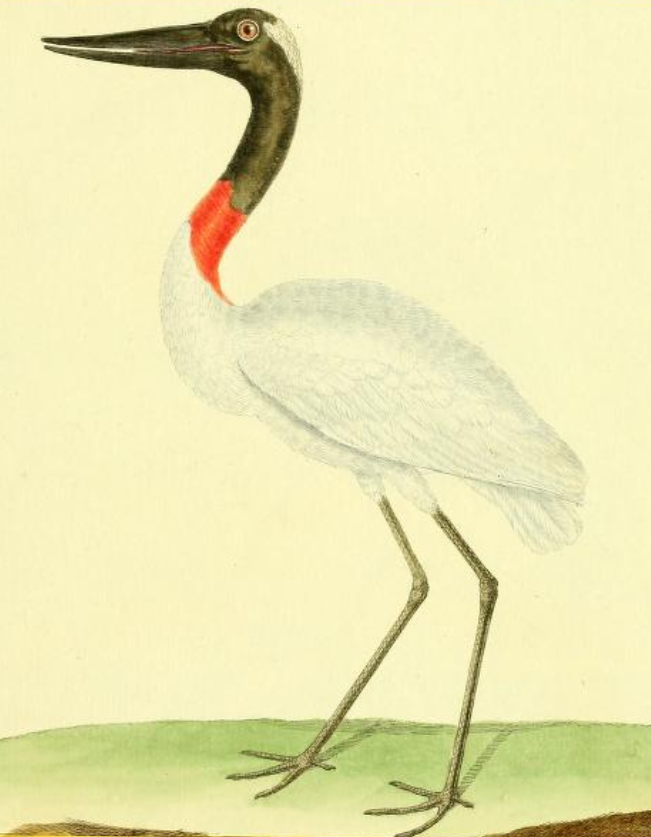
On 17 February 1795, a notice in the Gazette of the United StatesM/em> (Philadelphia) announced Peale's acquisition from Mr. William Duée of "The head of the Jabireu, or negro bird; one of the largest birds of Guinaa [sic], being about six feet high. They are great destroyers of the enormous snakes of that country."
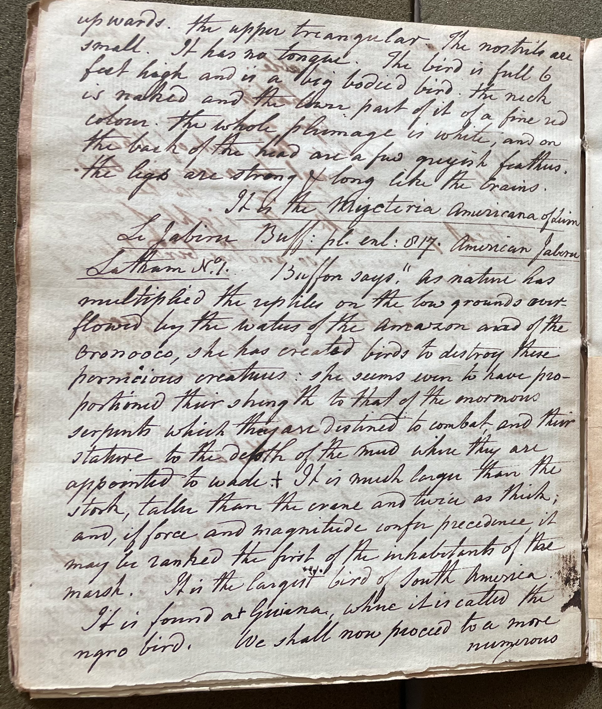
Charles Willson Peale (1741-1827) wrote, in his 25th Lecture (ca. 1799): "Even a part of an Animal becomes interesting to us in description. This head makes an impression on the mind of what the bird must be to which it belonged. No. 722. Head of the Jabiru. The bill is long and large, both mandibles bending upwards. The upper [mandible] triangular. The nostrils are small. It has no tongue. The bird is full 6 feel high and is a big bodied bird. the neck is naked and the lower part of it of a fine red colour. the whole plumage is white, and on the back of the head are a few greyish feathers. the legs are strong & long like the Crains. It is the Mycteria Americana of Linn. Le Jabiru Buff. pl. enl. 817. American Jabiru Latham No. 1." (Academy of Natural Sciences of Drexel University Archives, coll. 40)
Peale continued: "Buffon says, 'As nature has multipled, the reptiles on the low grounds overflowed by the waters of the Amazon and of the Oronoco, she has created birds to destroy these pernicious creatures; she seems even to have proportioned their strength to that of the enormous serpents which they are destined to combat, and their stature to the depth of the mud where they are appointed to wade.' It is much larger than the stork, taller than the crane and twice as thick; and, if force and magnitude confer precedence, it may be raned the first of the inhabitants of the marsh. It is the largest bird of South America. It is found at Guiana, where it is called the Negro bird." (ANSP Archives, coll. 40)
On 15 June 1805, "Jabiru Mycteria Americana Catalogue No. 3572 See Linn." donated by "Monsieur" (likely Bellvue Soisson) was entered in the Peale Museum Accessions Book (Historical Society of Pennsylvania, coll. 0481). On 6 June 1805, Peale wrote to his son Rubens: "We have had many valuable donations to the Museum of late … The Jarberew" (Miller 1988: 844, Selected Papers, Vol. 2, part 1, Yale University Press).
Peale wrote, in "A Walk Through the Philad[elphi]a Museum" (1805-1806): "…the next Genus Mycteria Jabiru whose stature is full six feet, and with a Beak of sufficient strength to crush enormous serpents which it finds on the shores of the Amazon and Oronooco; the contrast would be great placed near this American Jabiru. / How immensely valuable to the Inhabitants of the flat shores of South America is the Jabiru? after the rainy season is over, miriads of Reptiles would be left to putrify in the hot sun of that sultry climate, and contaminate the air in great a degree that no human being could long exist there. It may readily be conceived that a number of such large birds would devour multitudes of small animals that would be left on the Marshes when the waters subsided or was drying up. / This is a small family; only 3 species of the Jabaru is yet known." (Historical Society of Pennsylvania, coll. 0481)
Specimen Type:
Dead/preserved
Current Common Name:
Jabiru
Current Scientific Name
Ciconiidae | Jabiru mycteria