Object Status:
Extant
Accession Date:
By 1799
Primary Source Reference:
Charles Willson Peale, Lecture on Natural History 30. (ca. 1799). Academy of Natural Sciences of Drexel University Archives, coll. 40. / https://ansp.org/research/library/archives/0000-0099/coll0040/
Additional Source Text:
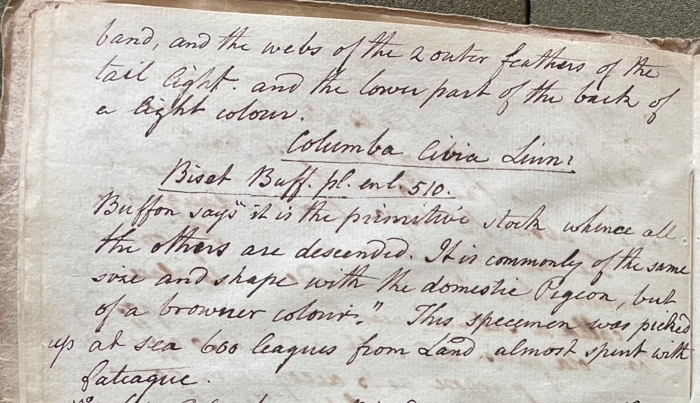
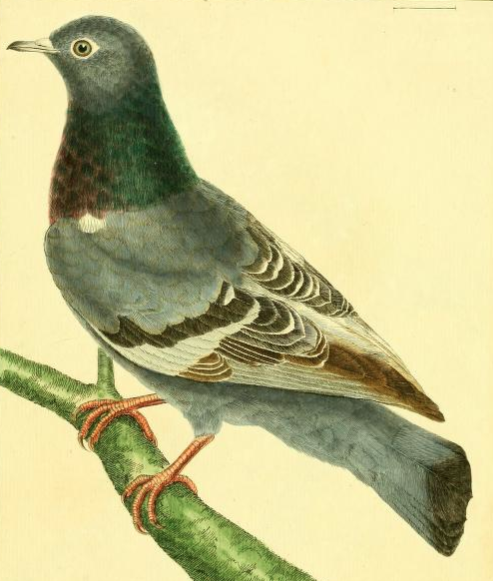
Charles Willson Peale (1741-1827) wrote, in his 30th Lecture (ca. 1799): "No. 1163. Biset Pigeon. Length about 14 Inches; bill pale red; head ash-coloured; hind part of the neck & side green gold, glossed with copper in different lights; the general colour ash; it has two black bands across the wings; the end of the tail [has a] broad black band, and the webs of the 2 outer feathers of the tail light; and the lower part of the back of a light colour. Columba livia Linn. Biset, Buff. pl. enl. 510. Buffon says 'it is the primitive stock whence all the others are descended. It is commonly of the same size and shape with the domestic Pigeon, but of a browner colour.' This specimen was picked up at sea, 600 leagues from land, almost spent with fateague..." (Academy of Natural Sciences of Drexel University Archives, coll. 40)
Peale continued; "No. 1165. Tumbler, a domesticated Pigeon. The plumage is of a redish Brown mixed with gree. This kind of Pigeon is small, and of [a] variety of colours; the chief difference from others is in frequently tumbling round when floying in the air, which they do by throwing themselves backwards. They are also called clappers. Columba gyratrix Linn. Pigeon culbutant Buff. 2. p. 517. No. 1166. Female – plumage white and red. No. 1167. A variety of the same. No. 1168. Another variety called the Normond Tumbler; general colour brown & white speckled; green reflections [on] the neck. No. 1169. Haget Tumbler, another variety, the general plumage russet; great quills white, with some spots of reflecting green on the neck." (ANSP Archives, coll. 40)
Peale continued: "No. 1170. Persian Pigeon. The general plumage dark, with the great quill feathers white; the neck reflecting green and towards the breast purple; the bill yellow; the space round red; the nostrils gibbous and russet with red tuburcles; feet pale red; a tuft of feathers on the hind head, inverted & turned up. Columba turcica Linn. No. 1171. Female, red round the eyes, but without the gibious nostrils; it has a tuft of turn up feathers behind the head; the covert of the sings and on the breast, russet brown, and the other parts pure white. Authors do not mention this tuft of feathers behind the head. It is something like the Roman Pigeon, but a smaller tuft." (ANSP Archives, coll. 40)
Peale continued: "No. 1172. Lace Pigeon. This is white, all but the feet, which are red; and the feathers of the whole body loose in their webs, and frizzled. They are generally white. Columba hispida Linn. Pigeon fries Buff. No. 1173. Shaker, or fan-tail Pigeon. These have a greater number of feathers in their tails, which they always carries erect; and they are frequently observed to shake their heads. Columba laticanda Linn. Le Pigeon [Paon]. Buff." (ANSP Archives, coll. 40)
Peale wrote, in "A Walk Through the Philad[elphi]a Museum" (1805–1806): "No. [blank] stock River Pigeon (Columba livia) This specimen was picked up at Sea 600 leagues from land, almost spent with fateague. Buffon says it is the primitive stock whence all the others are descended" (Historical Society of Pennsylvania, coll. 0481). Like he had done in his lecture, Peale also mentioned specimens of several domestic varieties of Rock Dove, which had been described by Linnaeus (1766) as distinct species. These included the "No. [blank] Tumbler (C. Gyratrix) a domesticated Pigeon. It is distinguished from others by its frequently tumbling round when flying in the air which they do by throwing themselves backward. They are also called clappers. here are other varieties of Tumblers. / The Persian Pigeon (C. Turcica) remarkable by the space round the Eyes being naked and rough. Lace pigeon (C. hispida) The feathers of the whole body loose in their webs. / Shaker, or fan tail Pigeon (C. laticauda) they generally carry their tails erect, and are frequently observed to shake their heads." (Historical Society of Pennsylvania, coll. 0481)
Specimen Type:
Dead/preserved
Current Common Name:
Rock Dove
Current Scientific Name
Columbidae | Columba livia