Object Status:
Extant
Accession Date:
By 12 October 1792
Primary Source Reference:
Charles Willson Peale, letter to Thomas Hall of Moorfields, London, dated 12 October 1792; Selected Papers, 2, part 1: 42.
Additional Source Text:
Charles Willson Peale (1741-1827) sent a "Blue Jay"to Thomas Hall in London, in exchange for European specimens, on 12 October 1792 (Miller 1988: 42, Selected Papers, Vol. 2, part 1, Yale University Press).
On 9 December 1792, Peale sent a "Blue Jay"to Christian Magus (Miller 1988: 44).
In early 1793, Peale sent another "Blue Jay" to Thomas Hall, in early 1793, in another exchange for European specimens (Miller 1988: 46).
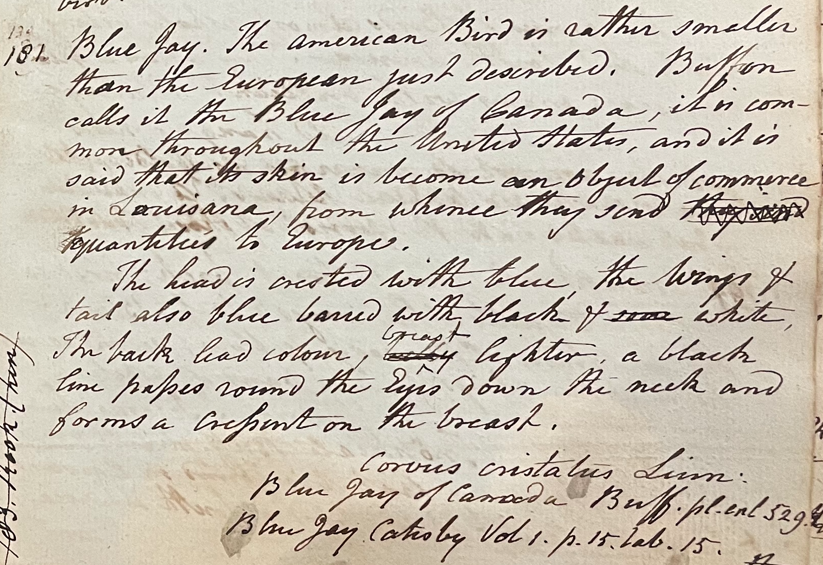
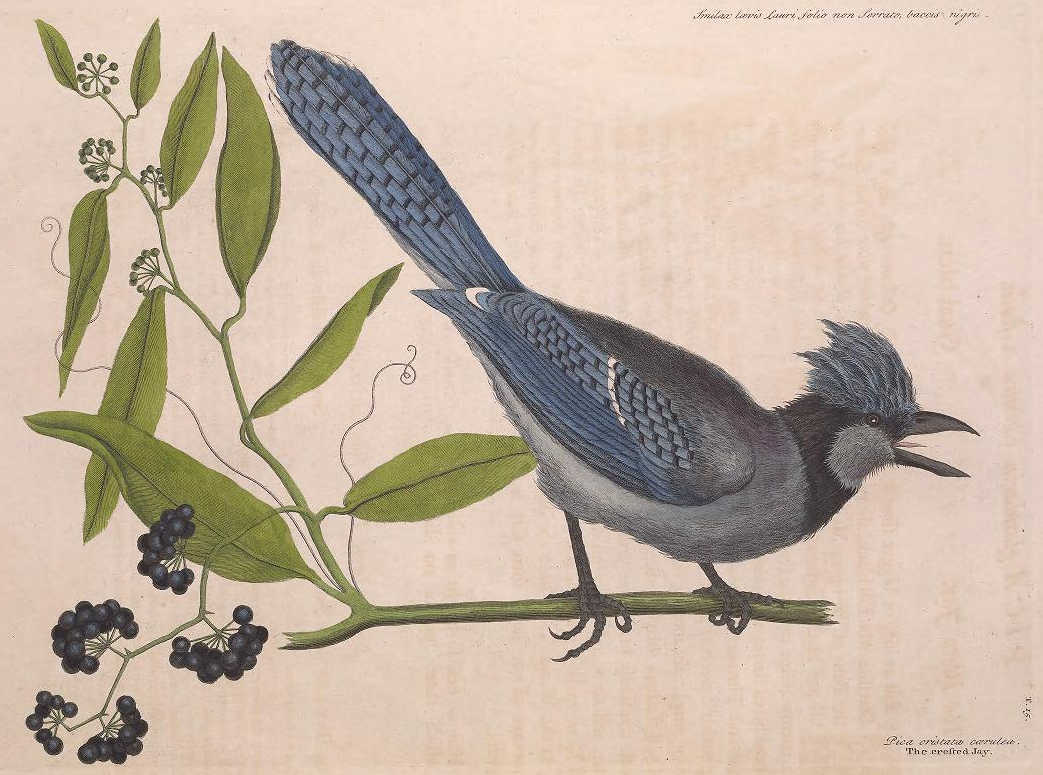
In his 17th Lecture, Peale wrote: "182. Blue Jay. The American Bird is rather smaller than the European just described [i.e., Eurasian Jay, Garrulus glandarius]. Buffon calls it the Blue Jay of Canada. It is common throughout the United States, and it is said that its skin is become an object of commerce in Louisiana, from whence they send quantities to Europe. The head is crested with blue; the wings & tail also blue barred with black & white; the back lead colour; breast lighter; a black line passes round the Eyes, down the neck, and forms a cressent on the breast. Corvus cristatus Linn. Blue Jay of Canada. Buff. pl. enl. 529. Blue Jay Catesby Vol. 1. p. 15. tab. 15." (Academy of Natural Sciences of Drexel University Archives, coll. 40)
Peale wrote, in "A Walk Through the Philad[elphi]a Museum" (1805–1806): "Our Jay (Corvus cristatus) is distinguished from the European Jay (Corvus Glandarius) not only by the blue colour, but also by its high Crest." (Historical Society of Pennsylvania, coll. 0481)
An undated list of 21 bird specimens in Peale's handwriting includes two "Blue Jay[s]" (American Philosophical Society Library, Mss.B.P31).
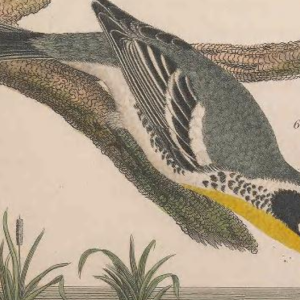
Alexander Wilson (1766-1813) described this species under the name "Blue Jay / Corvus cristatus" in American Ornithology, vol. 1 (Pl. 1), where "Peale's Museum No. 1290" was cited (Wilson 1808: 11). / https://www.biodiversitylibrary.org/item/175530#page/25/mode/1up (text) / https://www.biodiversitylibrary.org/item/175530#page/8/mode/1up (plate)
On 13 November 1820, a "White [leucistic] Jay, shot in Upper Dublin Township, Montgomery Coun[ty]" donated by Jonathan Collom was recorded in the Peale Museum Accessions Book (HSP, coll. 0481).
Two unmounted specimens (one male, one female) of "Corvus cristatus (Blue Jay)" were listed in "A Catalogue of Duplicate Specimens...", May 1822. [unpublished] American Philosophical Society Library (Mss.B.P31).
Specimen Type:
Dead/preserved
Current Common Name:
Blue Jay
Current Scientific Name
Corvidae | Cyanocitta cristata