Object Status:
Extant
Accession Date:
19 August 1789
Primary Source Reference:
Pennsylvania Packet, 19 August 1789.
Additional Source Text:
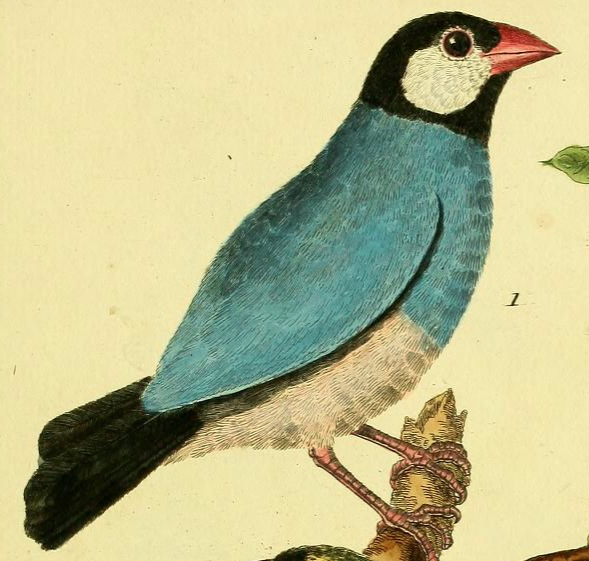
On 19 August 1789, a notice in the Pennsylvania Packet (Philadelphia) announced the Museum's acquisition of "A Pair Jarvis [sic] Sparrows, from the East-Indies", donated by "Mr. Ozeas" (not identified).
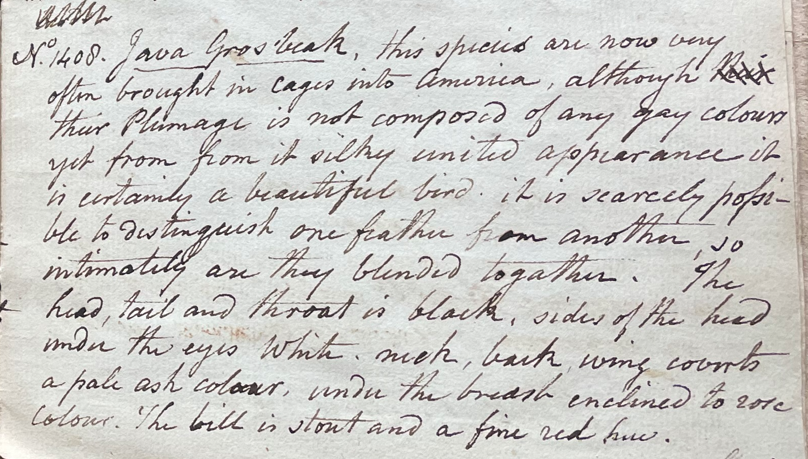
Charles Willson Peale (1741-1827) wrote, in his 32nd Lecture (ca. 1799): "No. 1408. Java Grosbeak. This species are now very often brought in cages into America, although their plumage is not composed of any gay colours; yet from [its] silky appearance it is certainly a beautiful bird. It is scarcely possible to distinguish one feather from another, so intimately are they blended together. The head, tail and throat is black; sides of the head [and] under the eyes white; neck, back [and] wing coverts a pale ash colour; under the breast enclined to rose colour; the bill is stout and a fine red hue. Loxia oryzivora Linn. Gros bec de la Chine. Buff. pl. enl. 152. f. 1. This species is met with at Java and the Cape of Good Hope, where it does much damage to the rice grounds. Chiefly known by the name of Java Sparrow. The female wants the white on the cheeks." (Academy of Natural Sciences of Drexel University Archives, coll. 40)
On 26 December 1811, a "Java Sparrow" donated by a patron with an illegible name ("Miss […]") was entered in the Peale Museum Accessions Book, p. 58 (Historical Society of Pennsylvania, coll. 0481).
Specimen Type:
Dead/preserved
Current Common Name:
Java Sparrow
Current Scientific Name
Estrildidae | Lonchura oryzivora