Object Status:
Extant
Accession Date:
By 1799
Primary Source Reference:
Charles Willson Peale, Lecture on Natural History 32. (ca. 1799). Academy of Natural Sciences of Drexel University Archives, coll. 40. / https://ansp.org/research/library/archives/0000-0099/coll0040/
Additional Source Text:
Charles Willson Peale (1741-1827) wrote, in his 32nd Lecture (ca. 1799): "The succeeding genus Loxia Grossbeak is more numerous and we have a prity variety before us. The bill in this genus is strong, convex above & below, and very thick at the base; nostrils small and round; Tongue entire or as if cut off at the end. The first species generally taken notice of amongst this genus of birds is the cross-bill." (Academy of Natural Sciences of Drexel University Archives, coll. 40)
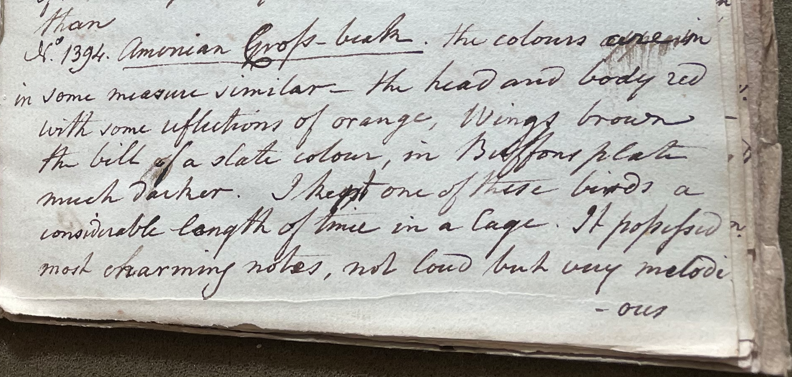
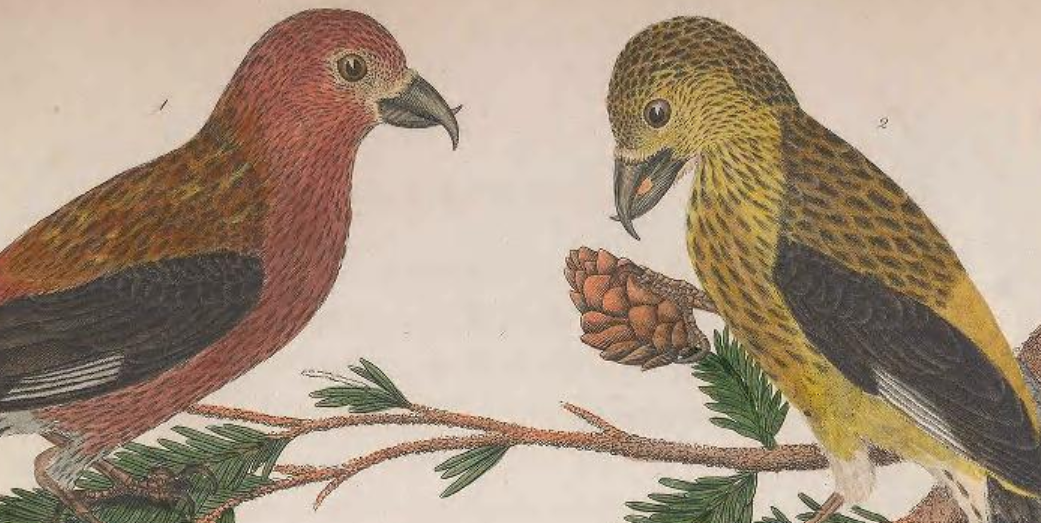
Peale continued: "The variety of this kind is not numerous. I possess only those belonging to America, how much they differ from that found in Germany I cannot say; the plate of the latter given by Buffon appears rather larger than No. 1394. American Cross-beak. The colours in some measure similar; the head and body red with some reflections of orange; wings brown; the bill of a slate colour, in Buffon's plate much darker. I kept one of these birds a considerable length of time in a cage. It possessed most charming notes, not loud but very melodious, and realy to me appeared extremely sagacious. It was so engaging that I often regret that they stay so short a time with us; we only find them in the fall, whether they go farther south, or at what season they go to the northward, I cannot say, but Mr. Pennant says they arrive at severn river in hudsons-bay, the latter end of May, and even go farther north to rbeed. Their habitations are the forests of pines. Loxia curvirostra Linn. Bec Crossé Buff." (ANSP Archives, coll. 40)
Peale continued: "No. 1395. Female, the plumage brown, with some reflections of yellow, brightest a little above the tail. In Mr. Robt. Townson's Natural History & Physiology, on the Crossbeak he expresses himself thus: 'To read the works of celebrated men merely with a view to detract from their merits, and to hold up their trifling errors as examples of the general tenor of the writings, is invidious and unjust. But when vanity and an unreasonable desire of popular applause, lead the man of science to quit the cool sagacious research and the simple language becoming the dignity of his pursuit, and, disregarding the approbation of the just distributors of fame, courts that of the multitude and on brilliant diction passes off his hasty speculations for the result of enquiry, I think'. his vain reasoning may be held [...] to derision and his errors be condemned […] punishment. I trust therefore, elucidating the following curious subject [i.e., the Red Crossbill], which the French Pliny [i.e., Buffon] has treated in a very careless manner, not to be censured as a literary detractor."(ANSP Archives, coll. 40)
Peale continued: "A few years ago, when I was at Gottingen, I kept several Cross-beaks, which, by kind treatment, soon becoming tame, I suffered to be loose in my study. I had this constant opportunities [sic] of observing them, and as often of admiring their docility and sagacity; but the singular structure of their bills chiefly engaged my attention. The bills of some of the feathered tribes seem so irregular in their form, and so preposterous in their size, that one would almost think that nature had not shown the usial kindness towards them. Yet those who have attentively considered the structure of animals and their offices in the great economy of nature, though they may have been often struck with some apparent irregularity or defect, yet will have found, upon attentive observation, that they are well adapted to their destinations." (ANSP Archives, coll. 40)
Peale continued: "The great pine forests, such as that of the Hartz in Germany, are the natural places of residence of the Cross-beaks, and the seeds of the cones of those trees their food, and it is to pull out the seeds from between the squamae, or seals of the cones, that this structure is given them. Their mode of operation is thus: they first fix themselves across the cone, then bring the points of the maxilla from their crossed or lateral position, to be immediately over each other. In this reduced compass, they insinuate their beaks between the scales, and then opening thereby drawing the inferior maxillae sideways, force open the points of the maxillae over each other and pick out the seed in the same manner as if the bill had the usual form." (ANSP Archives, coll. 40)
Peale continued: "The degree of this lateral force is surprising and they are fond of exercising it for mere amusement; my pets would often come to my table whilst I was writing and carry off my pensils, little chip boxes in which I occasionally kept Insects, and other similar objects, and tear them to pieces in a minute. Their mode of operation is by first pecking a little hole, in this they insert their bill and then split or tear the object by the lateral force. When I treated them, as I often did, with almonds in their shells, they got at the kernel in the same manner; first pecking a hole in the shell, and then enlarging it by wrenching off pieces by the lateral force." (ANSP Archives, coll. 40)
Peale continued: "Notwithstanding Mr. Buffon's assertion to the contrary, they can pick up and eat the smallest seed; with this indeed the dealers in birds in Germany commonly feed them, and they shell or husk help and similar seeds like other birds; so well contrived and useful is this singular beak. Such is the structure, and such the uses of the bill of the Cross-beak, yet the celebrated Buffon, without the smallest marks of diffidence, has given the following account, as void of sound philosophy as of the knowledge of facts." (ANSP Archives, coll. 40) Peale continued: "[Buffon] says: 'The Crossbill is distinguished only by a sort of deformity in its bill, a character, or rather a defect, which belongs to it alone of the winged tribe. What proves that it is a defect, an error of nature rather than a permanent feature, is, that it is variable; the bill in some subjects crosses to the left, in others to the right; but the productions of nature are regular in their arrangement. I should therefore impute this difference of position to the way in which the bird has used its bill, according as it has been more accustomed to employ the one side or the other to lay hold of its food. The same takes place with men, who, from habit, prefer the right hand to the left. Each mandible of the Cross-bill is affected by an exuberance of groath, so that in time the two points are parted asunder, and the bird can take its food only by the side; and hence if it oftener uses the left, the bill will protrude to the right, and vice versa'." (ANSP Archives, coll. 40) Following these long quotes, Peale wrote in his own words: "When we view any Animal, whose form appears extraordinary to us, we may wonder at such a natural production, the use of which we cannot account for, but we ought to be cautious in criticism. First, doubt our capacities to judge, or rather suppose that we have not a comprehensive knowledge of its proper use. For whatever may be the variety of opinion, taking the sentiment in a moral sence, yet in the Physical application it is most undoubtedly true; that "Whatever is, is right", so far at least may we have the consolatory assurance that no being in existence has been wrongly created or improperly placed … 1427. Crossbeak of Europe." (ANSP Archives, coll. 40) On 13 July 1802, Peale requested "the male of the cross beak Loxia Curvirostra" from Étienne Geoffrey Saint-Hilaire (1772-1844) at the Paris Museum, because he wished to compare American and European specimens (Miller 1988: 442, Selected Papers, Vol. 2, part 1, Yale University Press). Peale wrote to Rubens Peale (1784-1865), his son, on 30 August 1802: "The female Cross beak I have received from France and I have written for the Male" (Miller 1988: 451). Peale wrote, in "A Walk Through the Philad[elphi]a Museum" (1805–1806): "We next visit a very numerous Genera of Birds, Loxia, Grosbeak. The first notice of this genus by most authors is the Cross-bill (Curvirostra) at first sight it might be taken for a sport of Nature, but they are a distinct species & known to inhabit Europe Assia and America. Their bills are admirably fitted to divide the Cones of the Pine Tree the seed of which are their favorite food. They eat seeds and Nuts that have not an extraordinary hard shell — such as Amonds, these they peck a small hole to insert the [...], by the lateral force it breaks the shell." (Historical Society of Pennsylvania, coll. 0481) Alexander Wilson (1766-1813) described this species under the name "American Crossbill / Curvirostra americana" in American Ornithology vol. 4 (Pl. 31), where "Peale's Museum, No. 5640" was cited (Wilson 1811: 44). / https://www.biodiversitylibrary.org/item/175531#page/54/mode/1up (text) / https://www.biodiversitylibrary.org/item/175531#page/55/mode/1up (plate) An unmounted specimen of "Loxia curvirostra (Cross bill)" from Missouri was listed in "A Catalogue of Duplicate Specimens...", May 1822. [unpublished] American Philosophical Society Library (Mss.B.P31).
Specimen Type:
Live (later taxidermied)
Current Common Name:
Red Crossbill
Current Scientific Name
Fringillidae | Loxia curvirostra