Object Status:
Extant
Accession Date:
By 1799
Primary Source Reference:
Charles Willson Peale, Lecture on Natural History 30. (ca. 1799). Academy of Natural Sciences of Drexel University Archives, coll. 40. / https://ansp.org/research/library/archives/0000-0099/coll0040/
Additional Source Text:
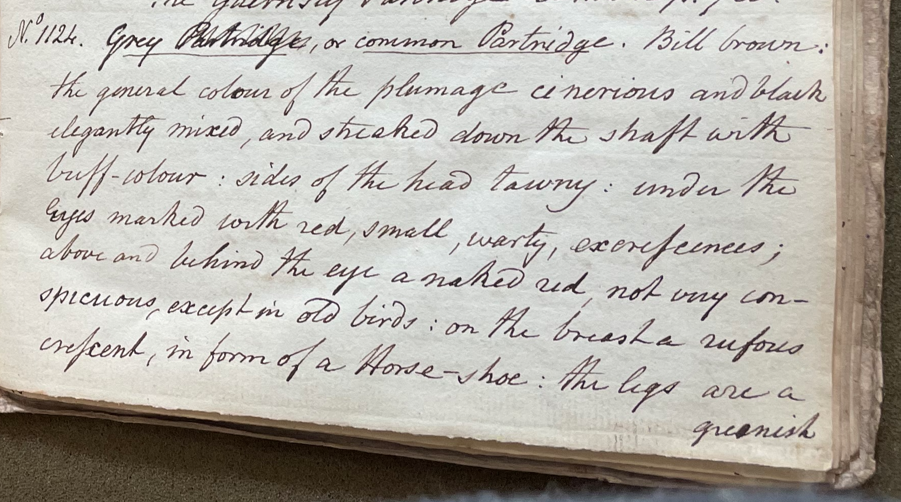
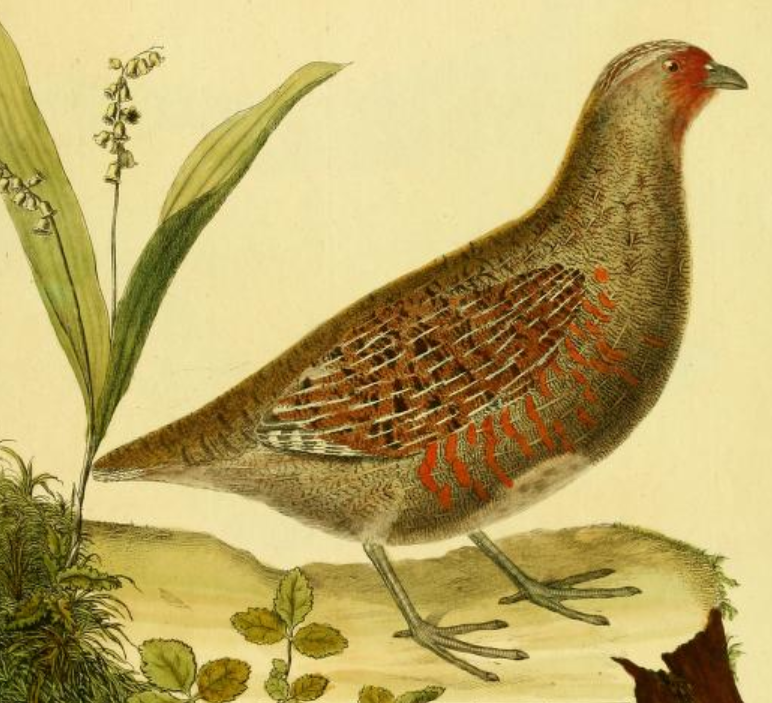
Charles Willson Peale (1741-1827) wrote, in his 30th Lecture (ca. 1799): "No. 1124. Grey, or Common Partridge. Bill brown; the general colour of the plumage cinerious and black, elegantly mixed, and streaked down the shaft with buff-colour; sides of the head tawny; under the eyes marked with red, small, warty, […]; above and behind the eye a naked red, not very conspicuous, except in old birds; on the breast a rufous crescent, in form of a horse-shoe; the legs are a greenish white, and furnished with a blunt spur or knob behind. No. 1125. Female, differs in having the colours not quite so distinct as the male; in wanting the horseshoe on the breast, and having no rudiment of a spur on the feed. Tetrao perdix Linn. La Perdrix grise Buff. pl. enl. 27. Female. Common Partridge Latham & Pennant." (Academy of Natural Sciences of Drexel University Archives, coll. 40)
This species is found throughout Europe in the temperate parts, but not everywhere equally common; the extremes of heat and cold being equally unfavorable, as they are less plenty in such parts. Frequent in the temperate parts of Russia and Sibiria, but unknown in Lapland and Norway; are more rare in Itally than in England and France. Willughby tells of a certain […] man that had, by his industry, made a covey of Partridges so tame, that he drove them before him, upon a wager, out of that county to London, though they were absolutely free, and had their wings grown. The Grey Partridge in its nature is more gentle than the red, and not difficult to tame; and when not teazed, it soon becomes familiar." A footnote inserted here reads: "[sourced from] Buffon; it is worthy to note, that in the next paragraph Buffon contradicts himself." (ANSP Archives, coll. 40)
Peale continued: "The female takes upon herself the whole task of covering, and, during that time, she undergoes a considerable moult; for all the feathers of her breast drop off. She sits with great assifuity, and, it is said, that she never leaves her eggs without strewing them with leaves. / The male, though it has no share in the incubation, assists the mother in raising the young. They lead them in common, continually call them together, point out to them their proper food, and teach them to find it by scratching the ground with their nails. It is not uncommon to discover them squatted beside each other, covering the chickins with their wings, whose heads project on all sides, presenting very lively eyes. In such case, the parents are not easily flushed; and the sportsman, who is attentive to the preservation of his game, avoids disturbing so interesting an office. But if the pointer comes too near, or runs in upon them, the male is always the first that springs, venting his anguish in a peculiar cry, and appropriated to this emergence." (ANSP Archives, coll. 40)
Peale continued: "He drops thirty or forty paces distant, and sometimes even he returns upon the dog and beats it with his wings. To such a degree does parental affection inspire courage in the most timid animals! Sometimes that tender sentiment inspires in these birds a sort of prudence, and suggests expedients for saving the brood. When the male springs in such cases, he has been observed to fly slowly, and hanging his wing, as if to decoy the enemy into a pursuit, in the expectation of an easy prey; while the bird keeps always before him, but at such a short distance as continually to afford hopes, till the sportsman is carried away from the covey. / On the other hand, the female springs shortly after the male, and shoots to a much greater distance, and invariably in a different direction. Immediately after she has alighted, she returns back running along the furrow, and finds her chickens scattered and squatted among the grass and the leaves, hastily collects them, and before the dog has returned from the eager pursuit of the male, she leads them to a distant spot, without giving the slightest notice to the sportsman by any noise in retreating." (ANSP Archives, coll. 40)
Peale continued: "What a charming lesson to us, of parental care and affection! Oh! What a contrast, when we see children left to run wild! Without a parents care to protect, or even warn them of danger, without instructing them to avoid danger or how to obtain by a laudable industry, their future sustinence, may still [be] more sorrowful, to behold! When parens, by intemperance, by passion, and by a base conduct, set such examples of folly before them, as sometimes even to make their own children ashamed! How dreadful such a picture! Such parents how much they degrade themselves, far beneath the lowest of the brute creation! They know little and think less, who suppose they do enough, when they pay for a good education, and also provide a support for their offspring. Perhaps, they give them good advice. No doubt precepts are good, but example is far superior." (ANSP Archives, coll. 40)
Peale continued: "It is much better and more pleasant to lead, than drive. And how delightful it is to see children obey their parents through love; who fill their obligations to them, for the labour, anxiety, and care they have had to rear them, through their helpless infancy, or perilous time of youth! And now, when arrived at manhood, becoming a bond of friendship! Like brothers & sisters to each other! When Father, Sons, Mothers & Daughters live in sweet harmonty together! Then how great, how sweet the reward of their tortuous conduct! How supremely happy such families! When we see the Partridge parents, facing every danger to foster and protect their offspring, can we help feeling? And to bring it home, digressing, as I have done? I flatter myself that you have granted the indulgence." (ANSP Archives, coll. 40)
Peale wrote, in "A Walk Through the Philad[elphi]a Museum" (1805–1806): "Partridges are distinguished by their orbits [?] being granulated: feet naked. [The] feet are the long bones to which the toes are joined. here we find the barbary Partridge (T. Rufus) the European Partridge, and the Grey or Common Partridge [P. perdix], this also is found throughout Europe in the temperate parts. They are by Nature more gentle than the red; if not teazed soon becomes familiar. To save their brood they will fly off a short distance hanging their wings as if cripled, to allure the pursuit of them while the female glides through the grain or Grass with her little ones." (Historical Society of Pennsylvania, coll. 0481)
A mounted specimen of "Tetrao perdix (Partridge English)" from France was listed in "A Catalogue of Duplicate Specimens...", May 1822. [unpublished] American Philosophical Society Library (Mss.B.P31).
Specimen Type:
Dead/preserved
Current Common Name:
Gray Partridge
Current Scientific Name
Phasianidae | Perdix perdix