Object Status:
Unlocated
Accession Date:
By 1805
Primary Source Reference:
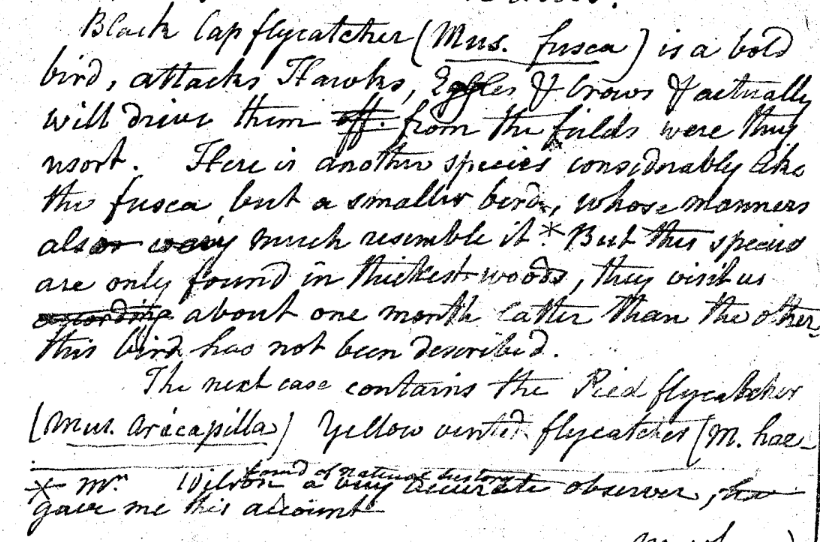
Charles Willson Peale, "A Walk through the Philad[elphi]a Museum" (1805-1806). Historical Society of Pennsylvania, coll. 0481.
Additional Source Text:
Charles Willson Peale (1741-1827) wrote, in "A Walk Through the Philad[elphi]a Museum" (1805-1806), after his account of "Black Cap flycatcher (Mus. fusca)" (=Eastern Phoebe, Sayornis phoebe): "Here is another species considerably like the fusca, but a smaller bird, whose manners also very much resemble it. Mr. Wilson [fond] of Natural History & a very accurate observer, gave me this account. But this species are only found in thickest woods, they visit us about one month latter than the other, this bird has not been described." (Historical Society of Pennsylvania, coll. 0481)
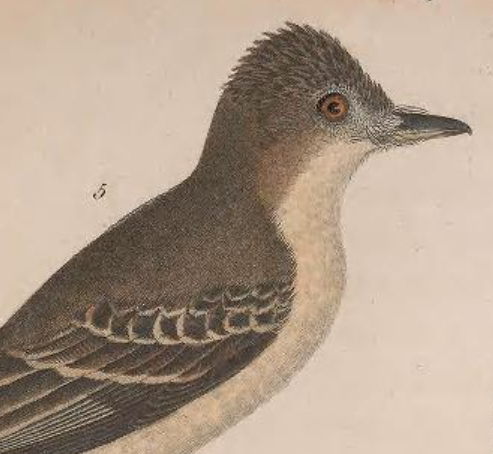
Alexander Wilson (1766-1813) described this species under the name "Wood Pewee Flycatcher / Muscicapa rapax" in American Ornithology vol. 2 (Pl. 13), where "Peale's Museum No. 6660" was cited (Wilson (1810: 81). https://www.biodiversitylibrary.org/item/175511#page/93/mode/1up (text) / https://www.biodiversitylibrary.org/item/175511#page/77/mode/1up (plate)
Notes:
A full accounting of the composite taxonomic history of this species was published recently by Matthew R. Halley, 2023, "The composite identity of Muscicapa virens Linnaeus, and a neotype designation for Eastern Wood Pewee Contopus virens (Tyrannidae)", Bulletin of the British Ornithologists’ Club 143: 196-211, who designated a neotype specimen to stabilize nomenclature. / https://doi.org/10.25226/bboc.v143i2.2023.a5
Specimen Type:
Dead/preserved
Peale's Common Name:
Wood Pewee Flycatcher (Wilson's name)
Peale's Scientific Name:
Muscicapa rapax (Wilson's name)
Current Common Name:
Eastern Wood Pewee
Current Scientific Name
Tyrannidae | Contopus virens