Object Status:
Extant
Accession Date:
By 1799
Primary Source Reference:
Charles Willson Peale, Lecture on Natural History 21. (ca. 1799). Academy of Natural Sciences of Drexel University Archives, coll. 40. / https://ansp.org/research/library/archives/0000-0099/coll0040/
Additional Source Text:
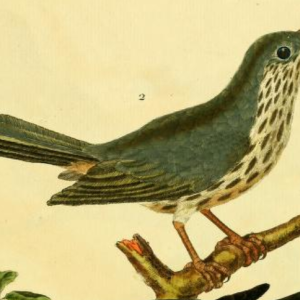
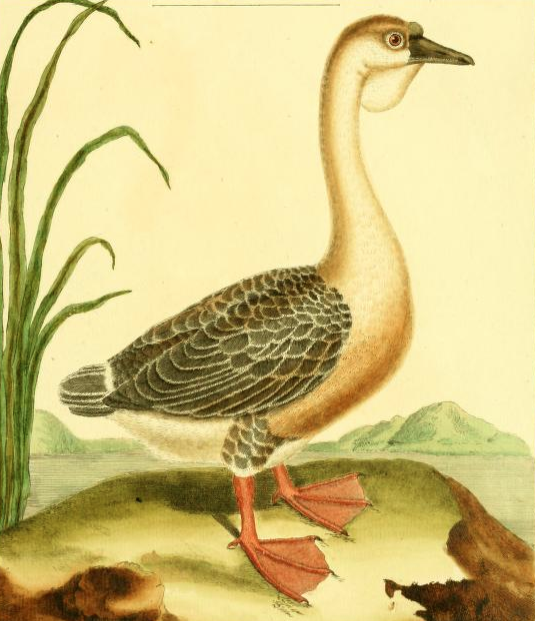
Charles Willson Peale (1741-1827) wrote, in his 21st Lecture (ca. 1799): "483. Chineese [sic] Goose. This is a large species, between the swan and goose; the Bill at the base has a large protuberance, raising the forhead high, and is a very distinguishing mark of this family. From the base of the upper mandible begins a brown colour, which extends by the Eyes over the head and down the back of the neck, spreading with the brown feathers of the back; the front of the neck is white, of [a] dingy hue; the brown feathers of the back, wings, tail, and sides, are edged with white; the lower part of the body white. Several authors call for a pouch under the throat, so that I cannot assimilate it to their subjects. Anas cygnoides? Linn. Chinese Goose Latham No. 12." (Academy of Natural Sciences of Drexel University Archives, coll. 40)
Peale continued: "The females have the nob on the beak smaller, and the colours generally paler. It was said when this species of geese was first brought here, that the flesh had a more delicate flavor than our common geese. I don't know that this is the case. They are a much more noisy race than the common tame geese, taking alarm at the least noise; and even without disturbance will emit their harsh and disagreeable scream the whole day through. They walk very erect, with the neck much elevated, and as they bear a middle line between that of the Swan and Goose, they have not improperly been called Swan Goose. Geese have been considered by the Ancients the surest guardians on a farm, and the most vigilant sentinels that can be planted in a besieged city. They discovered the intended assault of Rome by the Gauls; by which the City was saved. In memory of that important and salutary service, the censor allowed each year a sum of money for maintaining geese; while, on the same day, dogs were whipt in public, as a punishment for their criminal silence in so critical a moment." (ANSP Archives, coll. 40)
Peale continued: "Whether from fear or vigilance, the goose repeats every minute its loud calls. Often the whole flock answer by a general acclamation; and of all the inhabitants of the court-yard, none are so vociferous or blustering. This great loquasity [sic] induced the Ancients to give the name of goose to indiscreet prattlers, bad writers, and low informers, as its awkward pace and its uncouth gestures make us apply the same appellation to silly and simple persons. In this last instance the application is not so proper, because the goose shews evident marks of sentiment and of understanding, in many instance [of] uncommon attachments, affection and gratitude. Buffon mentions a singular Instance of the sencibility of a goose, and I might give one related to me by Major Howe (an officer of our army) of a goose becoming so much attached to him, as to follow wherever he went, even to cross the lakes and follow his boat several hundred miles, with other interesting particulars, but which would be taking up too much of your time." (ANSP Archives, coll. 40)
Peale wrote, in "A Walk Through the Philad[elphi]a Museum" (1805–1806): "The Chinease [sic] Goose (Cygnoides) is remarkable for that high nob on the base of its beak. It is more stately in its carriage than common Geese." (Historical Society of Pennsylvania, coll. 0481)
Specimen Type:
Dead/preserved
Current Common Name:
Swan Goose
Current Scientific Name
Anatidae | Anser cygnoides