Object Status:
Extant
Accession Date:
By 1799
Primary Source Reference:
Charles Willson Peale, Lecture on Natural History 22. (ca. 1799). Academy of Natural Sciences of Drexel University Archives, coll. 40. / https://ansp.org/research/library/archives/0000-0099/coll0040/
Additional Source Text:
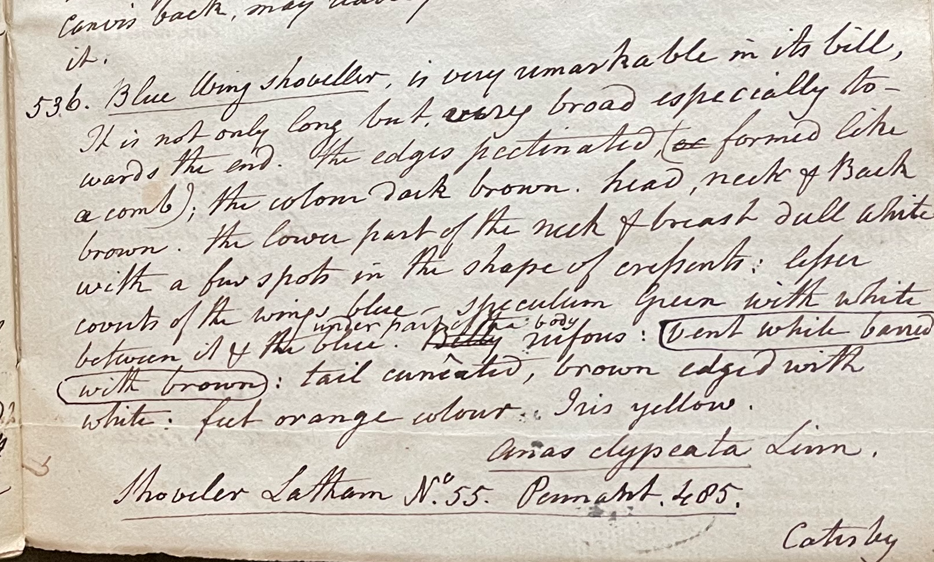
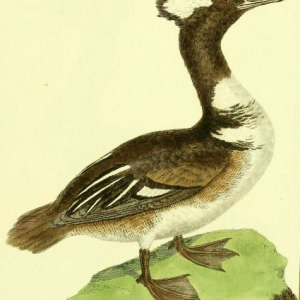
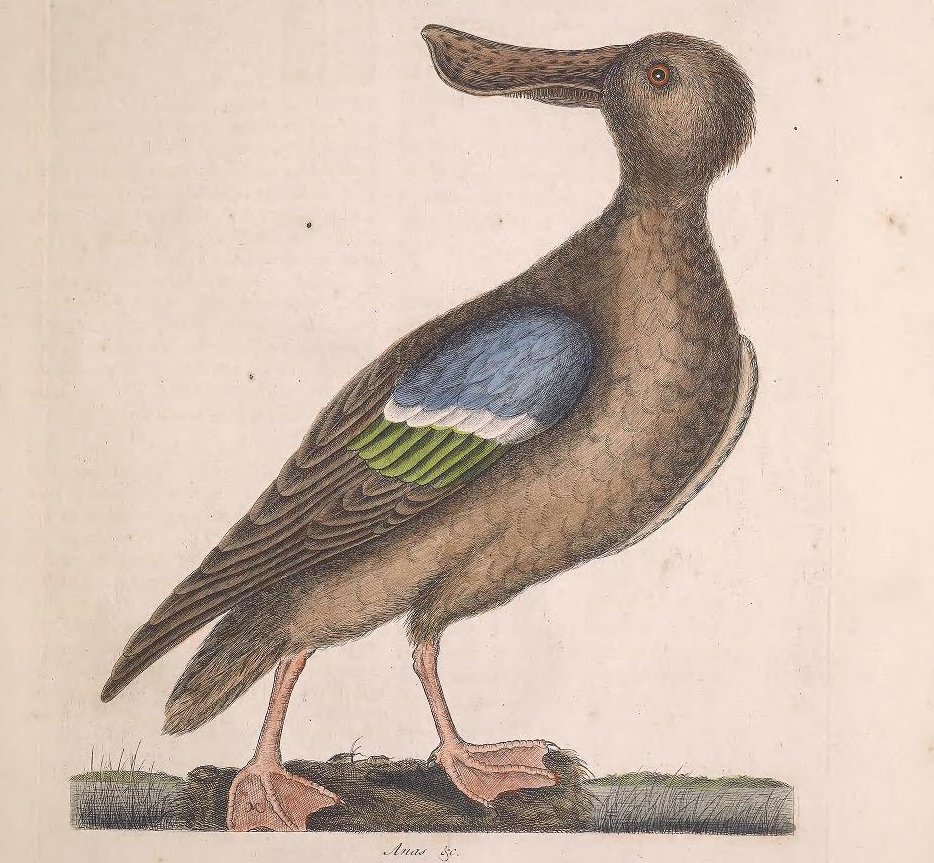
Charles Willson Peale (1741-1827) wrote, in his 22nd Lecture (ca. 1799): "Blue Wing Shoveler. is very remarkable in its bill, It is not only long but very broad especially towards the end. the edges pectinated (as formed like a comb); the colour dark brown. head, neck & Back brown. the lower part of the neck & breast full white with a few spots in the shape of crescents; lesser coverts of the wings blue; speculum green with white between it & the blue; under parts of the body rufous; vent white barred with brown; tail cuneated, brown edged with white; feet orange colour; Iris yellow. Anas clypeata Linn. Shoveler Latham No. 55. Pennant 485. Catesby 96. On the Bills, in neither of my birds, is such spots as Catesby has depicted." (Academy of Natural Sciences of Drexel University Archives, coll. 40)
Peale continued: "597. The Female has the bill of an olive green colour. The plumage generally like the male, but not so dark on the head, nor so red on the under part of the body. According to Latham the male having, just above the divarication of the wind pipe, where it passes into the lungs, an enlargement, or, as it is called by some, a labyrinth. This species is found in Germany; throughout the Russian dominions, as far as Kamtschatka; and in North America, from New York to Carolina. Some few have been met with in England. Its chief food is Insects, for which it is continually muddling in the water with its large bill. It also is said dexterously to catch flies, which pass on its way over the water. Shrimp, among other things, have been found in its stomack on dissection." (ANSP Archives, coll. 40)
An undated scrap of paper tucked into Peale's 21st lecture manuscript contains a scribbled list of duck specimens, including: "Blue wing shoveler (clypeata)." (ANSP Archives, coll. 40)
Peale wrote, in "A Walk Through the Philad[elphi]a Museum" (1805–1806): "That large [long] and broad Bill is a Striking trait of the blue winged Shoveller (a. clypeata) the Bill has the edges pectinated (formed like a Comb) the better to retain Insects on which it finds mudling in Water. They are found from New york to Carolina – and it is said also in Germany and throughout the Russian Dominions as far as Kamtschata" (Historical Society of Pennsylvania, coll. 0481).
On 15 August 1806, a donation from Thomas Hall that included a "Shovel-beaked Drake" specimen was entered into the Peale Museum Accessions Book, p. 17 (Historical Society of Pennsylvania, coll. 0481).
Alexander Wilson (1766-1813) described this species under the name "Shoveller / Anas clypeata" in American Ornithology vol. 8, published posthumously (Pl. 67), where "Peale's Museum, No. 2734" was cited (Wilson 1814: 65). / https://www.biodiversitylibrary.org/item/175758#page/79/mode/1up (text) / https://www.biodiversitylibrary.org/item/175758#page/62/mode/1up (plate)
Notes:
Thomas Hall (ca.1746-1813) was a natural history dealer and showman in London who, like Peale, assembled a collection of exotic taxidermy and natural oddities in his home, which he displayed to paying customers. Hall’s museum was known by the names “Curiosity House” and “Finsbury Museum”, and he distributed tokens advertising himself as “The first artist in Europe for preserving Birds, Beasts &c.” Today, many of these tokens are preserved in the British Museum. / https://www.britishmuseum.org/collection/term/BIOG145361
Peale proposed a specimen exchange with Hall, in a letter dated 28 April 1792: “I therefore make you the proposal of sending you all the Variety of this Country, for an Equal number of European [species] … which shall be preserved in the best manner (of which I now feel myself fully equal to) and sent and that I may be prepared for such an exchange I am now using every means in my power to Collect and preserve the Birds of the present season … I have not time to give you any description of such as I suppose are peculiar to this part of America, and I find that every year I discover some kinds that I had not known before, and from what I have read, I find that those who have attempted the Natural History of this Country [were] generally deficent of inteligence [sic].” (Miller 1988: 31–32, Selected Papers, Vol. 2, part 1, Yale University Press).
Peale announced in June 1792 that he was “busily employed in preserving the Birds of our Country [the United States] in order to furnish [himself] with such a number of duplicates as [would enable him] to make an extensive exchange” with Hall, and with institutions in Sweden and Holland (Miller 1988: 37). During his travels in London, Rubens Peale (1784-1865) wrote to his father on 1 June 1803: “I wish you to inform me in the next [letter] how you stand with Hall, recolleckting that I have had from him a considerable number of subjects in return from what I let him have.” (Miller 1988: 529)
The final specimen deposit from Hall was recorded in the Peale Museum Accessions Book on 17 August 1806 (Historical Society of Pennsylvania, coll. 0481).
Specimen Type:
Dead/preserved
Current Common Name:
Northern Shoveler
Current Scientific Name
Anatidae | Spatula clypeata