Object Status:
Extant
Accession Date:
By 1799
Primary Source Reference:
Charles Willson Peale, Lecture on Natural History 22. (ca. 1799). Academy of Natural Sciences of Drexel University Archives, coll. 40. / https://ansp.org/research/library/archives/0000-0099/coll0040/
Additional Source Text:
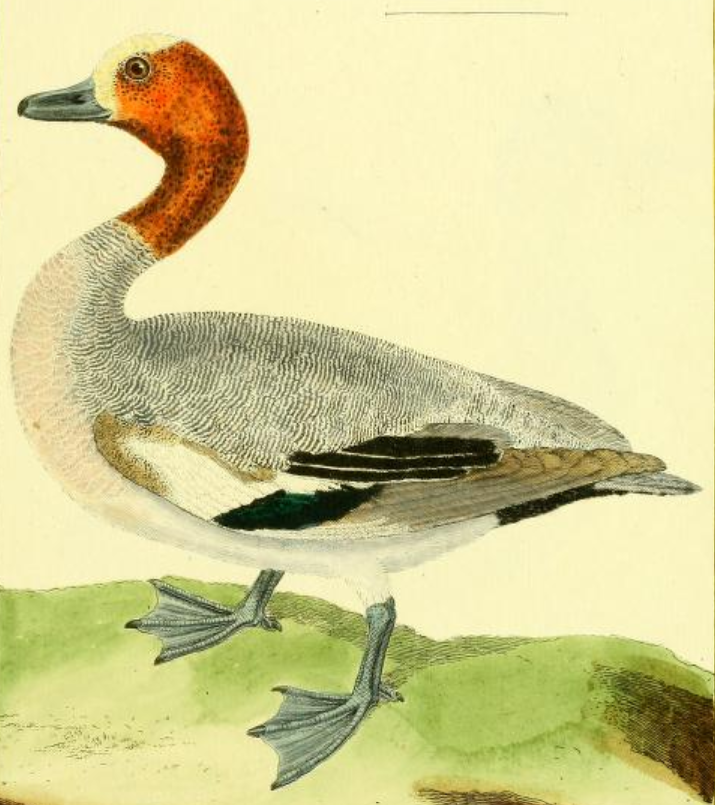
Charles Willson Peale (1741-1827) wrote, in his 22nd Lecture (ca. 1799): "504. Common Wigeon. Bill narrow, 1 ½ Inch long, of a blueish lead colour; tip black; top [of] the head is cream colour, a little mottled with dusky spots; over the bill almost white; head and neck of a bright bay; the lower part of it behind, and the breas, venaceous; back and scapulars minutely undulated with black and white lines; sides of the body the same, but paler; wing coverts brown, more or less mixed with white; quills dusky, banded with white; the outer webs of the middle ones green forming a speculum or spot, bounded above and below with black. Anas Penelope Linn. Le grand siffleur Buff. Pl. enl. 825. Common Wigeon. Latham No. 63. Pennant p. 574. K." (Academy of Natural Sciences of Drexel University Archives, coll. 40)
Peale continued: "This species is pretty common on most parts of the Old continent, on which we are assured it migrates as low as Egypt; being caught there, from the middle to the end of November, by nets in the marshes, before the departure of the waters. It is also found in Aleppo during the winter, in plenty. Observed likewise in the Caspian sea, and its neighborhood; and in most parts of Europe as far as Sweden. It is pretty common in England during the winter months; being caught, among other Ducks, in the decoys at that season. Its voise is said to be very much like the sound of a flute. The flesh is much esteemed. I received it from my correspondent in Sweden." (ANSP Archives, coll. 40)
At this point in his lecture, Peale inserted an additional slip of paper, which reads: "505. Female, is of a rusty brown, in all the upper parts striped with a darker colour, wings as the male, also a white body underneath the body. Linnaeus says they inhabit America, Asia and Europe. We have a species that in a considerable degree is like it, but not wholly so, and when we come to examine our birds critically we will find many that have been taken for the same birds, to have some distinguishing marks of difference. Perhaps in the water fowl less than in the other." (ANSP Archives, coll. 40)
Another undated scrap of paper, tucked into Peale's 21st lecture manuscript, contains a scribbled list of duck specimens, including: "504. Common Wigeon (penelope) & female (...)" (ANSP Archives, coll. 40).
Peale wrote, in "A Walk Through the Philad[elphi]a Museum" (1805–1806): "The … common wigeon (a. Penelope) came from Sweden, they differ from the … American Wigeon called the bald pate)." (Historical Society of Pennsylvania, coll. 0481)
Notes:
A letter from Rev. Nicholas Collin (1746-1831) to Charles W. Peale, dated 2 June 1793, confirms that “Mr. Gustavus Von Carlson (President of one of the supreme courts of Justice) has charged himself with the exchange of Birds. This eminent ornithologist owns a precious Cabinet of Birds, containing more than 800 species; & has by testamentary disposition generously bequeathed the whole to the said [Swedish] Academy of Sciences. You will therefore be pleased to send in future the birds directly to him. He has already in return, forwarded several of the most valuable Swedish Birds…” (Miller 1988: 49, Selected Papers, Vol. 2, part 1, Yale University Press).
Specimen Type:
Dead/preserved
Current Common Name:
Eurasian Wigeon
Current Scientific Name
Anatidae | Mareca penelope
Category:
Collection: