Object Status:
Unlocated
Accession Date:
By 1799
Primary Source Reference:
Charles Willson Peale, Lecture on Natural History 22. (ca. 1799). Academy of Natural Sciences of Drexel University Archives, coll. 40. / https://ansp.org/research/library/archives/0000-0099/coll0040/
Additional Source Text:
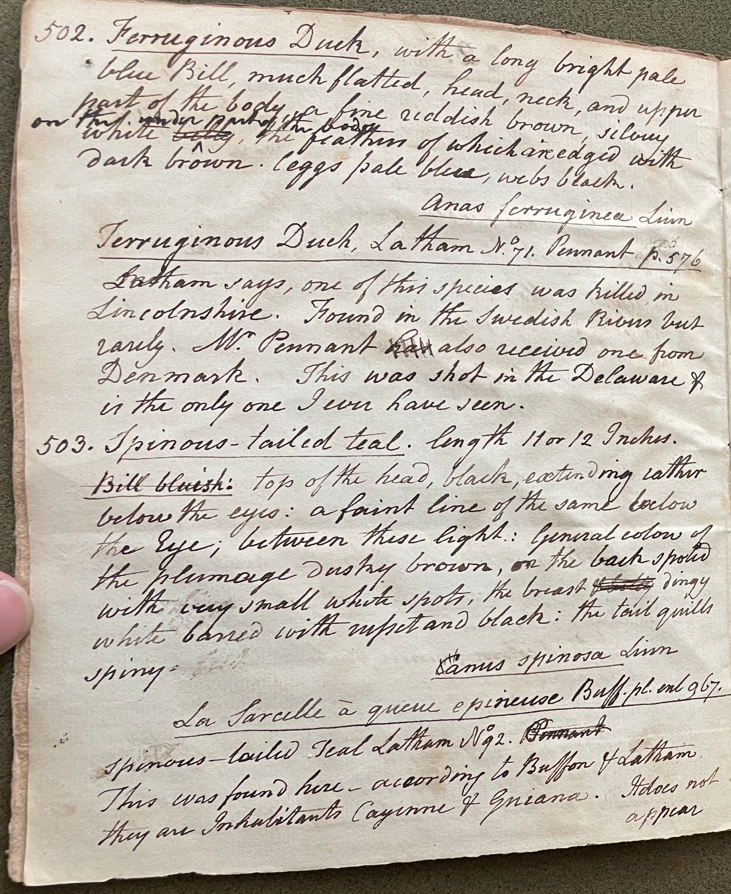
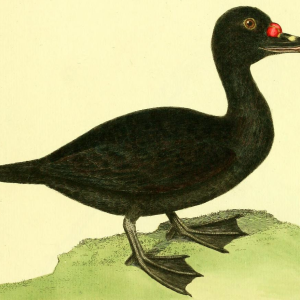
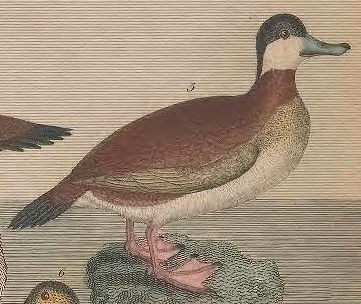
Charles Willson Peale (1741-1827) wrote, in his 22nd Lecture (ca. 1799): "502. Ferruginous Duck, with a long bright pale blue Bill, much flattened, head neck, and upper part of the body a fine reddish brown, silvery on the under parts of the body, the feathers of which are edged with dark brow. Leggs pale blue, webs black. Anas ferruginea Linn. Ferruginous Duck, Latham No. 71. Pennant p. 576. Latham says, one of this species was killed in Lincolnshire. Found in the Swedish Rivers but rarely. Mr. Pennant also received one from Denmark. This was shot in the Delaware [River] & is the only one I ever have seen." (Academy of Natural Sciences of Drexel University Archives, coll. 40)
Immediately following that account, he described an adult female under a different name: "503. Spinous-tailed teal. Length 11 or 12 Inches. Bill bluish: top of the heard, black, extending rather below the eyes: a faint line of the same below the eye; between these light: general colour of the plumage dusky brown, & the back spotted with very small white spots, the breast dingy white barred with russet and black; the tail quills spiny. Anas spinosa Linn. La Sarcelle à queue épineuse [de Cayenne] Buff. pl. enl. 967. Spinous-tailed Teal Latham No. 92. Pennant This was found here [near Philadelphia]—according to Buffon & Latham, they are Inhabitants of Cayenne & Guiana. It does not appear to me unlike the be the female of the Ferruginous Duck No. 502." (ANSP Archives, coll. 40)
An undated scrap of paper tucked into Peale's 21st lecture manuscript contains a scribbled list of duck specimens, including: "female Spinous tailed D. (spinosa)". (ANSP Archives, coll. 40)
Peale wrote, in "A Walk Through the Philad[elphi]a Museum" (1805–1806): "The Ferruginous Duck (a. ferruginea) appears by Authors to be a rare bird in Europe. This was shot in the Delaware, it is the only one I have seen. The purity of the blue of its bill while living greatly surpassed its present appearance." (Historical Society of Pennsylvania, coll. 0481)
Alexander Wilson (1766-1813) described this species under the name "Ruddy Duck / Anas rubidus" in American Ornithology vol. 8, published posthumously (Pl. 71), where Wilson (1814: 128, 130) provided separate accounts for the male ("Peale's Museum, No. 2808") and female ("Peale's Museum, No. 2809"). Of the male, Wilson (1814: 128) wrote: "This very rare Duck was shot, some years ago on the river Delaware, and appears to be an entire new species. The [male] specimen here figured, with the female that accompanies it, and which was killed in the same river, are the only individuals of their kind I have met with. They are both preserved in the superb Museum of my much respected friend, Mr. Peale, of this city." / https://www.biodiversitylibrary.org/item/175758#page/150/mode/1up (text, male) / https://www.biodiversitylibrary.org/item/175758#page/152/mode/1up (text, female) / https://www.biodiversitylibrary.org/item/175758#page/141/mode/1up (plate)
George Ord (1781-1866) wrote, in the second edition of American Ornithology, vol. 8 (1824: 139): "The year subsequent to the death of our author [1812] this Duck began to make its appearance in our waters. In October, 1814, the Editor procured a female, which had been killed from a flock, consisting of five, at Wind-mill Island, opposite to Philadelphia. In October, 1818, he shot three individuals, two females and a male; and in April last another male, all of which, except one, were young birds. He has also at various times, since 1814, seen several other male specimens of this species, not one of which was an adult. In effect, the only old males which he has ever seen are that in Peale’s Museum, and another in the Cabinet of the Academy of Natural Sciences of Philadelphia ... The Duck figured in the plate as the female was a young male, as the records of the Museum show" / https://www.biodiversitylibrary.org/item/233396#page/161/mode/1up
Three mounted specimens of "Anas rubidus (Ruddy Duck)" were listed in "A Catalogue of Duplicate Specimens...", May 1822. [unpublished] American Philosophical Society Library (Mss.B.P31).
Notes:
After Peale's Museum closed, a portion of Peale's bird collection was purchased in 1850 by Moses Kimball (1809–95), who displayed it at his "Boston Museum". An advertisement in the Boston Transcript, printed 1 October 1850, stated that Kimball had acquired "One Half of the celebrated Peale's Philadelphia Museum". The other half of Peale's birds had been sold to the circus promoter P. T. Barnum (1810–91) and would be subsequently destroyed in a fire at his "American Museum" in New York City in July 1865. When the Boston Museum closed, Kimball's Peale remnants passed temporarily to the Boston Society of Natural History, who disposed of them to Charles J. Maynard (1845-1929), a local taxidermist. The specimens were stored in a barn in Massachusetts for several years, then eventually were deposited at the Museum of Comparative Zoology (MCZ), Harvard University. By the time the collection was catalogued by Walter Faxon (1848-1920) at MCZ, in 1914, in virtually every case the original mounts and labels had been disassociated from the specimens, and an untold number were lost.
Walter Faxon, "Relics of Peale's Museum," Bulletin of the Museum of Comparative Zoology, 59, no. 3 (July 1915): 130, speculated that MCZ 67821, a data-deficient specimen from the Boston Museum collection, is "very probably Wilson's type, although the head is turned to one side, which is not the case in the figure." / https://www.biodiversitylibrary.org/page/6339801#page/180/mode/1up
Faxon was apparently unaware that at least three duplicate specimens were added to Peale's collection by May 1822 (APS Library, Mss.B.P31). These specimens were not seen by Wilson and therefore have no claim to type status. The extant specimen was probably one of the duplicates because it does not match the pose in Wilson's drawing.
Despite evidence to the contrary, the MCZ database lists MCZ 67854 as the "Holotype of Anas rubidus" and the specimen was included in a recently funded grant proposal aimed at "Preserving the genomes of the type specimens in the MCZ (CSBR)" (National Science Foundation, NSF Collections in Support of Biological Research: Award #1946857). / https://mczbase.mcz.harvard.edu/guid/MCZ:Orn:67821
Specimen Type:
Dead/preserved
Current Common Name:
Ruddy Duck
Current Scientific Name
Anatidae | Oxyura jamaicensis
Repository:
Museum of Comparative Zoology, Harvard University (MCZ 67821)