Object Status:
Extant
Accession Date:
By 1793
Primary Source Reference:
Charles Willson Peale, letter to Thomas Hall of Moorfields, London, dated 1793; Selected Papers, 2, part 1: 46.
Additional Source Text:
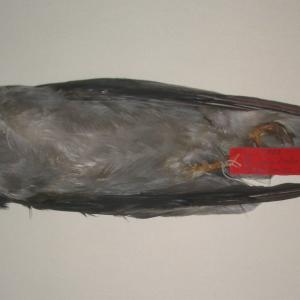
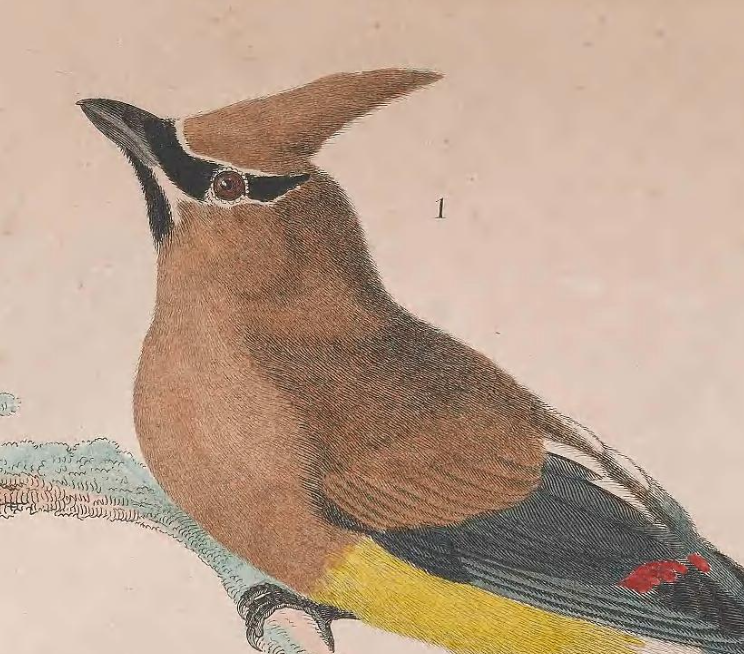
Charles Willson Peale (1741-1827) sent a "Chatterrer [sic] Cock" to Thomas Hall in London, in early 1793, in exchange for European specimens (Miller 1988: 46, Selected Papers, Vol. 2, part 1, Yale University Press).
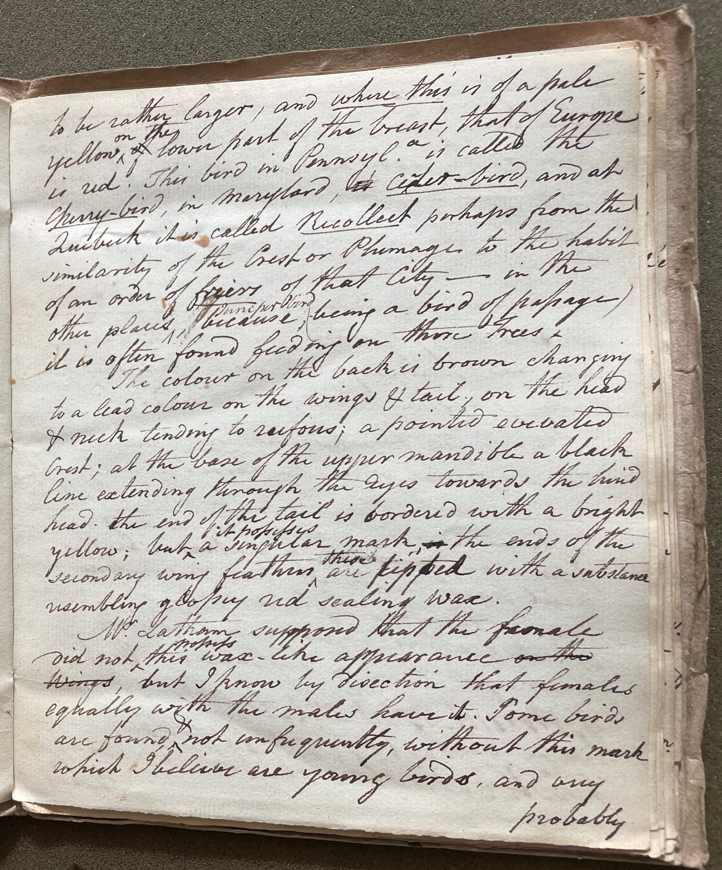
Peale wrote, in his 32nd Lecture (ca. 1799): "No. 1377. Waxen Chatterer of America, but it is said to be rather larger, and where this is of a pale yellow on the lower part of the breast, that of Europe is red. This bird in Pennsyla. is called the Cherry-bird, in Maryland, Cedar-bird, and at Quebeck it is called Recollect, perhaps from the similarity of the Crest or Plumage to the habit of an order of friars of that City. in the other places juniper bird because (being a bird of passage) it is often found feeding on those trees. The colour on the back is brown changing to a lead colour on the wings & tail, on the head & neck tending to rufous; a pointed elevated crest; at the base of the upper mandible a black line extending through the Eyes towards the hind head. the end of the tail is bordered with a bright yellow; but it possesses a singular mark [on] the ends of the secondary wing feathers; these are tipped with a substance resembling glossy red sealing wax." (Academy of Natural Sciences of Drexel University Archives, coll. 40)
Peale continued: "Mr. Latham supposed that the female did not possess wax-like appearance on the wings, but I know by dissection that females equally with the males have it. Some birds are found & not unfrequently, without this mark which I belived are young birds, and very probably they do not possess these wax-like points the first year. In some few instances I have found a like appearance on the extremities of the tail feathers. No. 1378. Female, and in external appearance exactly like the male. Ampelis garrulus Linn. Jaseur de la Caroline Buff. Chattr. of Carolina Catesby t. 46. We find many of these birds when cherries first come. their stay with us is short, they generally go farther northward to breed. Our late voyagers met with this bird at Aoonalashka [a footnote indicates that this information was sourced from "Ellis's Voy. ii. p. [75]."]. (ANSP Archives, coll. 40)
By the time Peale wrote "A Walk Through the Philad[elphi]a Museum" (1805-1806), he had concluded that the Cedar Waxwing and Bohemian Waxwing were distinct species: "No. [blank] Waxen Chatterer (Ampelis Garrulis) inhabits Europe & Assia. It is a very distinct species from the American Chatter. No. [blank] In Maryland they are called the Ceder Bird, because there they feed on Ceder berries in the winter, and coming into Pennsylvania in the spring & feeding on Cheries, acquire the name of Cherry Bird, and at Quebeck it is called Recollect, perhaps from the similarity of the crest or Plumage to the habit of an order of friars of that City. in some other places Juniper bird because (being a bird of passage) it is often found feeding on those Trees. Our late voyagers met with this bird at Aoonalaska. Ellis's voy. ii. p 15 / The female is exactly like the male, some authors had supposed the female to be without the wax like tips on the Wings, but we know that those are only young birds. some old Birds have also those Waxen tips on the Tail." (Historical Society of Pennsylvania, coll. 0481)
Alexander Wilson (1766-1813) described this species under the name "Cedar-bird / Ampelis americana" in American Ornithology vol. 1 (Pl. 7), where "Peale's Museum No. 5608" was cited (Wilson 1808: 107). Wilson (1808: 112) wrote: "Those of our fellow-citizens who have still any doubts, and wish to examine for themselves, may see beautiful specimens of both birds in the superb collection of Mr. Charles W. Peale of this city, whose magnificent is indeed a national blessing, and will be a lasting honor to his memory." / https://www.biodiversitylibrary.org/item/175530#page/133/mode/1up (text) / https://www.biodiversitylibrary.org/item/175530#page/132/mode/1up (plate)
Specimen Type:
Dead/preserved
Current Common Name:
Cedar Waxwing
Current Scientific Name
Bombycillidae | Bombycilla cedrorum