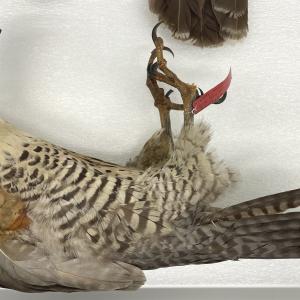
Object Status:
Extant
Accession Date:
By 1799
Primary Source Reference:
Charles Willson Peale, Lecture on Natural History 25. (ca. 1799). Academy of Natural Sciences of Drexel University Archives, coll. 40. / https://ansp.org/research/library/archives/0000-0099/coll0040/
Additional Source Text:
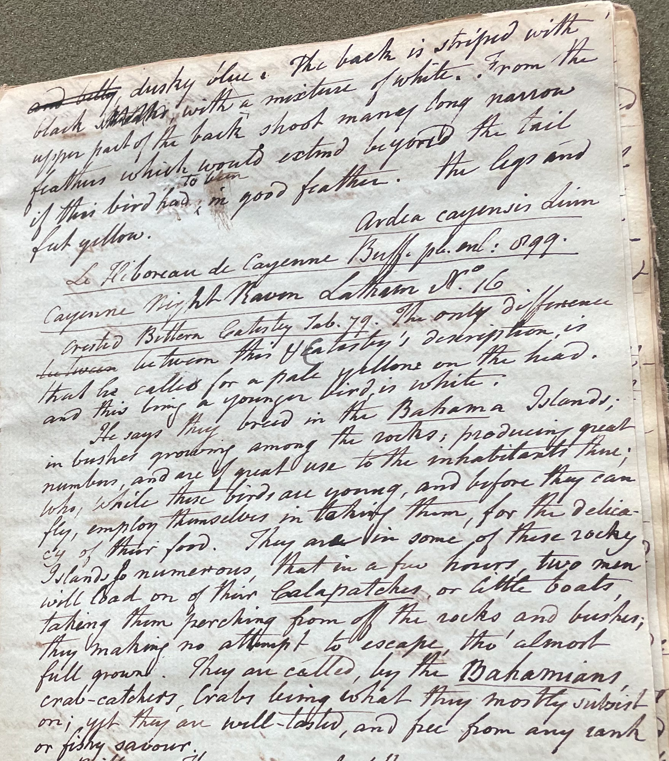
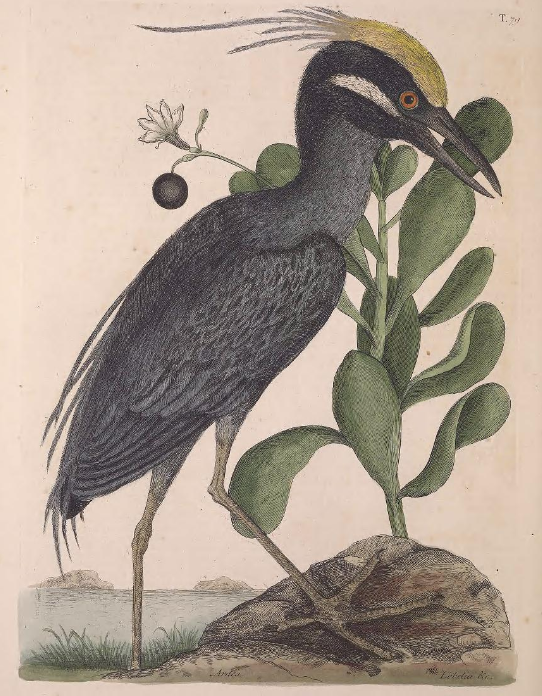
Charles Willson Peale (1741-1827) wrote, in his 25th Lecture (ca. 1799): "No. 740. Crested Bittern. I retain the name which Catesby gives of a bird found in Carolina in the rainy seasons. the top of the head is white, and a white strip on each side of the head extending towards the hind head; the crest of black & white feathers; the rest of the head is blue black; the neck & breast and belly dusky blue. The back is striped with black, with a mixture of white. From the upper part of the back shoot many long narrow feathers which would extend beyond the tail if this bird had been in good feather [condition]. the legs and feet yellow. Ardea cayensis Linn. Le Bihoreau de Cayenne Buff. pl. enl. 899. Cayenne Night Raven Latham No. 16. Crested Bittern Catesby Tab. 79." (Academy of Natural Sciences of Drexel University Archives, coll. 40)
Peale continued: "The only difference between this & Catesby's description is that he called for a pale yellow on the head, and this being a younger bird is white. He says they breed in the Bahama Islands, in bushes growing among the rocks, producing great numbers, and are of great use to the inhabitants there; who, while these these birds are young, and before they can fly, employ themselves in taking them, for the delicacy of their food. They are in some of these rocky Islands so numerous, that in a few hours, two men will load on of their Calapatches, or little boats, taking them perching from off the rocks and bushes; they making no attempt to escape, tho' almost full grown. They are called, by the Bahamians, crab-catchers, crabs being what they mostly subsist on; yet they are well-tasted, and free from any rank or fishy savour." A slip of loose paper tucked into Peale's 36th lecture contains a list of waterbirds with the following entry: "Crested bittern (A. cayensis)" (ANSP Archives, coll. 40).
Peale wrote, in "A Walk Through the Philad[elphi]a Museum" (1805–1806): "Catesby described a bird of Carolina under the name Crested Bittern (A. Cayensis) but other authors call it Night Raven.—It has a proportioned Bill to our Night Raven (A. Nycticorax). Most authors have given these Birds the names of night Raven, on account of a strange sort of Croaking which they make during the Night. They fly in the night, and lodge in day light in trees near the water" (Historical Society of Pennsylvania, coll. 0481).
Alexander Wilson (1766-1813) described this species under the name "Yellow-crowned Heron / Ardea violacea" in American Ornithology vol. 8, published posthumously (Pl. 65), where "Peale's Museum, No. 3738" was cited (Wilson 1814: 26). / https://www.biodiversitylibrary.org/item/175758#page/34/mode/1up (text) / https://www.biodiversitylibrary.org/item/175758#page/35/mode/1up (plate)
On 12 June 1821, a "Night Raven living (since dead) shot at the falls of Trenton", donated by Israel Taylor of Trenton, New Jersey, was entered into the Peale Museum Accessions Book, p.114 (Historical Society of Pennsylvania, coll. 0481).
Specimen Type:
Dead/preserved
Current Common Name:
Yellow-crowned Night Heron
Current Scientific Name
Ardeidae | Nyctanassa violacea