Object Status:
Extant
Accession Date:
By 1799
Primary Source Reference:
Charles Willson Peale, Lecture on Natural History 33. (ca. 1799). Academy of Natural Sciences of Drexel University Archives, coll. 40. / https://ansp.org/research/library/archives/0000-0099/coll0040/
Additional Source Text:
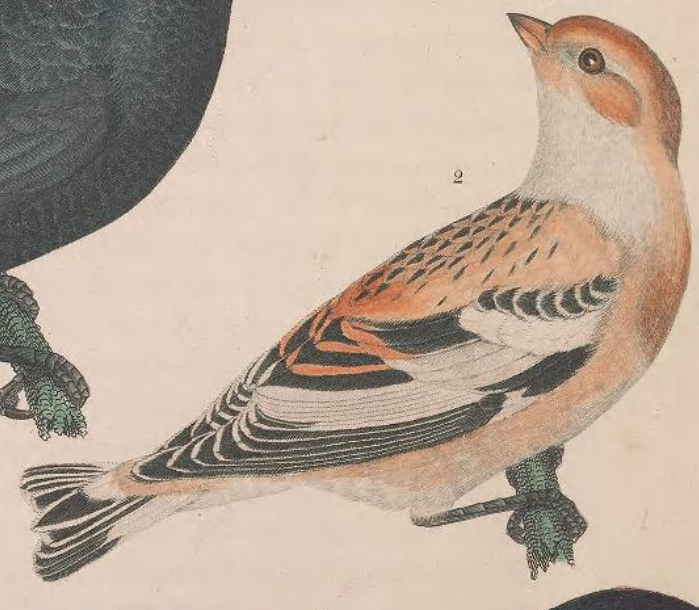
Charles Willson Peale (1741-1827) wrote, in his 33rd Lecture (ca. 1799): "No. 1469. Snow Bunting. the predominant colour of these birds is white, marked with russet black & grey. Russet is most conspicuous on the head, & a band across the breast. the back is brown russet & grey. Wing quils black edged with russet and the tail is black in the middle and white on each side. No. 1471. much whiter. these are evidently the same species of different ages & perhaps a different sex." (Academy of Natural Sciences of Drexel University Archives, coll. 40)
Peale continued: "We very rarely meet with these birds in Pennsylvania. those I have found in a cold season, and I suppose an early and severe winter in Canada, with perhaps a lack of their accustomary food, have drove them here. Edwards describes one found at Hudson's bay and his plate in some measure, agrees with the birds before us, except the band across is not made out. Authors describe this bird as being found in the northern parts of great Britain, and still colder regions, even to Spitzergen [i.e., Spitsbergen, an island in northern Norway]. This is the most probable way that animals who can bear extreme cold, will be found to be common to the old & new continent; such as can pass from one shore to the other on the Ice or by short flights; and also those that live almost wholely on the waters." (ANSP Archives, coll. 40)
Peale continued: "Otherwise, I firmly believe that we shall not find any two exactly corresponding, they may have some general appearance, but critically examined will be always found to differ. Whether this Snow Bunting is exactly the same as those in the north of Europe is still doubtful, I cannot fully make up my mind before I get specimens from abroad to compare with those of America, especially as I know Mr. Buffons coloured plates are generally very correct, and his plate of the Snow bunting differs from these, in having the head wholy white; no band on the breast; and without the russet colouring. Mr. Latham, describing them as the same bird, says, In America, they advance no father to the south than Nova Scotia, never being found at New York. he believes the more northward they are found the whiter the plumage. ? Emberiza nivalis Linn. L'ortolan de Neige Buff. pl. enl. 494 f. 1." (ANSP Archives, coll. 40)
Peale continued: "As it a bird on which the epicures of Europe set a high price and esteem it so dainty a morsel, their manner of treating [the Ortolan Bunting, Emberiza hortulana, to which Americans have compared the Snow Bunting] may be acceptable. As ortolans are birds of passage in the temperate parts of Europe (for they go to the most northern climes to breed), when they first arrive in Grance, are very lean, but they are soon made fat by the bird catchers. Ortolans, as they are called, are licenced by the Officers of the game Laws, and each of these men have a limited district, the bounds of which they dare not exceed. And those bird-catchers fatten the birds they take with millet. They are well paid for their trouble by a high price; for an Ortolan in Paris more than 40 years past sold for […] Livres." (ANSP Archives, coll. 40)
Peale continued: "Several Authors to fatten these have advised the puting them into a dark chamber lighted by lanthors; so that, not knowing the vicissitudes of day and night, they are not agitated by the change, and feed with millet, grow so fat, that they would certainly die if not killed in a critical minute. They are a mere lump of fat; of a most exquisite taste; but apt soon to satiate. The Antients constructed magnificent and convenient places to keep them. But the method practiced in the vicinity of Paris, is simple and convenient; they put them into dark cages, and only let light on the Trough, which holds the food. In this manner only 8 days feeding is sufficient to make the ortolan exceedingly fat, and although it is a game the most esteemed, it is however agreed that the flesh, almost a pellet of fat, is more tender than jucey. On account of its singing, they are kept in cages in countries where they about, and it is said they sing agreably in the night as often as by day." (ANSP Archives, coll. 40)
Peale wrote, in "A Walk Through the Philad[elphi]a Museum" (1805–1806): "The American Ortolan, or Snow Bunting, is considerably like that of Europe, they are rarely found in the vicinity of Philadelphia. the sight of them indicate a hard winter at least northward, and probably the want of food drive them southerly." (Historical Society of Pennsylvania, coll. 0481)
Alexander Wilson (1766-1813) described this species under the name "Snow Bunting / Emberiza nivalis" in American Ornithology vol. 3 (Pl. 21), where "Peale's Museum, No. 5900" was cited (Wilson 1811: 36). / https://www.biodiversitylibrary.org/item/175516#page/46/mode/1up (text) / https://www.biodiversitylibrary.org/item/175516#page/42/mode/1up (plate)
An unmounted specimen of "Emberiza nivalis (Snow Bunting)" was listed in "A Catalogue of Duplicate Specimens...", May 1822. [unpublished] American Philosophical Society Library (Mss.B.P31).
Specimen Type:
Dead/preserved
Current Common Name:
Snow Bunting
Current Scientific Name
Calcariidae | Plectrophenax nivalis