Object Status:
Unlocated
Accession Date:
By 1799
Primary Source Reference:
Charles Willson Peale, Lecture on Natural History 26. (ca. 1799). Academy of Natural Sciences of Drexel University Archives, coll. 40. / https://ansp.org/research/library/archives/0000-0099/coll0040/
Additional Source Text:
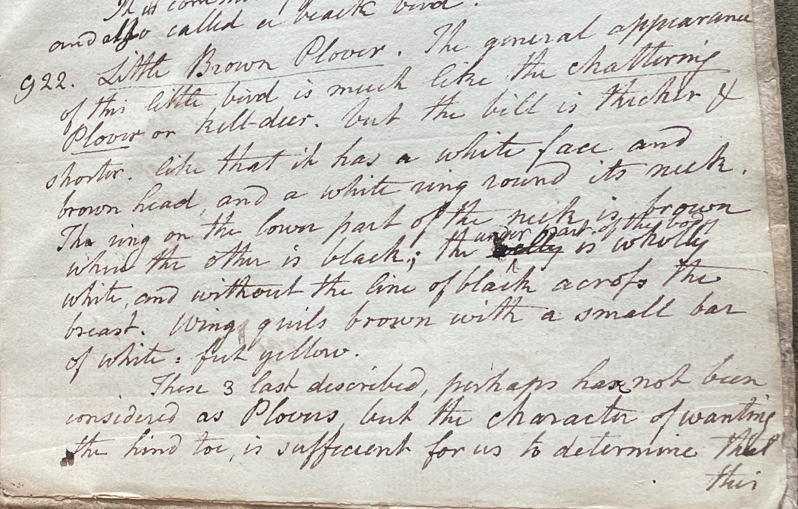
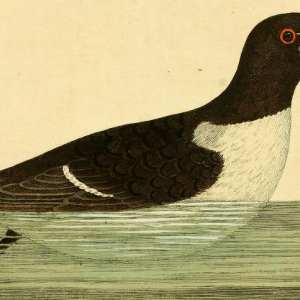
Charles Willson Peale (1741-1827) wrote, in his 26th Lecture (ca. 1799): "922. Little Brown Plover. The general appearance of this little bird is much like the Chattering Plover or Kill-deer, but the bill is thicker & shorter. Like that [species] it has a white face and brown head, and a white ring round its neck. The ring on the lower part of the neck is brown where the other is black; the under parts of the body is wholly white, and without the line of black across the breast; wing quils brown with a small bar of white; feet yellow." (Academy of Natural Sciences of Drexel University Archives, coll. 40)
Alexander Wilson (1766-1813) described (posthumously, under the editorship of George Ord [1781-1866]) this species under the name "Wilson's Plover / Charadrius wilsonia" in American Ornithology vol. 9, published posthumously (Pl. 73), where "Peale Museum, No. 4159, male—[and] 4160, female" was cited (Wilson 1814: 77). / https://www.biodiversitylibrary.org/item/175518#page/83/mode/1up (text) / https://www.biodiversitylibrary.org/item/175518#page/8/mode/1up (plate)
Notes:
George Ord (1781-1866) wrote, in his original description of Wilson's Plover: “Of this neat and prettily marked species I can find no account, and have concluded that it has hitherto escaped the eye of the naturalist. The bird of which the figure in the plate is a correct resemblance, was shot the thirteenth of May, 1813, on the shore of Cape-Island, Newjersey, by my ever-regretted friend; and I have honored it with his name. It was a male, and was accompanied by another of the same sex and a female, all of which were fortunately obtained” (Wilson 1814: 77, American Ornithology, vol. 9). Thus, Ord evidently overlooked Peale's specimen of the "Little Brown Plover" (or else it was destroyed by then). / https://www.biodiversitylibrary.org/item/175518#page/83/mode/1up After Peale's Museum closed, a portion of Peale's bird collection was purchased in 1850 by Moses Kimball (1809–95), who displayed it at his "Boston Museum". An advertisement in the Boston Transcript, printed 1 October 1850, stated that Kimball had acquired "One Half of the celebrated Peale's Philadelphia Museum". The other half of Peale's birds had been sold to the circus promoter P. T. Barnum (1810–91) and would be subsequently destroyed in a fire at his "American Museum" in New York City in July 1865. When the Boston Museum closed, Kimball's Peale remnants passed temporarily to the Boston Society of Natural History, who disposed of them to Charles J. Maynard (1845-1929), a local taxidermist. The specimens were stored in a barn in Massachusetts for several years, then eventually were deposited at the Museum of Comparative Zoology (MCZ), Harvard University. By the time the collection was catalogued by Walter Faxon (1848-1920) at MCZ, in 1914, in virtually every case the original mounts and labels had been disassociated from the specimens, and an untold number were lost. Walter Faxon, "Relics of Peale's Museum," Bulletin of the Museum of Comparative Zoology, 59, no. 3 (July 1915): 135, speculated that MCZ 67839 (male) and 67840 (female), data-deficient specimens from the Boston Museum collection (the former shown here), were "Probably the types of the species, the male being the one figured by Wilson, and both described by Ord in the accompanying text. If I am right as to their identity, they were both shot by Wilson at Cape [May] Island, [New Jersey], May 13, 1813." This claim may be true, but the evidence is purely circumstantial.
Specimen Type:
Dead/preserved
Current Common Name:
Wilson's Plover
Current Scientific Name
Charadriidae | Charadrius wilsonia
Repository:
Museum of Comparative Zoology, Harvard University (MCZ 67839 and 67840)