Object Status:
Unlocated
Accession Date:
By 1 March 1787
Primary Source Reference:
George Washington to Charles Willson Peale, 16 February 1787; Selected Papers, 1: 466.
Additional Source Text:
Charles Willson Peale (1741-1827) wrote to George Washington (1732-1799) on 31 Dec 1786, offering to "preserve [the pheasants] in the best manner I am able, and either send them back to you, or place them in my Museum", in the event of their death. One died on 15 Feb 1787, and the next day Washington wrote to Peale, "You will receive by the stage of my gold Pheasant packed up in wool agreeable to your directions. He made his exit yesterday which enables me to comply with your request [for his body] much sooner thant I wished to do." (Selected Papers, 1: 464-466, 473)
On 1 March 1787, the following notice ran in both the Pennsylvania Packet and Daily Advertiser: "Mr. Peale has now preserved in his museum of natural curiosities, a Gold Pheasant, one of those beautiful birds of China, which the Marquid de la Fayette presented to His Excellency George Washington, as mentioned under the Baltimore head in our paper of Nov. 16 last, which it is said cost the Marquis de la Fayette sixteen guineas."
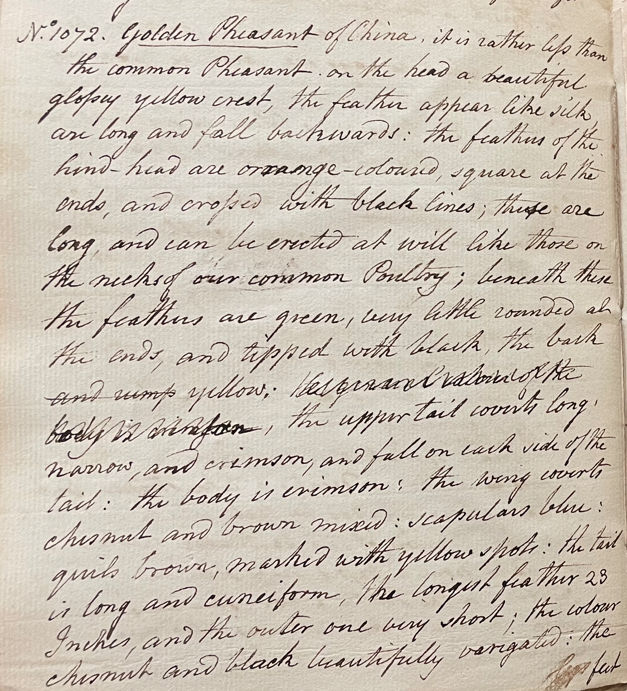
In his 29th Lecture, Peale wrote: "No. 1072. Golden Pheasant of China. It is rather less than the common pheasant, on the head a beautiful glossy yellow crest, the feathers appear like silk, are long and fall backwards; the feathers of the hind-head are orange-coloured, square at the ends, and crossed with black lines; these are long, and can be erected at will like those on the neck of our common poultry; beneath these the feathers are green, very little rounded at the ends, and tipped with black; the back and rump yellow; the upper tail covers long, narrow, and crimson, and fall on each side of the tail; the body is crimson; the wing coverts chesnut and brown mixed; scapulars blue; quils brown, marked with yellow spots; the tail is long and cuneiform, the longest feather 23 inches, and the outer one very short; the colour chesnut and black, beautifully variegated; the feet, yellow, furnished with a spur. In China it is called Kin-ki." (Academy of Natural Sciences of Drexel University Archives, coll. 40)
Peale continued: "It bears confinement better than other pheasants and will breed in captivity, and it is very probable they may be naturalized in our climate, as they are well covered with feathers to ward off the cold of our winters. Phasianus pictus Linn. Le Faisan dorè de la Chine. Buff. pl. enl. 217. Painted Pheasant Lath. p. 177. No. 1073. Female is smaller, and has not the gaudy feathers of the male. The general colour is brown varigated with some lights; the tail is shorter but not much unlike those of the male; the feet have no spurs." (ANSP Archives, coll. 40)
Peale wrote, in "A Walk Through the Philad[elphi]a Museum" (1805–1806): "How Splendid the coulours of the Golden Pheasant (P. pictus) of China. It is said to bear confinement better than other Pheasants, and will breed in Captivity — The Naturalizing to our Country deserves a tryal. The female smaller & in a plain brown dress." (Historical Society of Pennsylvania, coll. 0481)
Notes:
Many years after the closing of Peale's Museum, one of his Golden Pheasant specimens was mentioned in an article in the Boston Evening Transcript on 13 April 1900, which read: “At the rooms of the Appalachian Mountain Club this afternoon and evening, Walter B. Davis exhibits his collection … Two of the most valuable birds in the collection are an English Skylark, from the old Charles Wilson Peale collection made in 1784 in Philadelphia, and a golden pheasant presented to Mr. Peale by George Washington. These specimens have recently been discovered by C. J. Maynard of Newtonville, after having been lost for over fifty years. When the Peale Museum was sold a portion of the remainder was purchased by Moses Kimball of the Boston Museum, and its identity became lost. When this museum was broken up a few years since, the collection as given to the Boston Natural History Society, who sold the birds to Mr. Maynard, not knowing their origin. Many of Alexander Wilson’s types are in the collection.” (transcribed from photocopy in the American Philosophical Society Library, Mss.Ms.Coll.3) Fifteen years later, by which time the Golden Pheasant had been accessioned in the museum at Harvard University, Walter Faxon, "Relics of Peale's Museum," Bulletin of the Museum of Comparative Zoology, 59, no. 3 (July 1915): 127, wrote: "I believe the only surviving labels which probably go back to the Peale Museum are two wooden ones belonging to a pair of Golden Pheasants presented to Charles Willson Peale by George Washington." Those specimens are MCZ 335908 (male) and 335909 (female) in the Museum of Comparative Zoology, Harvard University (shown here).
Specimen Type:
Dead/preserved
Current Common Name:
Golden Pheasant
Current Scientific Name
Phasianidae | Chrysolophus pictus
Repository:
Museum of Comparative Zoology, Harvard University (MCZ 335908 and 335909)