Object Status:
Extant
Accession Date:
By 1799
Primary Source Reference:
Charles Willson Peale, Lecture on Natural History 32. (ca. 1799). Academy of Natural Sciences of Drexel University Archives, coll. 40. / https://ansp.org/research/library/archives/0000-0099/coll0040/
Additional Source Text:
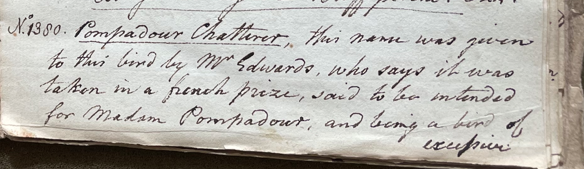
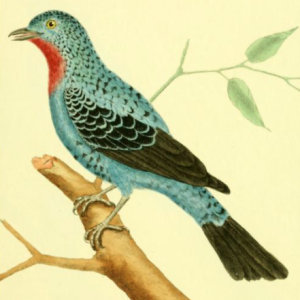
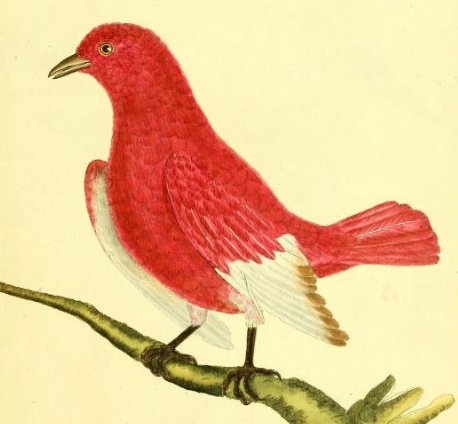
Charles Willson Peale (1741-1827) wrote, in his 32nd Lecture (ca. 1799): "No. 1380. Pompadour Chatterer. this name was given to this bird by Mr. Edwards, who says it was taken in a french prize, said to be intended for Madam Pompadour, and being a bird of excessive beauty, he named it after that Lady. The general colour is a crimson purple; wing quills white and black at the extremities; the lesser coverts with very sharp points; their shafts white; the feathers are wholly white next the skin. Ampelis pompadora Linn. Cotinga pouprè de Cayenne. Buff. pl. enl. 279. Pompadour Edwards glean, tab. 341. These species of birds are said to frequent low marshy grounds, differing much from the Chatter of North America, which are commonly found on the uplands. I received it from Cayenne. There are a few more of this genus of birds yet wanting in the Museum, one species of which is curious, by having at the base of the beak a fleshy caruncle like the Turkey. Found also at Cayenne." (Academy of Natural Sciences of Drexel University Archives, coll. 40)
Peale wrote, in "A Walk Through the Philad[elphi]a Museum" (1805–1806): "No. [blank] Pompadour Chatterer (A. Pompadora) one of these birds intended for Madam Pompadour, taken in a [prize] carried into England, [George] Edwards gave it that name. They frequent marshy grounds in Cayanne." (Historical Society of Pennsylvania, coll. 0481)
Notes:
In his lecture account of this species, Peale referred to Gleanings of Natural History, 3 vols. (1758-1764) by the English ornithologist George Edwards (1694-1773). / https://www.biodiversitylibrary.org/bibliography/153666 In 1793, Raphaelle Peale (1774-1825) travelled to Cayenne, French Guiana, to collect specimens for Peale's Museum. However, to the editor's (MRH) knowledge, there is no detailed inventory of the specimens he brought back, and there are many examples of specimens from northern South America that were donated by other people. For more discussion about Raphaelle's travels, see Lillian B. Miller, 1993, "Father and Son: The Relationship of Charles Willson Peale and Raphaelle Peale", The American Art Journal 25: 4-161. / https://doi.org/10.2307/1594599
Specimen Type:
Dead/preserved
Current Common Name:
Pompadour Cotinga
Current Scientific Name
Cotingidae | Xipholena punicea