Object Status:
Extant
Accession Date:
By 1793
Primary Source Reference:
Charles Willson Peale, letter to Thomas Hall of Moorfields, London, dated 1793; Selected Papers, 2, part 1: 46.
Additional Source Text:
Charles Willson Peale (1741-1827) sent a "creeper" to Thomas Hall in London, in early 1793, in exchange for European specimens (Miller 1988: 46, Selected Papers, Vol. 2, part 1, Yale University Press).
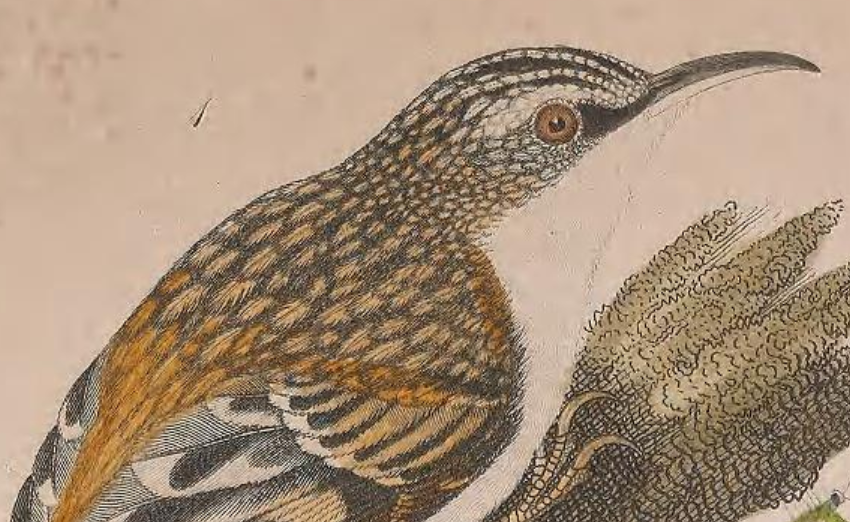
Peale wrote, in his 20th Lecture (ca. 1799): "397. Common Creeper. This bird is scarce bigger than the Crested Wren; it weighs 5 drams; and its length 5 Inches & a half. bill curved, the upper mandible brown, the lower whitish; the irides hazel; the head and upper part of the neck are brown, streaked with black; lower part of the back tawny; the wing coverts variegated with brown and black; quills dusky, tipped with white, and edged and barred with tawny marks; the breast and belly of a silvery white; the tail long, consisting of 12 still feathers, sharp pointed; feet & claws grey. Certhia familiaris Linn. Le Grimpereau Buff. pl. enl. 681. f. 1." (Academy of Natural Sciences of Drexel University Archives, coll. 40)
Peale continued: "[It is the] Common Creeper [of] Latham, who says "it is found in most parts of Europe, though it is believed no where so common as in England. It may be thougt more scarce than it really is, by the less attentive observer; for, supposing it on the body, or branch of any tree, the moment it observes any one, it gets to the opposite side, and so on, let a person walk round the tree ever so often; the facility with which it runs on the bark of a tree, in all directions, is wonderful, doing this with [as] much ease as a fly on a glass window. Its food is principally if not wholly Insects, which it finds in the chinks or among the moss of trees. It builds its nest in some hole of a tree, and lays generally 5 eggs, very rarely more than 7; these are ash coloured, marked at the end with spots and streaks of a deeper colour; and the shell is observed to be pretty hard." A footnote mentions that this information was sourced from Latham. (ANSP Archives, coll. 40)
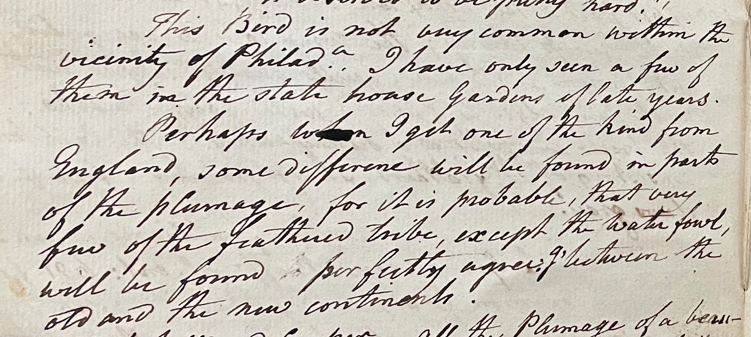
Peale continued: "This bird is not very common within the vicinity of Philada. I have only seen a few of them in the state house gardens of late years. Perhaps when I get one of the kind from England, some difference will be found in part of the plumage, for it is probable, that very few of the feathered tribe, except the water fowl, will be found [to] perfectly agree between the Old and the New continents." (ANSP Archives, coll. 40)
On 13 July 1802, Peale wrote to Étienne Geoffrey Saint-Hilaire (1772-1844) at the Paris Museums, mentioning his suspicion that the American species was distinct from its European relative: "I am the more interested to get the various Animals of the old World to compare them with those of this country, as in several Instances, on comparing some species which Authors have said are common to both continants, I have found them to differ although Mr. Buffon's plate 681. f. 1. le Grimpereau. Certhia familiaris Linn: is generally like this of America yet it may not be critically so" (Miller 1988: 442).
Peale wrote, in "A Walk Through the Philad[elphi]a Museum" (1805–1806): "This plain brown striped bird, of a delicate form belongs to Europe Asia and America. The American species have the throat and breast whiter than those of Europe; we seldom see birds of the two continents so much alike." (Historical Society of Pennsylvania, coll. 0481)
Alexander Wilson (1766-1813) described this species under the name "Brown Creeper / Certhia familiaris" in American Ornithology vol. 1 (Pl. 8), where "Peale's Museum No. 2434" was cited (Wilson 1808: 122). / https://www.biodiversitylibrary.org/item/175530#page/148/mode/1up (text) / https://www.biodiversitylibrary.org/item/175530#page/149/mode/1up (plate)
Specimen Type:
Dead/preserved
Current Common Name:
Brown Creeper
Current Scientific Name
Certhiidae | Certhia americana