Object Status:
Extant
Accession Date:
By 1799
Primary Source Reference:
Charles Willson Peale, Lecture on Natural History 25. (ca. 1799). Academy of Natural Sciences of Drexel University Archives, coll. 40. / https://ansp.org/research/library/archives/0000-0099/coll0040/
Additional Source Text:
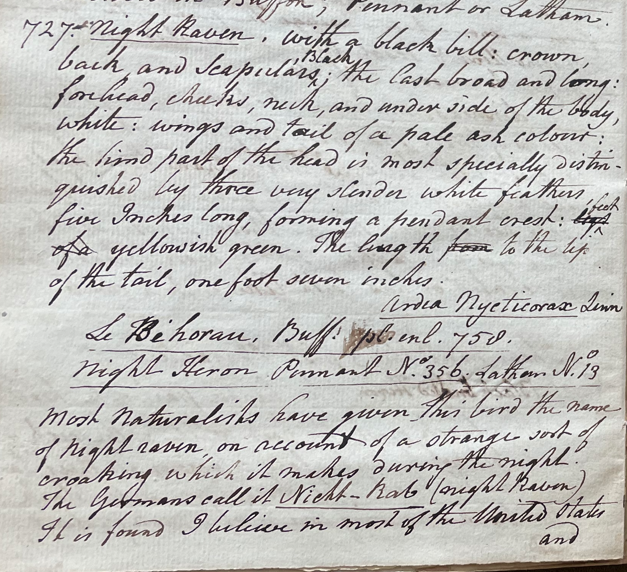
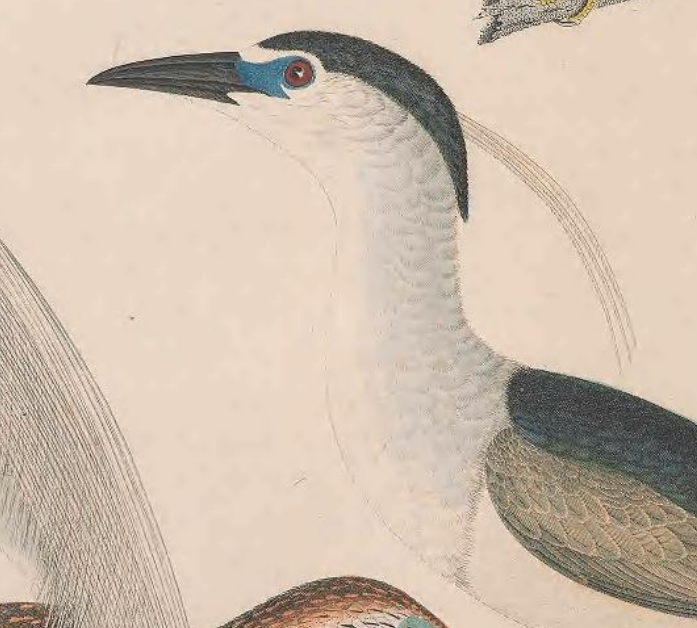
Charles Willson Peale (1741-1827) wrote, in his 25th Lecture (ca. 1799): "No. 727. Night Heron. With a black bill; crown, back, and scapulars, black; the last broad and long; foreheard, cheeks, neck, and under side of the body, white; wings and tail of a pale ash colour; the hind part of the head is most specially distinguished by three very slender white feathers, five Inches long, forming a pendant crest; feet yellowish green. The length to the tip of the tail, one foot seven inches. Ardea Nycticorax Linn. Le Behorau. Buff. pl. enl. 758. Night Heron Pennant No. 356. Latham No. 13. Most Naturalists have given this bird the name of Night raven, on account of a strange sort of croaking which it makes during the night. The Germans call it Night Rab (Night Raven). It is found I believe in most of the United States and it is also common in Europe. Is frequent in the southern parts of the Russian dominions; but does not extend farther than Lat. 53." (Academy of Natural Sciences of Drexel University Archives, coll. 40)
Peale continued: "728. The Female, nearly of the same size of the male; has a light edge to the upper mandible, head & neck striped with brown & white, lightest on the under side. Back & wings brown spotted with white, of an oblong form; under parts of the body white; feet the same as the male. Ardea grisea ? Linn. Femalle du Hiborean Buff. pl. enl. 759. Night Heron Femalle. Latham No. 13. Latham says that he known only a single Instance of it being found in Britain. A male was shot near London in 1782, which is now in the Leverian Museum." (ANSP Archives, coll. 40)
Peale wrote, in "A Walk Through the Philad[elphi]a Museum" (1805–1806): "Catesby described a bird of Carolina under the name Crested Bittern (A. Cayensis) but other authors call it Night Raven—It has a proportioned Bill to our Night Raven (A. Nycticorax). Most authors have given these Birds the names of night Raven, on account of a strange sort of Croaking which they make during the Night. They fly in the night, and lodge in day light in trees near the water. Here are several other varieties of Herons commonly found on the borders of Rivers through out the United States." (Historical Society of Pennsylvania, coll. 0481)
Alexander Wilson (1766-1813) described this species under the name "Night Heron, or Qua-bird / Ardea nycticorax" in American Ornithology vol. 7 (Pl. 61), where "Peale's Museum, No. 3728" and "Young, No. 3729" were cited (Wilson 1813: 101). / https://www.biodiversitylibrary.org/item/175507#page/119/mode/1up (text) / https://www.biodiversitylibrary.org/item/175507#page/114/mode/1up (plate)
On 12 June 1821, a "Night Raven living (since dead) shot at the falls of Trenton" donated by Israel Taylor of Trenton was recorded in the Peale Museum Accessions Book (Historical Society of Pennsylvania, coll. 0481).
On 9 January 1822, a notice in Poulson's American Daily Advertiser mentioned Dr. Richard Harlan's (1796-1843) donation of a skull of a "Night Raven."
An unmounted specimen of "Ardea nycticorax (Night Raven)" was listed in "A Catalogue of Duplicate Specimens...", May 1822. [unpublished] American Philosophical Society Library (Mss.B.P31).
Specimen Type:
Dead/preserved
Current Common Name:
Black-crowned Night Heron
Current Scientific Name
Ardeidae | Nycticorax nycticorax