Object Status:
Extant
Accession Date:
By 1799
Primary Source Reference:
Charles Willson Peale, Lecture on Natural History 30. (ca. 1799). Academy of Natural Sciences of Drexel University Archives, coll. 40. / https://ansp.org/research/library/archives/0000-0099/coll0040/
Additional Source Text:
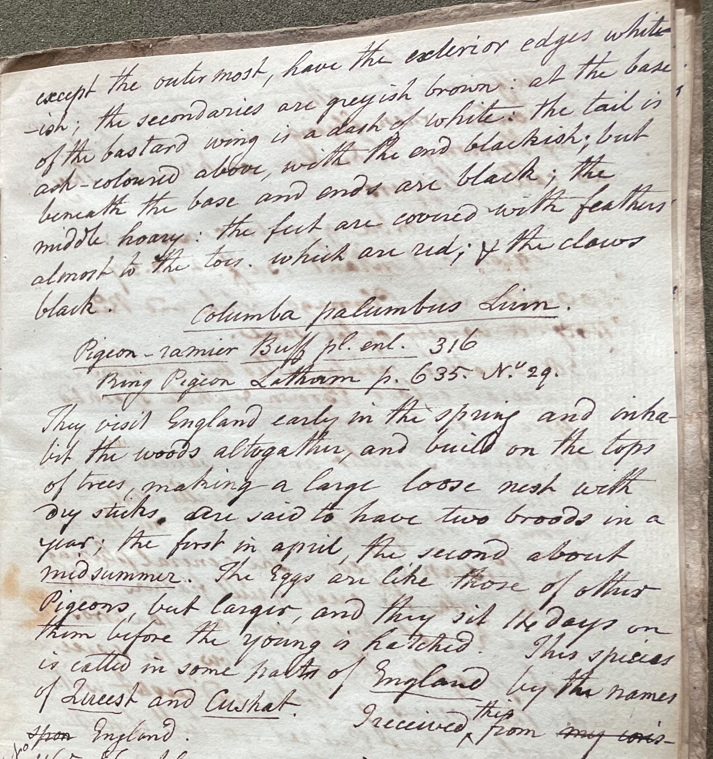
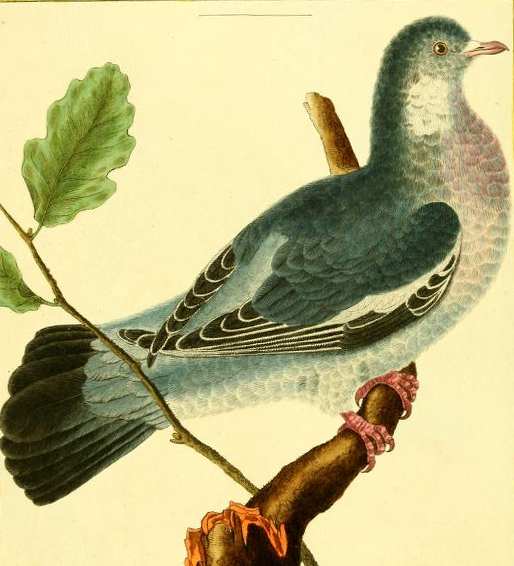
Charles Willson Peale (1741-1827) wrote, in his 30th Lecture (ca. 1799): "No. 1164. Palumbus, or Ring Dove, is a native of Europe and Asia. It is the largest Pigeon they have and might be distinguished from others on that account alone. Its weight is about 20 Oz.; its length 18 [inches], the breadth 30 inches. The head, back and coverts of the wings are of a blueish ash colour; the lower side of the neck and breast are of a purplish red, dashed with ash colour; the hind part and sides of the neck are green gold, in some lights changing into blue, with a copper gloss; and on each side of the neck is a white crescent; the greater quills are dusky; all of them except the outermost, have the exterior edges whiteish; the secondaries are greyish brown; at the base of the bastard wing is a dash of white; the tail is ash-coloured above, with the end blackish; but beneath the base, and [the] end, are black; the middle hoary; the feet are covered with feathers, almost to the toes, which are red; & the claws black." (Academy of Natural Sciences of Drexel University Archives, coll. 40)
Peale continued: "Columba palumbus Linn. Pigeon-ramier Buff. pl. enl. 316. Ring Pigeon Latham p. 635. No. 29. They visit England early in the spring and inhabit the woods altogether, and build on the tops of trees, making a large loose nest with dry sticks. [They] are said to have two broods in a year; the first in April, the second about midsummer. The eggs are like those of other Pigeons, but larger, and they sit 14 days on them before the young is hatched. This species is called in some parts of England, by the names of Queest and Cushat. I received this [specimen] from England." (ANSP Archives, coll. 40)
Peale wrote, in "A Walk Through the Philad[elphi]a Museum" (1805–1806): "Ring dove (C. Palumbus) is a native of Europe. They visit England in the spring and inhabit the Woods altogether — It is a large Pigeon, but far short of the size of the Great Crowed Pigeon (C. Coronata) this is the size of a hen Turkey." (Historical Society of Pennsylvania, coll. 0481)
Specimen Type:
Dead/preserved
Current Common Name:
Common Wood Pigeon
Current Scientific Name
Columbidae | Columba palumbus