Object Status:
Extant
Accession Date:
By 30 May 1799
Primary Source Reference:
Charles Willson Peale, diary entry dated 30 May 1799; Selected Papers, 2, part 1: 241.
Additional Source Text:
Charles Willson Peale (1741-1827) wrote in his diary on 30 May 1799, during a collecting trip to Cape May, New Jersey: "I shot a Summer Red bird [in] the evening also crested fly-catcher" (Miller 1988: 241, Selected Papers, Vol. 2, part 1, Yale University Press).
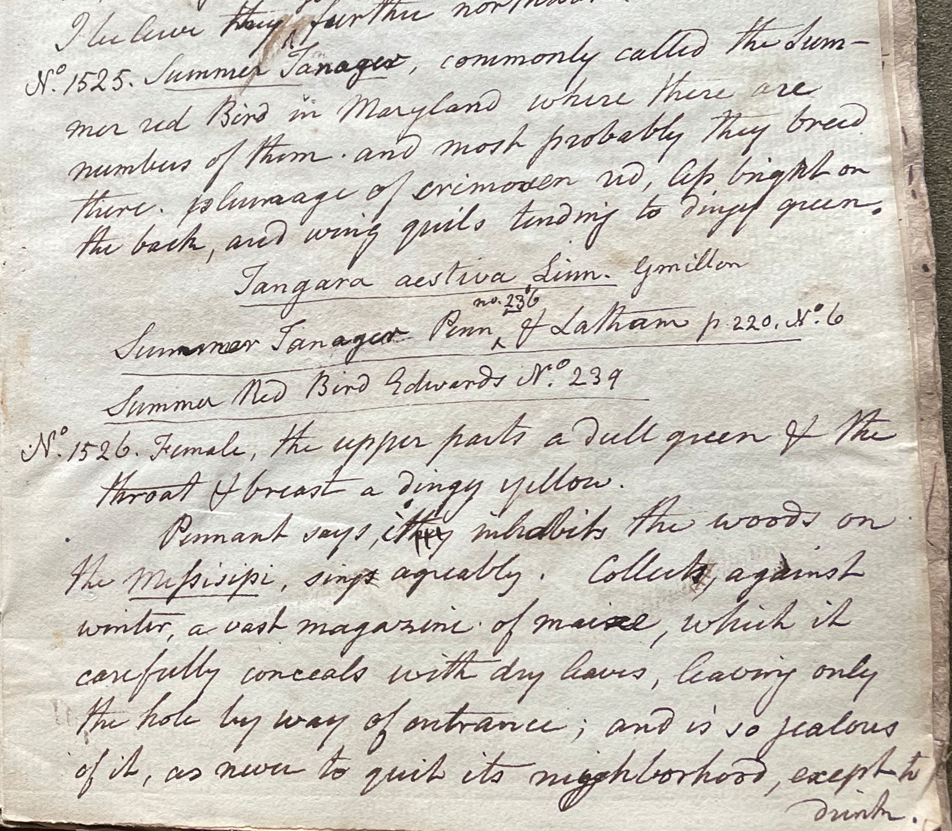
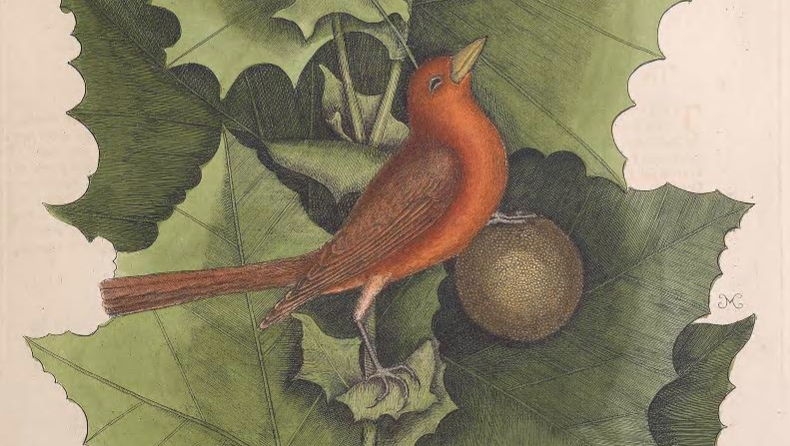
Peale wrote, in his 33rd Lecture (ca. 1799): "No. 1525. Summer Tanager, commonly called the Summer red Bird in Maryland where there are numbers of them, and most probably they breed there. plumage of crimson red, less bright on the back, and wing quils tending to dingy green. Tangara aestiva Linn. Gmillon. Summer Tanager Penn. No. 236. & Latham p. 220. No. 6. Summer Red Bird Edwards No. 239. No. 1526. Female, the upper parts a dull green & the throat & breast a dingy yellow. Pennant says, it inhabits the woods on the Missisipi, sings agreably. Collects, against winter, a vast magazine of maize, which it carefully conceals with dry leaves, leaving only the hole by way of entrance; and is so jealous of it, as never to quit its neighborhood, except to drink. They do not come much father north than Maryland. I have never found them in my hunting excursions near Philada. We have said before that it is not a good custom to name a subject after a particular place, unless it shall be found only to inhabit such place. It is equally improper to call this bird Summer Tanager, or Summer Red bird, as it is found in the winter on theMississippi. Perhaps it would be better to call it the Crimson Tanager, as the plumage of this has that tinge compared to the Red [Scarlet] Tanager No. 1523. However, for the present I leave it with the name which Mr. Pennant & Latham give it." (Academy of Natural Sciences of Drexel University Archives, coll. 40)
Peale wrote, in "A Walk Through the Philad[elphi]a Museum" (1805–1806): "The same contrast [between the sexes of Scarlet Tanager, P. olivacea] holds between the male & female in the summer Tanager (T. Aestiva) but the plumage of this male has more of a crimson hue. very few of these come so far north as Pennsylvania, they breed in Maryland, and winter near the Missisipi." (Historical Society of Pennsylvania, coll. 0481)
Peale wrote in a letter to his son, Rembrandt Peale (1778-1860), on 8 May 1805: "I got there [Carpenter Point, Maryland] two Summer Tangara's (males)" (American Philosophical Society Library, Peale-Sellers Family Collection, Mss.B.P31).
Alexander Wilson (1766-1813) described this species under the name "Summer Red-Bird / Tanagra aestiva" in American Ornithology vol. 1 (Pl. 6), where "Peale's Museum No. 6134" was cited (Wilson 1808: 95). / https://www.biodiversitylibrary.org/item/175530#page/119/mode/1up (text) / https://www.biodiversitylibrary.org/item/175530#page/111/mode/1up (plate)
Five specimens (4 mounted, 1 unmounted) of "Tanagra aestiva (Summer Red Bird)" were listed in "A Catalogue of Duplicate Specimens...", May 1822. [unpublished] American Philosophical Society Library (Mss.B.P31).
Notes:
Witmer Stone (1866-1939) was evidently unaware of the extent of Peale's collection and his collecting effots at Cape May and Delaware, in the late 18th century, when preparing his classic work, Bird studies at Old Cape May, Philadelphia: Delaware Valley Ornithological Club). In his second volume, Stone (1937: 881) assumed that Wilson's (1808) account was the earliest for this species, lamenting: "The Summer Tanager seems to have been very much more plentiful in southern New Jersey on hundred years ago than it is today and we have but meager information on its decrease ... Whether it was as plentiful as Wilson infers may be open to question as it is difficult to explain how such a bird should have been practically exterminated." Stone's suspicion seems well founded because Peale, who collected extensively in southern New Jersey before Wilson, acquired most of his specimens in Maryland, and wrote (ca. 1799): "They do not come much father north than Maryland. I have never found them in my hunting excursions near Philada."
Specimen Type:
Dead/preserved
Current Common Name:
Summer Tanager
Current Scientific Name
Cardinalidae | Piranga rubra