Object Status:
Extant
Accession Date:
By 1799
Primary Source Reference:
Charles Willson Peale, Lecture on Natural History 21. (ca. 1799). Academy of Natural Sciences of Drexel University Archives, coll. 40. / https://ansp.org/research/library/archives/0000-0099/coll0040/
Additional Source Text:
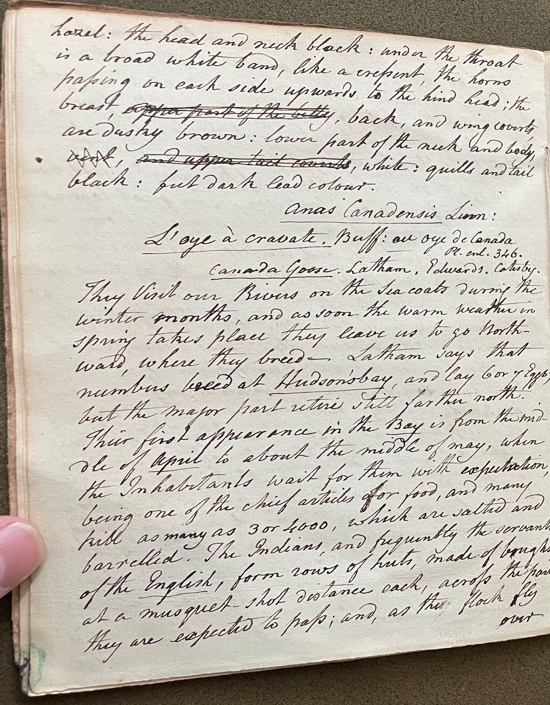
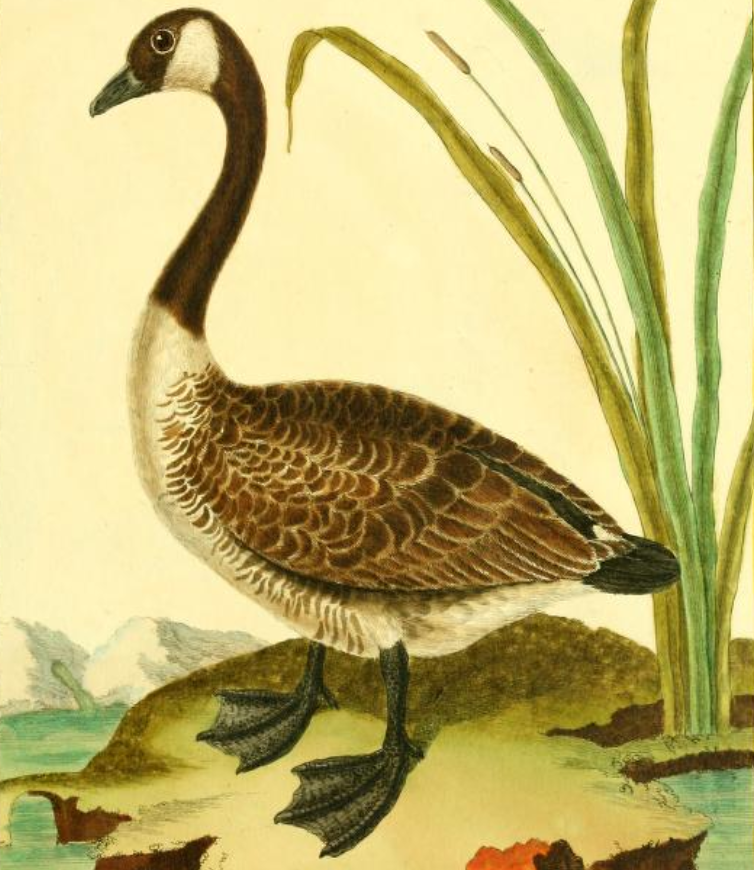
Charles Willson Peale (1741-1827) wrote, in his 21st Lecture (ca. 1799): "[No.] 484. Canada Goose. It is bigger than the tame goose. The Bill is two Inches & ½ long, and black; irides hazel; the head and neck black; under the throat is a broad white band, like a crescent, the horns passing on each sude upwards to the hind head; the breast, back, and wing coverts are dusky brown; lower part of the neck and body, black; feet dark lead colour. Anas Canadensis Linn. L'oye a cravate. Buff. ou oye de Canada. pl. enl. 346. Canada Goose. Latham. Edwards. Catesby." (Academy of Natural Sciences of Drexel University Archives, coll. 40)
Peale continued: "They visit our Rivers on the Sea Coasts during the winter months, and as soon [as] the warm weather in spring takes place they leave us to go northward, where they breed. Latham says that numbers breed at Hudson's Bay, and lay 6 or 7 Eggs, but the major part retires still farther north. Their first appearance in the Bay is from the middle of April to about the middle of May, when the Inhabitants wait for them with expectations, being one of the chief articles for food, and many kill as amny as 3 or 4000, which are salted and barreled." (ANSP Archives, coll. 40)
Peale continued: "The Indians, and frequently the servants of the English, form rows of huts, made of long […] at a musquet-shot distance each, across the […] they are expected to pass; and, as the flock flys over, they mimic their noise so well as to stop the geese in their flight; when each Person, having two guns, fires the first, and directly after the second; by this means a good marksman has been known to kill two hundred in a day. In this sport they must be very cautious to secrete themselves, for the birds are very shy, and, on the least motion, fly off. On their return south, which is from the middle of August to the middle of October, much havoc is made among them, but these are preserved fresh for winter store, by putting them, feathers and all, into a large hole dug in the ground, and covering them with mould; and these, during the whote time of the frosts, are found perfectly sweet and good. The feathers constitute an article of commerce, and are sent into England. [A footnote mentions this information was sourced from Latham and Pennant.]" (ANSP Archives, coll. 40)
Peale wrote, in "A Walk Through the [Philadelphia] Museum" (1805–1806): "The Canadian Goose (A. Canadensis) is also larger than our tame geese. They visit us only in the winter season, and go in the spring to northern parts of America to breed – and form a considerable part of the food of those who inhabit the settlements on Hudson Bay. The loquasity [sic] of these animals induced the Ancients to give the name of Goose to indiscreet pratlers." (Historical Society of Pennsylvania, coll. 0481)
Alexander Wilson (1766-1813) described this species under the name "Canada Goose / Anas canadensis" in American Ornithology vol. 8, published posthumously (Pl. 67), where "Peale's Museum, No. 2704" was cited (Wilson 1814: 53). / https://www.biodiversitylibrary.org/item/175758#page/67/mode/1up (text) / https://www.biodiversitylibrary.org/item/175758#page/62/mode/1up (plate)
Specimen Type:
Dead/preserved
Current Common Name:
Canada Goose
Current Scientific Name
Anatidae | Branta canadensis