Object Status:
Unlocated
Accession Date:
By 1799
Primary Source Reference:
Charles Willson Peale, Lecture on Natural History 32. (ca. 1799). Academy of Natural Sciences of Drexel University Archives, coll. 40. / https://ansp.org/research/library/archives/0000-0099/coll0040/
Additional Source Text:
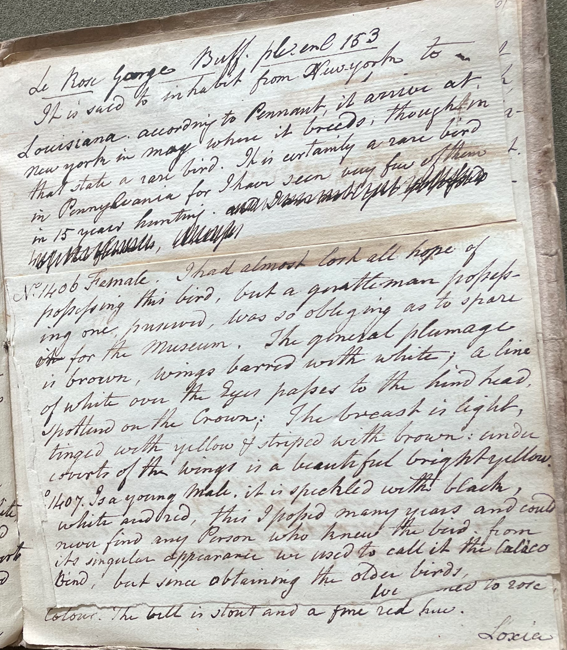
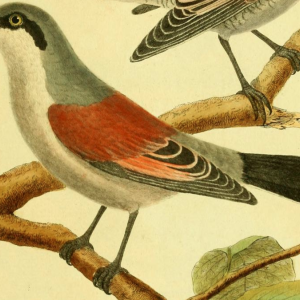
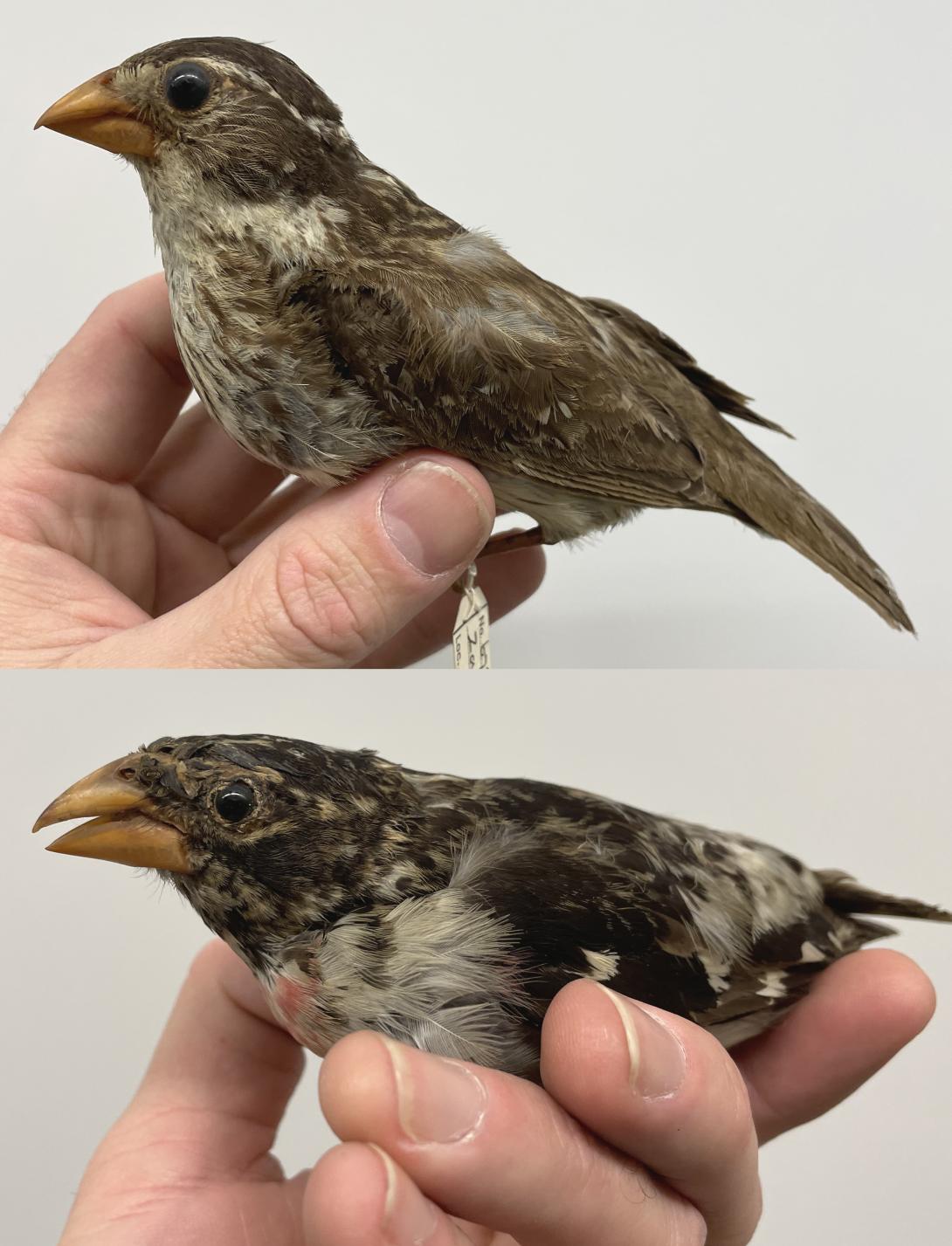
Charles Willson Peale (1741-1827) wrote, in his 32nd Lecture (ca. 1799): "No. 1405. Rose-breasted Grossbeak. The head, chin and back, deep black; wings barred with white; tail black with the inner web of the outward feathers white; the breast and the inner coverts of the wings of a fine rose colour, or nearly blood red. Loxia ludoviciana Linn. Le Rose Gorge Buff. pl. enl. 153. It is said to inhabit from New York to Louisiana. According to Pennant, it arrives at New York in May where it breeds, though in that state a rare bird. It is certainly a rare bird in Pennsylvania for I have seen very few of them in 15 years hunting. No. 1406. Female. I had almost lost all hope of possessing this bird, but a gentleman possessing one preserved, was so obliging as to spare it for the Museum." (Academy of Natural Sciences of Drexel University Archives, coll. 40)
Peale continued: "The general plumage is brown; wings barred with white; a line of white over the eyes passes to the hind head; spotted on the crown; the breast is light, tinged with yellow & striped with brown; under coverts of the wings is a beautiful bright yellow. No. 1407 is a young Male. It is speckled with black, white and red. This I possessed many years and could never find any Person who knew the bird, from its singular appearance we used to call it the Calico Bird, but since obtaining the older birds, we know it to be a young bird of the first year. It is not uncommon in many species of birds to find them spotted before their first moulting." (ANSP Archives, coll. 40)
Peale wrote, in "A Walk Through the Philad[elphi]a Museum" (1805–1806): "The most beautiful we possess is the Rose Breast Gross beak (L. Ludoviciana). The female of which is very different being dressed with brown & white." (Historical Society of Pennsylvania, coll. 0481)
Alexander Wilson (1766-1813) described this species under the name "Rose-breasted Grosbeak / Loxia rosea" in American Ornithology vol. 2 (Pl. 17), where "Peale's Museum No. 5806, male—[and] 5807, female—[and] 5806 A, male of one year old" were cited (Wilson 1810: 135). / https://www.biodiversitylibrary.org/item/175511#page/155/mode/1up (text) / https://www.biodiversitylibrary.org/item/175511#page/152/mode/1up (plate)
Charles Lucien Bonaparte (1803–1857) described this species under the name "Rose-breasted Grosbeak / Fringilla ludoviciana" in his continuation of American Ornithology vol. 2 (1828, Pl. 15), where the same Peale numbers ("Philadelphia Museum, No. 5806, Male; [and] 5807, Female") were cited (Bonaparte 1828: 79). Whether the female in his Plate 15, which was engraved by Alexander Lawson (ca. 1772-1846) after a drawing by Alexander Rider, was based on Peale's original female specimen (i.e., donated by the "gentleman") is uncertain. / https://search.library.wisc.edu/digital/AFKPEJIASN54OC8L/pages/ACWZMFDI… (text) / https://search.library.wisc.edu/digital/AFKPEJIASN54OC8L/pages/ATIEYCCT… (plate)
Two mounted and one unmounted specimen of "Loxia ludoviciana (Rosebreasted G)" were listed in "A Catalogue of Duplicate Specimens...", May 1822. [unpublished] American Philosophical Society Library (Mss.B.P31).
Notes:
After Peale's Museum closed, a portion of Peale's bird collection was purchased in 1850 by Moses Kimball (1809–95), who displayed it at his "Boston Museum". An advertisement in the Boston Transcript, printed 1 October 1850, stated that Kimball had acquired "One Half of the celebrated Peale's Philadelphia Museum". The other half of Peale's birds had been sold to the circus promoter P. T. Barnum (1810–91) and would be subsequently destroyed in a fire at his "American Museum" in New York City in July 1865. When the Boston Museum closed, Kimball's Peale remnants passed temporarily to the Boston Society of Natural History, who disposed of them to Charles J. Maynard (1845-1929), a local taxidermist. The specimens were stored in a barn in Massachusetts for several years, then eventually were deposited at the Museum of Comparative Zoology (MCZ), Harvard University. By the time the collection was catalogued by Walter Faxon (1848-1920) at MCZ, in 1914, in virtually every case the original mounts and labels had been disassociated from the specimens, and an untold number were lost. Walter Faxon, "Relics of Peale's Museum," Bulletin of the Museum of Comparative Zoology, 59, no. 3 (July 1915): 138, thought it was "extremely probable" that three data-deficient specimens (MCZ 67862-67864) from the Boston Museum collection were the specimens cited by Wilson (1810); and that MCZ 67864 (male) should "be accepted without doubt as the figured type of Loxia rosea Wils." However, those specimens were apparently mounted in the museum by 1799, and Wilson (1810: viii, American Ornithology, vol. 2) clearly stated that "no drawings have been, or will be made for this work, from any stuffed subjects, where living specimens of the same can be procured; yet the former serve a very important purpose; they enable the author to ascertain the real existence and residence of such subjects". / https://www.biodiversitylibrary.org/item/175511#page/14/mode/1up Wilson (1810: 135) wrote of the adult male Rose-breasted Grosbeak: "The bird from which the figure on the plate was taken, was shot, late in April, on the borders of a swamp, a few miles from Philadelphia. Another male of the same species was killed at the same time, considerably different in its markings; a proof that they do not acquire their full colors until at least the second spring or summer." However, Peale's lecture account demonstrates that Wilson was not the first to acquire that knowledge. Like the adults, the immature bird cited by Wilson ("[Peale's Museum No.] 5806 A") was Peale's original specimen. Wilson deposited many specimens at Peale's Museum, after completing his drawings, but the combined evidence from American Ornithology and the Peale Museum Accessions Book (Historical Society of Pennsylvania, coll. 0481) suggests that it was probably fewer than 50 skins, whereas many authors have assumed that all the "Peale numbers" cited in Wilson's work were those of his own specimens (e.g., "he contributed 279 specimens to the collection", Edward H. Burtt, Jr., and William E. Davis, Jr., 2013, Alexander Wilson: The Scot Who Founded American Ornithology, Belknap Press, p. 310). This assumption appears to be based on a misunderstanding — Wilson was citing the numbers to give credit to Peale, to acknowledge his contributions, not to stake a claim to his own specimen deposits. To the editor's (MRH) knowledge, there is no evidence that Wilson deposited a Rose-breasted Grosbeak at Peale's Museum.
Specimen Type:
Dead/preserved
Current Common Name:
Rose-breasted Grosbeak
Current Scientific Name
Cardinalidae | Pheucticus ludovicianus
Repository:
Museum of Comparative Zoology, Harvard University (MCZ 67862–67864)