Object Status:
Extant
Accession Date:
By 1799
Primary Source Reference:
Charles Willson Peale, Lecture on Natural History 33. (ca. 1799). Academy of Natural Sciences of Drexel University Archives, coll. 40. / https://ansp.org/research/library/archives/0000-0099/coll0040/
Additional Source Text:
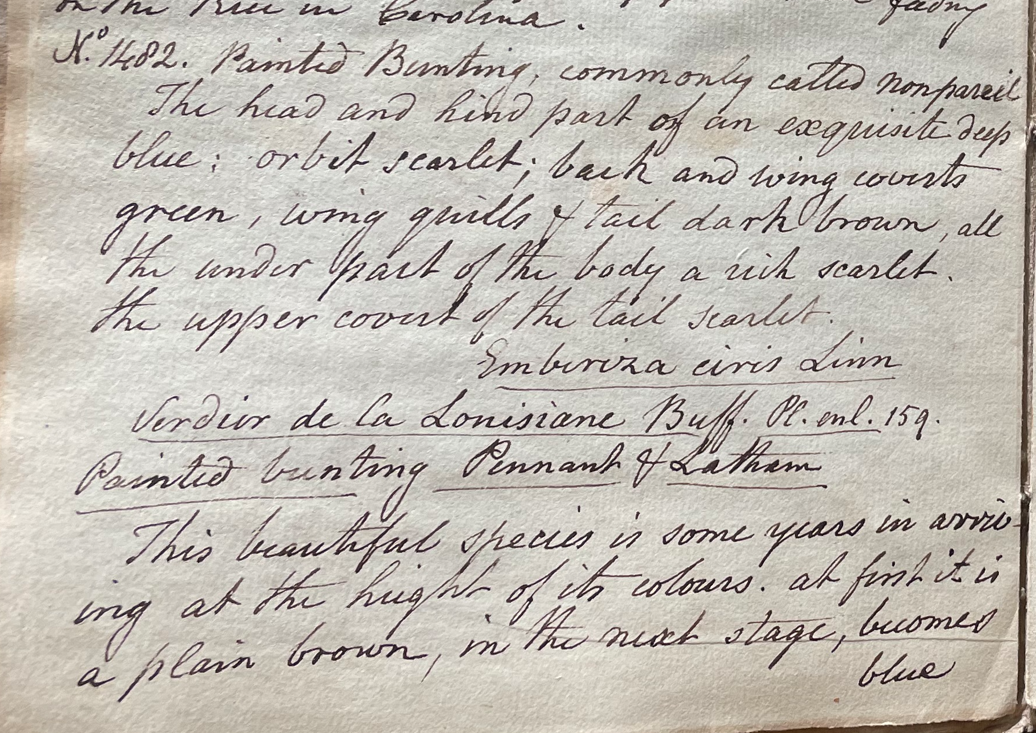
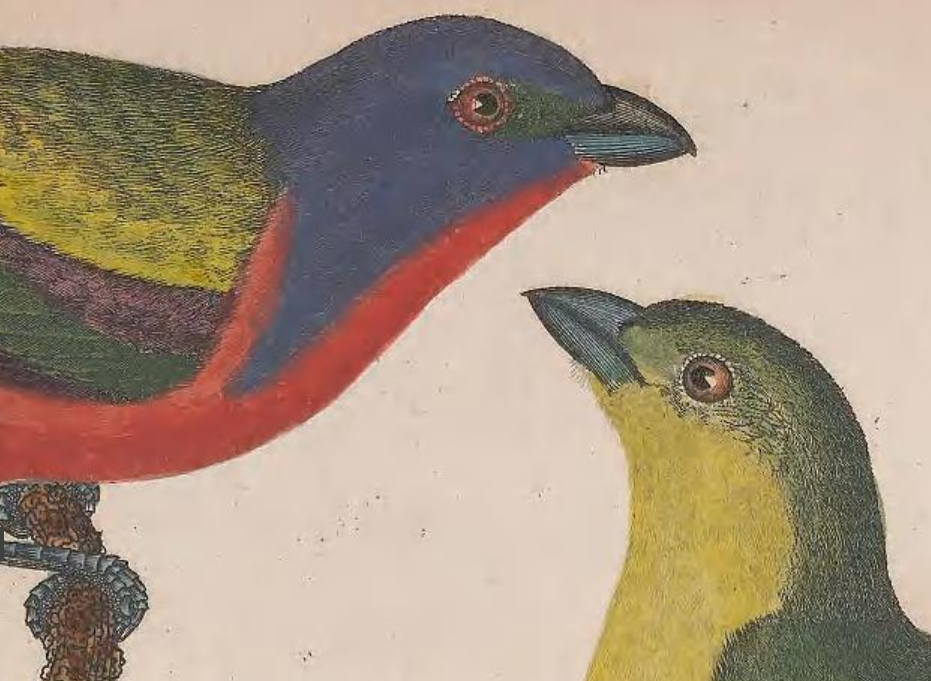
Charles Willson Peale (1741-1827) wrote, in his 33rd Lecture (ca. 1799): "No. 1482. Painted Bunting, commonly called Nonpareil. The head and hind part of an exquisite deep blue; orbit scarlet; back and wing coverts green, wing quills & tail dark brown, all the under part of the body a rich scarlet. the upper coverts of the tail scarlet. Emberiza ciris Linn. Verdier de la Louisiane Buff. pl. enl. 159. Painted bunting Pennant & Latham. This beautiful species is some years in arriving at the height of its colours. at first it is a plain brown, in the next stage, becomes blue; in the 3d, attains the perfection of its gay teints. I have known one which was brought into this City possessing all this variety of colours, which the first molting after became yellow, and 2 years that it lived and never obtained its former dress; how this change happened, whether caused by a change of climate, or a more advanced age, remains a question to be decided. The female is brown, and has over its plumage a tinge of green. Inhabits Carolina in the summer, but migrates in winter perhaps as far as Vera Cruz, in Spanish America [i.e., Mexico], where the Spaniards call it Mariposa pintada, or the painted butterfly. They build their nests in orange Trees." (Academy of Natural Sciences of Drexel University Archives, coll. 40)
Peale wrote, in "A Walk Through the Philad[elphi]a Museum" (1805–1806): "For beauty of plumage, the Nonpariel (Emberiza ciris), or Snow [sic] bunting, is by far the most brilliant in Colours of any of this genus of birds. They are brought to us from south Carolina." (Historical Society of Pennsylvania, coll. 0481)
Alexander Wilson (1766-1813) described this species under the name "Painted Bunting / Emberiza ciris" in American Ornithology vol. 3 (Pl. 24), where "Peale's Museum, No. 6062, and 6063" was cited (Wilson 1811: 68). / https://www.biodiversitylibrary.org/item/175516#page/82/mode/1up (text) / https://www.biodiversitylibrary.org/item/175516#page/83/mode/1up (plate)
Specimen Type:
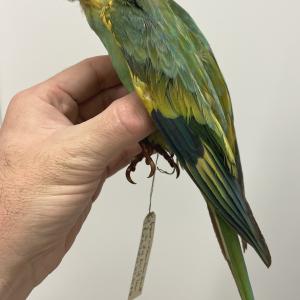
Dead/preserved
Current Common Name:
Painted Bunting
Current Scientific Name
Cardinalidae | Passerina ciris