Object Status:
Extant
Accession Date:
By 1799
Primary Source Reference:
Charles Willson Peale, Lecture on Natural History 17. (ca. 1799). Academy of Natural Sciences of Drexel University Archives, coll. 40. / https://ansp.org/research/library/archives/0000-0099/coll0040/
Additional Source Text:
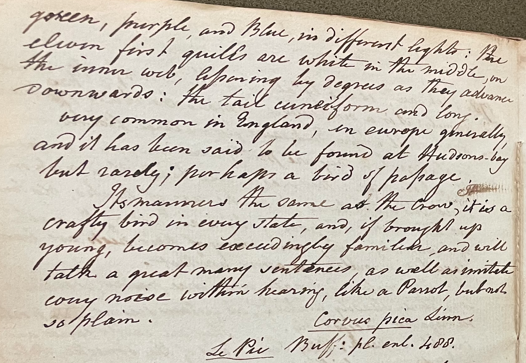
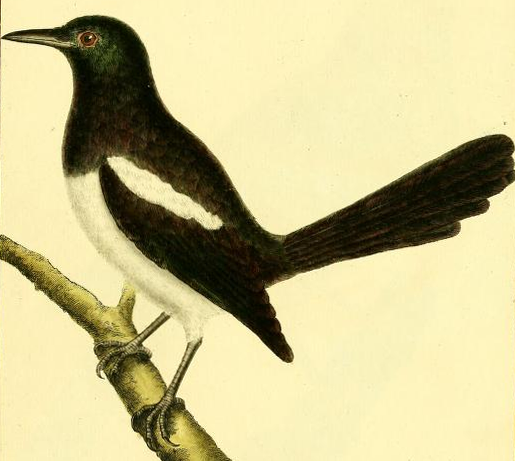
Charles Willson Peale (1741-1827) wrote, in his 17th Lecture (ca. 1799): "No. 179. Magpie. It is smaller than the Jackdaw. The bill black; irides hazel; the scapulars, and all the upper parts of the Belly white; the rest of the plumage is Black, glossed with green, purple, and Blue, in different lights; the elevent first quills are white in the middle, on the inner web, lessening by degrees as they advance downwards; the tail cuneiform and long. Very common in England, in Europe generally, and it has been said to be found at Hudsons Bay but rarely; perhaps a bird of passage. Its manners [are] the same as the crow; it is a crafty bird in every state, and, if brought up young, becomes exceedingly familiar, and will talk a great many sentences, as well as imitate every noise within hearing, like a Parrot, but not so plain. Corvus pica Linn. Le Pie Buff. pl. enl. 488. (Academy of Natural Sciences of Drexel University Archives, coll. 40)
Two mounted specimens of "Corvus pica (Magpie)" from Europe were listed in "A Catalogue of Duplicate Specimens...", May 1822. [unpublished] American Philosophical Society Library (Mss.B.P31).
Specimen Type:
Dead/preserved
Current Common Name:
Eurasian Magpie
Current Scientific Name
Corvidae | Pica pica