Object Status:
Extant
Accession Date:
By 10 September 1793
Primary Source Reference:
Charles Willson Peale, diary entry dated 10 September 1793; Selected Papers, 2, part 1: 60.
Additional Source Text:
Charles Willson Peale (1741-1827) wrote in his diary on 10 September 1793, during a collecting trip to Cape Henlopen, Delaware: "after doing something to make Mr. Borleys Gun shoot better (for she had a crook to the left) I went out with her, and shot at a White Crain, which had cost me some labour to come within gunshot, this I mist, afterwards, I went round a large savana, and and crawled on my hands & knees in a corn field where I found considerable quantities of sand-burs, the first I observed of them was by puting my hand on a bunch, when pricked severely, attempting to pull them off they stick fast into my fingers and it was some minutes before I could disengage myself from them and at expence of leaving some of the points in my hand that had rested on them, afterward I was so careful as to pull up those that I could not avoid without shewing myself, for about 150 yards I moovd in this manner, but I secured my bird" (Miller 1988: 60, Selected Papers, Vol. 2, part 1, Yale University Press).
The following day, while Peale was mounting his "White Crain", his son Titian Peale I (1780–1798) brought two more specimens into camp; "I mounted a 2d After dinner," Peale wrote (Miller 1988: 60). On 13 September 1793, Peale wrote: "The morning I went down the creek with Titian in a boat, we shot some will-willets snipe & 2 crains [Ardea alba], both of which are valuable, as being in some measure new, I have none such in the Museum" (Miller 1988: 61).
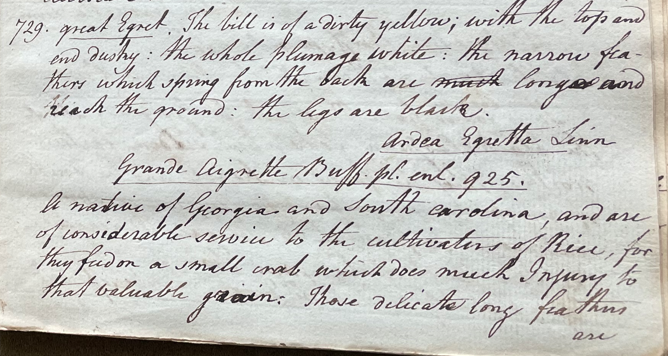
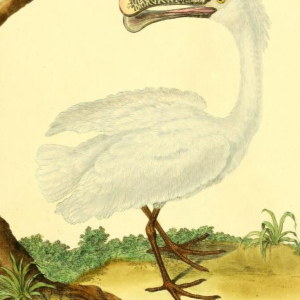
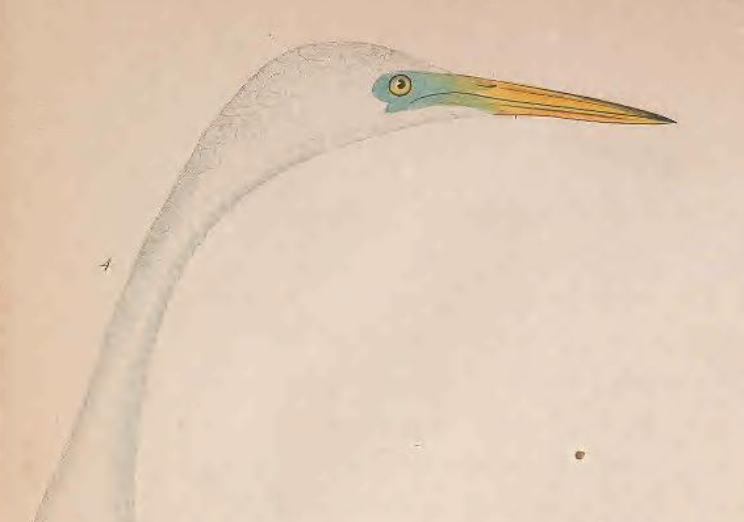
In his 25th Lecture, C. W. Peale first described an adult specimen of this species: "729. Great Egret. The bill is of a dirty yellow; with the top and end dusky; the whole plumage white; the narrow feathers which spring from the back are much longer and reach the ground; the legs are black. Ardea Egretta Linn. Grade Aigrette Buff. pl. enl. 925. A native of Georgia and South Carolina, and are of considerable service to the cultivators of Rice, for they feed on a small crab which does much Injury to that valuable grain. Those delicate long feathers are worn as an ornamental head dress. They are also found at Cayenne, Guiana, and other parts of South America. They delight in living on the borders of fresh water rivers & ponds, and are not found on salt water rivers or the sea shore. They do not collect in flocks, and are very shy. Monsr. Bougainville met with Egrets in the Faukland Islands. Towards night they make a harsh barking noise." (Academy of Natural Sciences of Drexel University Archives, coll. 40)
Peale wrote, in the same lecture: "745. White Crain. This bird is nearly allied to the great Egret No. 729. I should not hesitate to pronounce it to be of the same species, though in a younger state. Had not the bill been intirely white, as it is, except a little dusky near the tip of the upper mandible. And as far as my observation has yet extended, I do not find that the bills of birds become darker when they arrive at full maturity, but on the contrary, very frequently become white. The instance I gave you of the change of colour in the bill of the White headed Eagle [i.e., Bald Eagle, Haliaeetus leucocephalus]; from a dark brown to a cream-coloured white at the age of 5 years, is very striking. Comparing the colour of the bills of hese two birds, the difference is considerable. This [specimen] was alive in my yard a long time, and I was much pleased to see those slender feathers beginning to appear on its back. had I been able to have preserved it alive one other year, I doubt not that it would have had them equally long as those of the Great Egret. This species is frequently seen about the shores of the Schoolkill [River] in the proper season." (ANSP Archives, coll. 40)
Peale later wrote in "A Walk Through the Philad[elphi]a Museum" (1805–1806): "The Great Egret (a. agretta) is an elegant Bird. Those delicate long feathers from its back have been coveted as ornaments of Head dress. It is a native of south Carolina & Georgia said to be of important service to the cultivators of Rice as they feed on small crab which does much injury to that valuable grain. The little Egret [E. thula] is not less beautiful having those delicate feathers turning up, a contrast to the others hanging down in a trail" (Historical Society of Pennsylvania, coll. 0481).
Alexander Wilson (1766-1813) described this species under the name "Great White Heron / Ardea egretta" in American Ornithology vol. 7 (Pl. 61), where "Peale's Museum, No. 3754,—[and] Young, 3755" were cited (Wilson 1813: 106). / https://www.biodiversitylibrary.org/item/175507#page/124/mode/1up (text) / https://www.biodiversitylibrary.org/item/175507#page/114/mode/1up (plate)
Notes:
Peale's collecting efforts at Cape Henlopen were overlooked by compilers of Delaware bird records, prior to this study (Gene K. Hess, in litt. 10 February 2024).
Specimen Type:
Live (later taxidermied)
Current Common Name:
Great Egret
Current Scientific Name
Ardeidae | Ardea alba