Object Status:
Extant
Accession Date:
By October 1805
Primary Source Reference:
Thomas Jefferson, letter to Charles Willson Peale, dated 6 October 1805; Selected Papers, 2, part 2: 894.
Additional Source Text:
Meriwether Lewis (1774-1809) sent two individuals to Thomas Jefferson (1743-1826), who listed them (one living, one dead) in a letter to Charles Willson Peale (1741-1827) on 6 October 1805 (Miller 1988: 894, Selected Papers, Vol. 2, Part 2, Yale University Press).
Jefferson wrote, in a subsequent letter to Benjamin Smith Barton (1766-1815) on 21 November 1805: "Mr. Peale informs me that the Missouri magpie is precisely the same with the European. I had not expected this, tho' I never had observed the magpie of Europe, because the descriptions speak of the blue & red hues of the wings & tail, which I had not observed in the Missouri magpie." (Historical Society of Pennsylvania, Dreer Collection, Box 303).
Barton ("The Editor") wrote in The Philadelphia Medical and Physical Journal (1806: 161): "The Corvus Pica, or Magpie, has lately been discovered in the country that is washed by the Missouri, at a considerable distance from the mouth of this rivier, and a specimen of it has been transmitted to the Museum of Mr. Peale."
On 7 February 1806, a notice in the United States Gazette (Philadelphia) announced Jefferson's donation of "A living Magpye from Louisiana. This is one of the articles forwarded to the president by captain Lewis, from the Missouri, where they are said to be plenty. It is very extraordinary that whereas the animals of Europe and America differ essentially, the Mag-pye is precisely the same as the European, and until now was never proved to belong to this country."
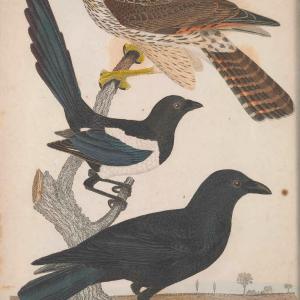
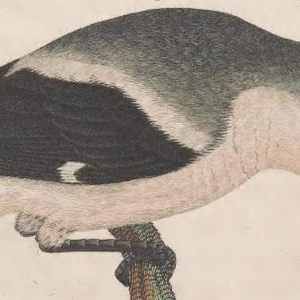
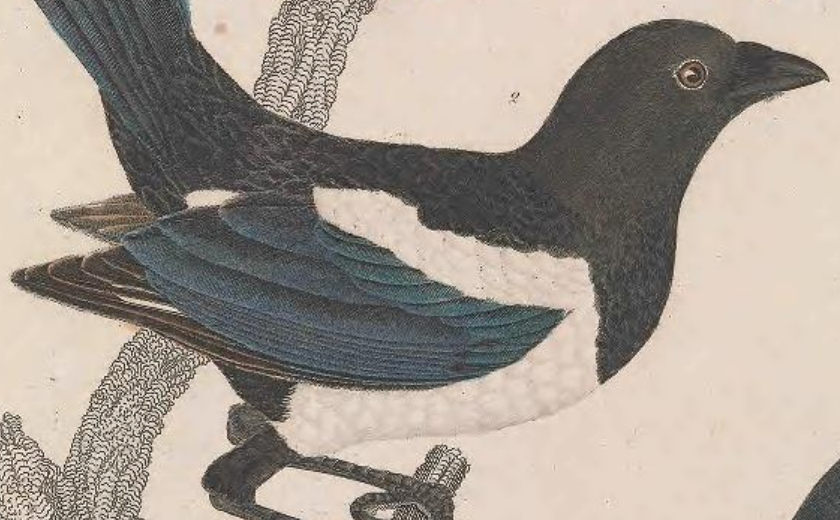
Alexander Wilson (1766-1813) described and illustrated one of Lewis's specimens under the name "Magpie / Corvus pica" in American Ornithology vol. 4 (Pl. 35), where "Peale's Museum, No. 1333" was cited (Wilson 1811: 75). Wilson stated that his drawing was "taken from a very beautiful specimen, sent from the Mandan nation, on the Missouri, to Mr. [Thomas] Jefferson, and by that gentleman to Mr. Peale of this city [Philadelphia], in whose Museum it lived for several months, and where I had the opportunity of examining it." / https://www.biodiversitylibrary.org/item/175531#page/95/mode/1up (text) / https://www.biodiversitylibrary.org/item/175531#page/92/mode/1up (plate)
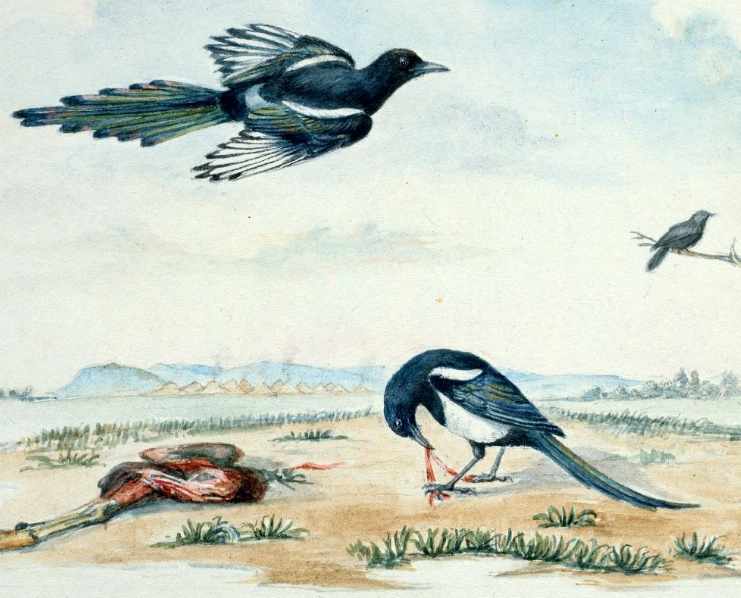
Titian Ramsay Peale (1799-1885) deposited specimens of "4 Magpies" and one "finished" drawing of "Magpies" on 23 March 1821, after returning from the Long Expedition, according to the Peale Museum Accessions Book, p. 112 (Historical Society of Pennsylvania, coll. 0481). Titian's field drawing (shown here) is dated 29 June 1820 (American Philosophical Society Library, Mss.B.P31.15d).
One unmounted specimen of "Corvus pica (Magpie)" from Missouri was listed in "A Catalogue of Duplicate Specimens...", May 1822. [unpublished] American Philosophical Society Library (Mss.B.P31).
Notes:
This species was presumed to be conspecific with the Eurasian Magpie (Pica pica) until the 1820s, when the American species was distinguished as Corvus hudsonius (now Pica hudsonia) by Joseph Sabine (1770-1837) in J. Franklin, 1823, Narrative of a journey to the shores of the Polar Sea, in the years 1819, 20, 21, and 22, London: J. Murray. / https://www.biodiversitylibrary.org/page/32215478#page/761/mode/1up Here, for simplicity, we state that Titian R. Peale (1799-1885) deposited the Long Expedition specimens at Peale's Museum. However, it should be noted that the specimens did not belong to Titian, and were not his to give away. Officially, they were the property of the United States government, and as such were formally deposited by Major Stephen Harriman Long (1784-1864), who led the government-sponsored expedition. The Peale Museum Accessions Book, pp. 112-113 (Historical Society of Pennsylvania, coll. 0481) contains an "Invoice of Zoological Specimens and Drawings prepared by Titian Peale, Assistant Naturalist for the Exploring Expedition, and deposited in the Philadelphia Museum by Majr. S. H. Long, Maj. U.S. Engr. pursuant to instructions of the Secretary of War." At the conclusion of the invoice, "Rubens Peale [1784-1865], manager" signed the following statement: "Received, Philadelphia Museum, March 23d. 1821. of Majr. S. H. Long, the several articles, specified in the above Invoice, as a deposit for safe keeping, preservation and Exhibition; and I hereby promise, as agent for the Institution to hold the said articles subject to the orders of the War Department, thru the said Maj. Long." (HSP, coll. 0481)
Specimen Type:
Live (later taxidermied)
Current Common Name:
Black-billed Magpie
Current Scientific Name
Corvidae | Pica hudsonia