Object Status:
Extant
Accession Date:
By 1799
Primary Source Reference:
Charles Willson Peale, Lecture on Natural History 33. (ca. 1799). Academy of Natural Sciences of Drexel University Archives, coll. 40. / https://ansp.org/research/library/archives/0000-0099/coll0040/
Additional Source Text:
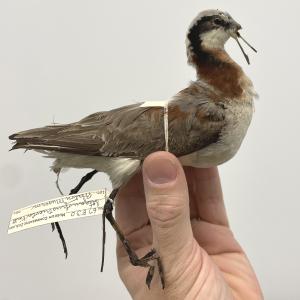
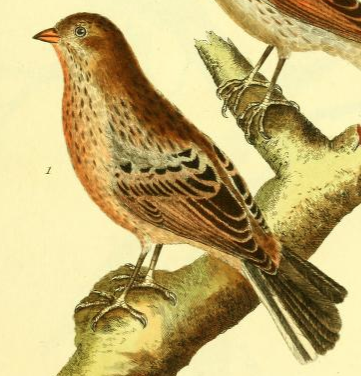
Charles Willson Peale (1741-1827) wrote, in his 33rd Lecture (ca. 1799): "No. 1489. Reed Bunting. with a black head and throat; cheeks and head encircled with white; body rusty striped with black; beneath white. No. 1490. Female. the same rusty colour, & striped with black, but wants the white ring & black head. Emberiza schoeniclus Linn. L'Ortolan du roseaux Buff. pl. enl. 247. f. 1. They inhabit marshy places, most commonly among reeds. Its nest is worthy of notice for its artful contrivance, being fastened to four reeds, and suspended by them like a hammock about 3 feet above the water; the cavity of the nest deep, and narrow, and the materials [are] rushes, bent grass and hairs. It lays 4 or 5 eggs, of a bluish white, marked with irregular purplish veins. Its song nocturnal & sweet." (Academy of Natural Sciences of Drexel University Archives, coll. 40)
Peale continued: "They are found in Great Britain & as far north as Denmark, sometimes in Sweden; very common in the south of Russia & Sibiria. No. 1491 is a young male Reed Bunting. the head and throat has not yet abtained its full black colour. I give this as a specimen to shew that is necessary to examine other characters besides the marking of the plumage, to be able to determine with certainty on any subject. Altho here is the black beginning to appear, yet it is so faint as at least to make it doubtful, but having recourse to the character of the bill; the edges of the mandibles turning inwards, is so determined a character as to clear up every doubt, or uncertainty. Without paying attention to this character it is easy to mistake one of these birds for a sparrow, which has a bill generally about the same size." (ANSP Archives, coll. 40)
Peale wrote, in "A Walk Through the Philad[elphi]a Museum" (1805–1806): "Here we see the Reed-bunting (E. Schoeniclus) … They inhabit Europe generally." (Historical Society of Pennsylvania, coll. 0481).
A mounted male specimen of "Fringilla (Reed Sparrow)", which presumably referred to this species, was listed in "A Catalogue of Duplicate Specimens...", May 1822. [unpublished] American Philosophical Society Library (Mss.B.P31).
Specimen Type:
Dead/preserved
Current Common Name:
Common Reed Bunting
Current Scientific Name
Emberizidae | Emberiza schoeniclus