Object Status:
Extant
Accession Date:
By 5 December 1797
Primary Source Reference:
Charles Willson Peale, letter to Thomas Hall of Moorfields, London, dated 5 December 1797; Selected Papers, 2, part 1: 207.
Additional Source Text:
Charles Willson Peale (1741-1827) sent a "Carolina Cuckoo Cock" to Thomas Hall in London, in 1797, in exchange for European specimens (Miller 1988: 207, Selected Papers, Vol. 2, part 1, Yale University Press).
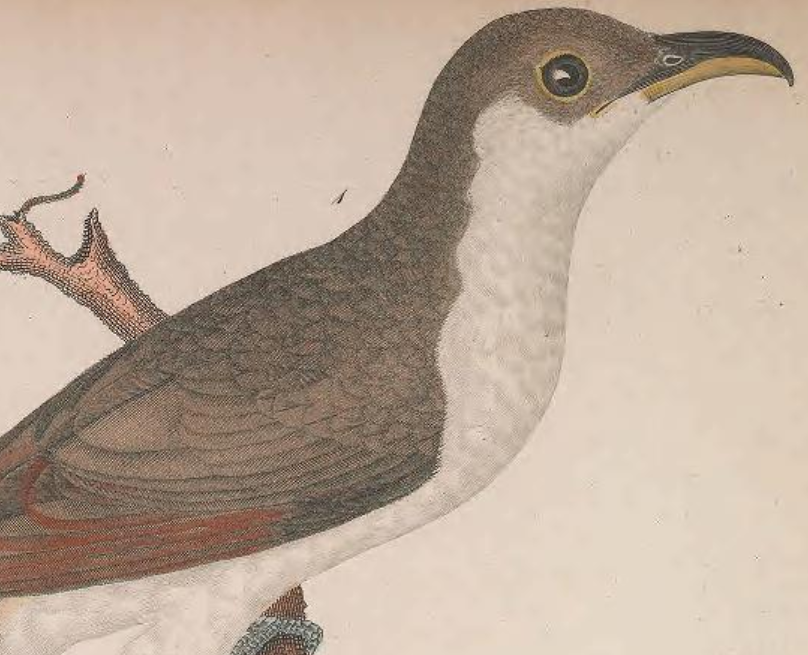
In his 18th Lecture, Peale wrote: "265. Carolina Cuckoo . These are described by all the most authors, perhaps generally taken from Catesby's plate. here the Bill has yellow at the base of the upper, and wholly yellow in the under mandible; the cenerious olive colour of the former Bird [i.e., Black-billed Cuckoo, C. erythropthalmus], but on the wings the difference of the quill feathers is striking; they are a pale rufous or rust colour. The tail much darker than the former and the white on the outer feathers is more lengthened. Cuculus americanus Linn. Carolina Cuckoo Catesby I. pl. 9. Le Coucou de la Caroline Buff. pl. enl. 816." (Academy of Natural Sciences of Drexel University Archives, coll. 40)
Peale continued: "[No.] 266. Female, no difference of the external form. Here, I feel a gratification; nay a pleasure, that I am able to show you this nest & Eggs belonging [to] hese American Cuckoo's [sic]. They build their own nest; they foster their young; they diligently chant their soft notes to sweeten the care of Incubation, and I am proud to believe, that they are faithful; and constant to each other. However bad the rapport on all the Cuckoo's, that are described yet here is one Instance of contrary manners, in those species of Birds. Perhaps by our enquires into the economy of the birds of South America, and other parts of the world, that other Cuckoo's, will also be found to differ from those of Europe." (ANSP Archives, coll. 40)
Peale wrote, in "A Walk Through the Philad[elphi]a Museum" (1805–1806): "Here are two species found in Pennsyla: one which we call the Black bill Cuckow is not described, besides the bill having none of the white on the under mandible, it is also without the pale rufous quil feathers of the Carolina Cuckow (C. americanus). Altho' the general appearance of the two species, are no very different, yet it is obvious that they are two species, & both of them are found in vicinity of Philada. They are placed in prs." (Historical Society of Pennsylvania, coll. 0481)
Alexander Wilson (1766-1813) described this species under the name "Yellow-billed Cuckoo / Cuculus carolinensis" in American Ornithology vol. 4 (Pl. 28), where "Peale's Museum, No. 1778" was cited (Wilson 1811: 13). / https://www.biodiversitylibrary.org/item/175531#page/19/mode/1up (text) / https://www.biodiversitylibrary.org/item/175531#page/8/mode/1up (plate)
Three unmounted specimens (2 males, 1 female) of "Cuculus Americanus (Carolina Cuckoo)" were listed in "A Catalogue of Duplicate Specimens...", May 1822. [unpublished] American Philosophical Society Library (Mss.B.P31).
Specimen Type:
Dead/preserved
Current Common Name:
Yellow-billed Cuckoo
Current Scientific Name
Cuculidae | Coccyzus americanus