Object Status:
Extant
Accession Date:
By 1 June 1797
Primary Source Reference:
Charles Willson Peale, letter to Étienne Geoffroy Saint-Hilaire (1772-1844) dated 1 June 1797; Selected Papers, 2, part 1: 204.
Additional Source Text:
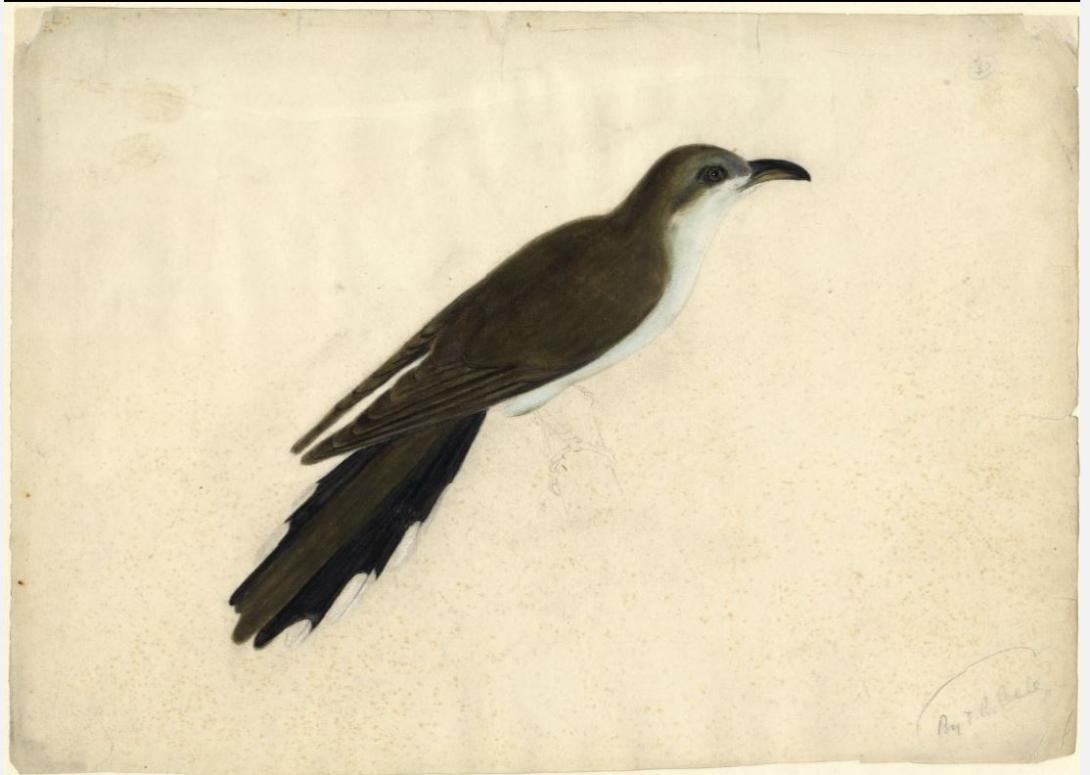
Charles Willson Peale (1741-1827) mentioned his discovery of this species in a letter dated 1 June 1797, addressed to Étienne Geoffrey Saint-Hilaire (1772-1844) of the Paris Museum: "I have been very successful with the feathered tribe, having procured several which appear quite new to me. We find that we I have found a variety of the Carolina Cuckoo, one kind is only described in Catesby" (Miller 1988: 204, Selected Papers, Vol. 2, Part 1, Yale University Press).
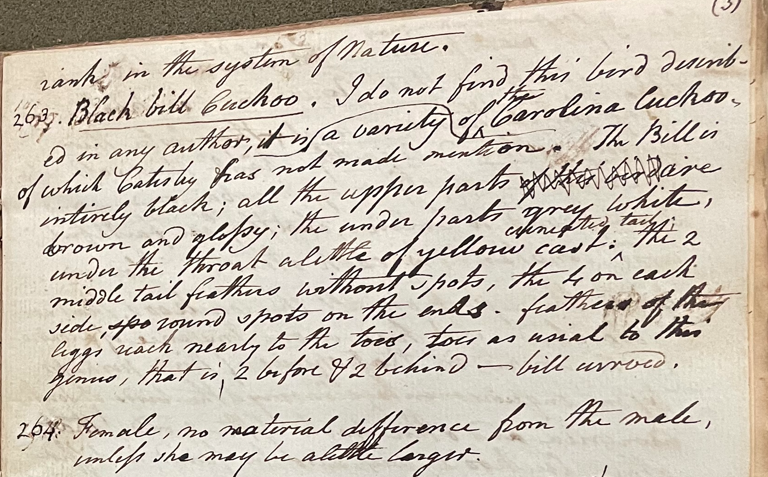
In his 18th Lecture, Peale wrote: "263. Black bill Cuckoo. I do not find this bird described in any author; it is a variety of the Carolina Cuckoo, of which Catesby has not made mention. The Bill is intirely black; all the upper parts of this bird are brown and glossy; the under parts grey white; under the throat a little of yellow cast; cuneated tail; the 2 middle tail feathers without spots the 4 on each side, round spots on the ends; feathers of the legs reach nearly to the toes; toes as usial to this genus, that is 2 before & 2 behind; bill curved. 264. Female, no natural difference from the male, unless she may be a little longer." (Academy of Natural Sciences of Drexel University Archives, coll. 40)
Peale wrote, in "A Walk Through the Philad[elphi]a Museum" (1805–1806): "Here are two species found in Pennsyla: one which we call the Black bill Cuckow is not described, besides the bill having none of the white on the under mandible, it is also without the pale rufous quil feathers of the Carolina Cuckow (C. americanus). Altho' the general appearance of the two species, are no very different, yet it is obvious that they are two species, & both of them are found in vicinity of Philada. They are placed in prs." (Historical Society of Pennsylvania, coll. 0481)
Alexander Wilson (1766-1813) described this species under the name "Black-billed Cuckoo / Cuculus erythropthalma" in American Ornithology vol. 4 (Pl. 28), where "Peale's Museum, No. 1854" was cited (Wilson 1811: 16). / https://www.biodiversitylibrary.org/item/175531#page/22/mode/1up (text) / https://www.biodiversitylibrary.org/item/175531#page/8/mode/1up (plate)
Notes:
Egerton (1962, Wilson Bulletin 74: 104-107), in a heated review of Cantwell (1961, Alexander Wilson: Naturalist and Pioneer, Philadelphia: J. B. Lippincott), wrote: "Mr. Cantwell shows that he has no understanding of procedures in systematics when he states that it is an injustice for Wilson to receive credit in ornithological literature for naming the Black-billed Cuckoo, which was pointed out to him by John Abbot [1751-1840]. "Credit" is not given to honor the finder, but to stabilize the name of the species, and it is only given for an adequate published description, which in this case never came from Abbot." / https://www.jstor.org/stable/4159031 With respect to scientific nomenclature, Egerton (1962) was correct. However, he may have softened his tone, had he realized the extent of Peale's knowledge, and that he had delivered an account of this species to a public audience. Wilson clearly learned about the Black-billed Cuckoo from Peale—not Abbot—because the species was already mounted by 1797 in the Philadelphia Museum, where Wilson first visited in 1804, but Wilson did not meet Abbott until 1809, during his travels in Georgia. / For the timing of these events, see Matthew R. Halley, 2022, "Rediscovery of the holotype of the American Goshawk, Accipiter gentilis atricapillus (Wilson, 1812), and a commentary about Alexander Wilson’s contributions to the Peale Museum", Proc. Acad. Nat. Sci. Philadelphia 167: 233-240. / https://doi.org/10.1635/053.167.0114 / and Clark Hunter, 1983, Life and Letters of Alexander Wilson, p. 86, Philadelphia: American Philosophical Society. Jeff Holt, ca. 2006, "Alexander Wilson, Poet to Ornithologist", Cassinia 71: 17-32, citing Cantwell (1961), also attributed the discovery of the Black-billed Cuckoo to Abbot, overlooking Peale. / https://dvoc.org/wp/wp-content/uploads/2016/12/C71_17_32.pdf
Specimen Type:
Dead/preserved
Current Common Name:
Black-billed Cuckoo
Current Scientific Name
Cuculidae | Coccyzus erythropthalmus