Object Status:
Extant
Accession Date:
23 August 1788
Primary Source Reference:
Pennsylvania Packet, 23 August 1788.
Additional Source Text:
On 23 August 1788, a notice in the Pennsylvania Packet (Philadelphia) reported Captain Thomas Bell's donation of an albatross specimen, "One of the largest of the feathered tribe; its wings, when extended, measure 11 feet." (Bell was the captain of the Philadelphia mercantile vessel United States, recently returned from the Far East.)
In a 1792 broadside, Peale wrote: "I find [that glass cases] is the best mode to keep all the small birds. But the birds of the largest size, such as the ostrich, the cassawar, the albatross, and some other very large birds, may, in the method which I must use for preserving large animals, be kept without glass covers, their strength and form being superior to slight injuries" (Miller 1988: 17, Selected Papers, Vol. 2, part 1, Yale University Press).
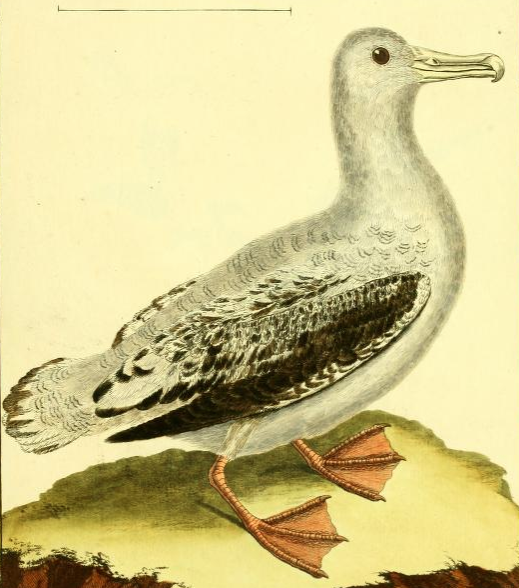
Charles Willson Peale (1741-1827) wrote, in his 23rd Lecture (ca. 1799): "586. Wandering Albatross. plumage white, masked with black on the back & wings; beak yellow; feet red; tail round & lead colour. Diomedea exulans Linn. L'ablatross Buffon Pl. enl. 237. Wandering Albatross Pennant No. 423. Latham No. 1. The length of the wing bone will give a proper Idea of the spread of this bird. and from this sharp cutting bill we might suppose it a warrior bird. yet we are not told that it assails the other fowl, which also cross the vast seas; it seems even to act on the defensive agains gulls, which, ever quarrelsome and voracious, harass and annoy it. In cooks voyage it is said, several large grey gulls, that were pursuing a white albatross, afforded us a diverting spectacle; they overtook it, not withstanding the length of its wings, and tried to attack it under the belly, that part being probably defenceless; the Albatross had now no means of escaping, but dipping its body into the water; its formidable bill seemed then to repel them [A note in the margin indicates that Peale sourced this information from Buffon]." (Academy of Natural Sciences of Drexel University Archives, coll. 40)
Peale continued: "They feed on dead whales, but its ordinary food is the spawn and fry of fish, which the currents bear along, and which sometimes cover a great extent. The celebrated Cook met with Albatrosses differing so much from each other, that he regarded them as distinct species. But from the description which he gives we are disposed to section them only as mere varieties. He distinguishes three; the gray albatross, which most probably is only a young bird, since most of the white fowls are of such colour; the dark brown, or chocolate Albatross; and the sooty or brown Albatross, which the sailors, on account of its sober garb, stiyled the quaker-bird."(ANSP Archives, coll. 40)
Peale continued: "I have had some of this brown colour, also others where the back was more beautifully marked with fine lines of black, but generally they have been so much abused in those long voyages, as to render them unfit for a place in the Museum. These birds are no where more plentiful than among the Islands of Ice in the south Sea, from the fortieth degree of latitude to the frozen barriers under the sixty-fifth and sixty-sixth degrees. According to Stellar, they are common at Kamtschatka under the name tohaiki. The quantity of feathers on the body of one of these birds is much greater than on any other I have noticed, wherefore they are well defended against cold of any climate." (ANSP Archives, coll. 40)
Peale wrote, in "A Walk Through the Philad[elphi]a Museum" (1805–1806): "This called the wandering Albatross (D. exulans) from its sharp cutting bill we might suppose is a warrier [sic] bird—yet the Gulls harrass and annoy it." (Historical Society of Pennsylvania, coll. 0481)
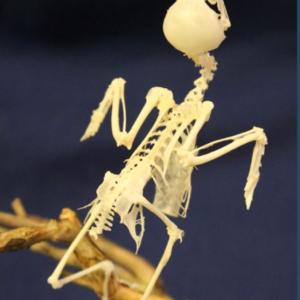
On 28 November 1806, the donation of an albatross skeleton (possibly this species), "Dissected for the Museum", was announced in the Aurora General Advertiser.
On 13 September 1815, "an albatross" donated by Captain Biddle was entered in the Peale Museum Accessions Book, p. 78 (Historical Society of Pennsylvania, coll. 0481).
On 9 January 1822, a notice in Poulson's American Daily Advertiser mentioned Dr. Richard Harlan's (1796-1843) donation of an albatross skull. Some of these donations may not have been the same species.
Notes:
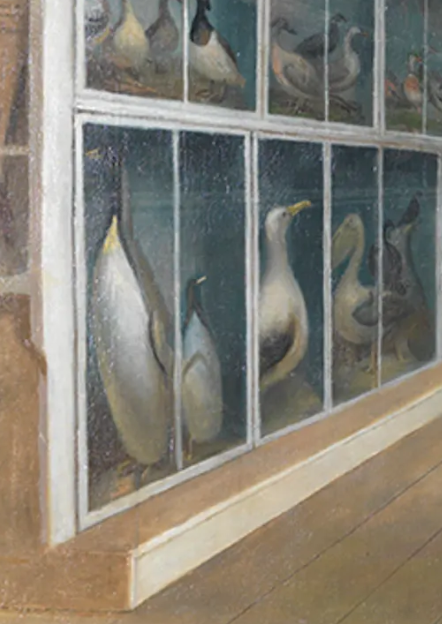
A specimen of this species is visible in Peale's oil painting, "The Artist in His Museum" (1822), in the second floor-level case to the right of the door (Pennsylvania Academy of Fine Art, 1878.1.2), shown here.
Specimen Type:
Dead/preserved
Current Common Name:
Wandering Albatross
Current Scientific Name
Diomedeidae | Diomedea exulans