Object Status:
Extant
Accession Date:
26 May 1791
Primary Source Reference:
Dunlap's American Daily Advertiser, 26 May 1791.
Additional Source Text:
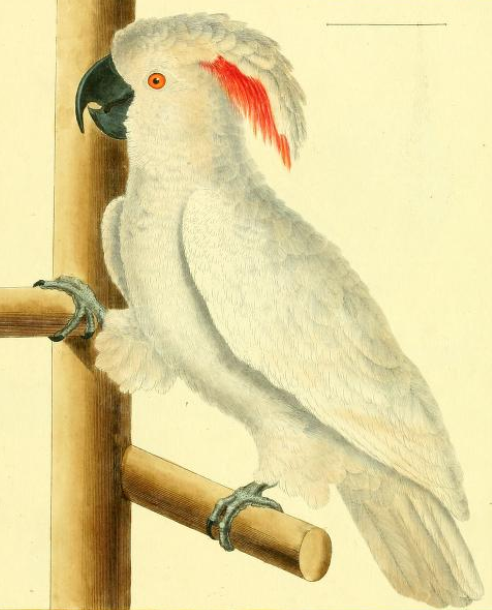
On 26 May 1791, "a Cockatoo (alive)", donated by Mrs. John O'Donnell, was announced in Dunlap's American Daily Advertiser (Philadelphia) and the General Advertiser (Philadelphia): "This beautiful bird, Edwards makes the third in the class of Parrots; he places the large red Macaw first; the blue and orange coloured Macaw the Second, and then the Cockatoo; but some authors place it at the head of that order, on account of its beautiful high crest and docile manners. It seems highly to enjoy carresses." The donation was also announced in the Independent Gazetteer (Philadelphia) on 28 May 1791, Osborne's New-Hampshire Spy on 8 Jun 1791, and the Maryland Gazette (Annapolis) on 9 June 1791.
Charles Willson Peale (1741-1827) visited the O'Donnells in June 1791, writing in his diary: "I went to Captn. O'Donnel's ... Neither Mr. or Mrs. O'Donnel gave any invitation to Mrs. Peale to visit them. This I conceive a great want of politeness as well as respect to me, as especially as I am painting this picture without any expectation of reward. It is true that I had received many articles for my Museum of them, and when I received the Cokatoo, and made the promise of doing this picture in return, altho I did not consider the bird to be worth such a price, yet as I had before recieved the bird of paradise and several other articles [from them], I do not begrudge my labour in this picture" (American Philosophical Society Library, Peale-Sellers Family Collection, Mss.B.P31).
In his 16th Lecture, Peale wrote: "No. 133. Cockatoo. These are the largest Parrots of the old continent. They are all natives of the south of Asia, where they seem to be indigenous; tho' we are uncertain whether they are not also found in Africa. They certainly are not found in South America. They are spread through the southern parts of India, and all the islands of the Indian Ocean. Their names kakatou, catacua, and cacatou, are formed from their cries. They are easily distinguished from other Parrots, by their white plumage, by the rounder and more hooked shape of their bill, and particularly by a crest of long feathers, which they can raise or depress at pleasure. The crown of the head, which is covered by these long reclined feathers, is intirely [sic] bald." (Academy of Natural Sciences of Drexel University Archives, coll. 40)
Peale continued: "It is difficult to teach the Cockatoos to prattle, and some species can never acquire the imitation. But they are more easily bred; they all grow tame, and in some parts of India, they seem domesticated; for they build their nests on the roofs of the houses. And this facility of Education seems to result from their superior understanding; they are more attentive and obedient than other Parrots, and they strive, though without success, to repeat what they hear. Their defects are compensated by other expressions of feeling, and by affectionate caresses. All their motions have a gentleness and grace which add new charms to their beauty." (ANSP Archives, coll. 40)
Peale continued: "This [specimen] before us I had living several years; it was the delight of all my family. It would press to my cheeks and rub its bill round my face, and kiss when desired. It would swing and flutter its wings, laugh, crow, and, play a thousand […] to divert the company. Although it could not articulate a single word of our language, yet it imitated the crowing of a Cock, the clucking of a Hen, and cry of chickens; also the crying of fowls when they are caught, and sometimes the barking in the hoarse note of the house dog &c. in so faithful a manner, that none could suppose it to be done by a Parrot. This extraordinary bird loved, and was capable of jealousy. It formed its attachment to me whilst I was a widower. When I married again, I pleased my self in the Idea, that here it would show its fond disposition and become also a favorite with Mrs. Peale. This could not be effected, for it became so enraged with jealousy, that she never dared to come within its reach." (ANSP Archives, coll. 40)
Peale continued: "Mr. Buffon says, that two of these birds, a male and a female, was shown in March 1775 at the fair of St. Germain at Paris. They discovered great docility, raised their crest, made a salute with their head, touched with their bill or their tongue, answered their keeper's questions with a sign of assent, as they were desired; they marked by repeated motions the number of persons in the Room, the colour of their cloaths, the […] of the day, &c.; they billed each other without being directed, and showed considerable fondness for each other. Though the Cockatoos, like other Parrots, use their bill in climbing, they have not the same heavy unpleasant gait; they are, on the contrary, very agile, and walk gracefully, tripping with short quick steps. The length of this species is about 17 inches. The crest is very long, near 6 inches, which raised up shews in a beautiful form those bright pink feathers beneath; the others are generally white with a light rose-coloured tinge. Psittacus Moluccensis Linn. Kakatou a huppe rouge Buffon pl. enl. 498. It is a native of the Molucca Island in the East Indies." (ANSP Archives, coll. 40)
Peale wrote, in "A Walk Through the Philad[elphi]a Museum" (1805–1806): "But all the tribe none are so affectionate as the Cockatoo. They seem in a high degree to enjoy our attentions to them." (Historical Society of Pennsylvania, coll. 0481)
A mounted specimen of "Psittacus sulphurus (White Cockatoo)" was listed in "A Catalogue of Duplicate Specimens...", May 1822. [unpublished] American Philosophical Society Library (Mss.B.P31).
Specimen Type:
Live (later taxidermied)
Current Common Name:
Salmon-crested Cockatoo
Current Scientific Name
Cacatuidae | Cacatua moluccensis