Object Status:
Extant
Accession Date:
By 1799
Primary Source Reference:
Charles Willson Peale, Lecture on Natural History 25. (ca. 1799). Academy of Natural Sciences of Drexel University Archives, coll. 40. / https://ansp.org/research/library/archives/0000-0099/coll0040/
Additional Source Text:
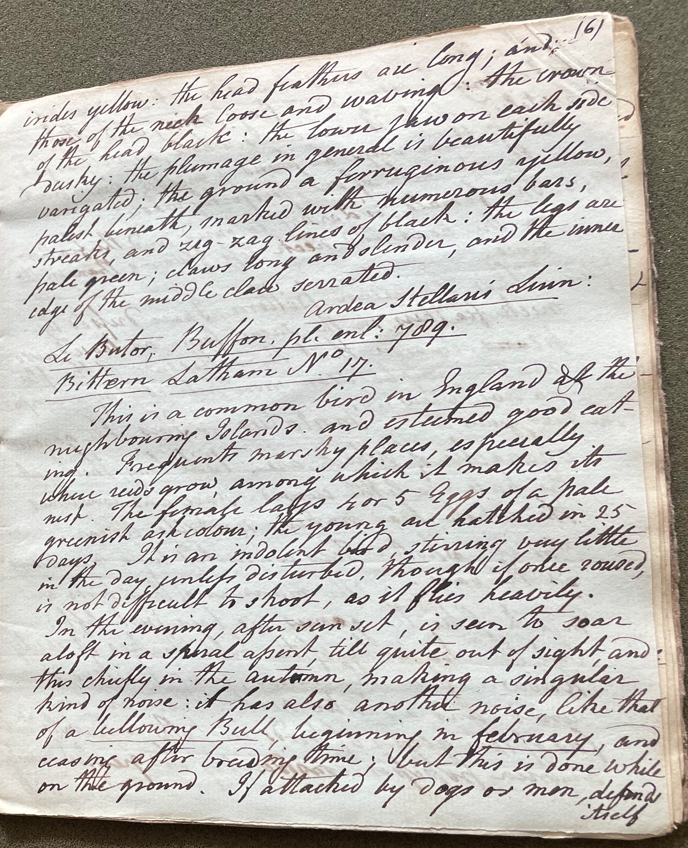
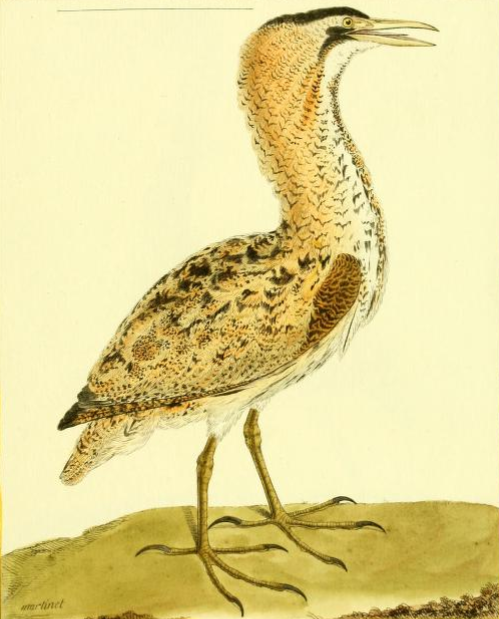
Charles Willson Peale (1741-1827) wrote, in his 25th Lecture (ca. 1799): "No. 742. European Bittern. This is an Elegant species. The bill brown, beneath inclining to green; irides yellow; the head feathers are long; and those of the neck loose and waving; the crown of the head black; the lower jaw on each side dusky; the plumage in general is beautifully variegated; the ground a ferruginous yellow, palest beneath, marked with numerous bars, streaks, and zig-zag lines of black; the legs are pale green; claws long and slender, and the inner edge of the middle claw serrated. Ardea Stellaris Linn. Le Butor, Buffon. pl. enl. 789. Bittern Latham No. 17. This is a common bird in England & the neighbouring Islands, and esteemed good eating. Frequents marshy places, especially where reeds grow, among which it makes its nest. The female lays 4 or 5 Eggs of a pale greenish ash colour; the young are hatched in 25 days. It is an indolent bird, stirring very little in the day, unless disturbed, though if once roused, is not difficult to shoot, as it flies heavily." (Academy of Natural Sciences of Drexel University Archives, coll. 40)
Peale continued: "In the evening, after sun set, is seen to soar aloft in a spiral assent, till quite out of sight, and this chiefly in the Autumn, making a singular kind of noise; it has also another noise, like that of a bellowing Bull, beginning in february, and ceasing after breeding time; but this is done while on the ground. If attacked by dogs or men defends itself well; and is said to strike at the eyes of the enemy. The food is frogs, mice, and other reptiles, which it swallows whole, as well as fish. Mr. Latham says he found 2 middle sized trouts in the stomack of one, perfectly whole. 743. The female, is darker coloured and the feathers on the head and neck less flowing then in the male." (ANSP Archives, coll. 40)
Peale wrote, in "A Walk Through the Philad[elphi]a Museum" (1805–1806): "while speaking on Bitterns, step a little forward and we shall the European Bitterns (a. Stellaris) they are elegant birds with that wide spread of neck feathers. one of America is here mounted in the same manner. it is smaller and a different species." (Historical Society of Pennsylvania, coll. 0481)
An unmounted specimen of "Ardea stellaris (Bittern)" was listed in "A Catalogue of Duplicate Specimens...", May 1822. [unpublished] American Philosophical Society Library (Mss.B.P31).
Specimen Type:
Dead/preserved
Current Common Name:
Eurasian Bittern
Current Scientific Name
Ardeidae | Botaurus stellaris