Object Status:
Extant
Accession Date:
By 1799
Primary Source Reference:
Charles Willson Peale, Lecture on Natural History 37. (ca. 1799). Academy of Natural Sciences of Drexel University Archives, coll. 40. / https://ansp.org/research/library/archives/0000-0099/coll0040/
Additional Source Text:
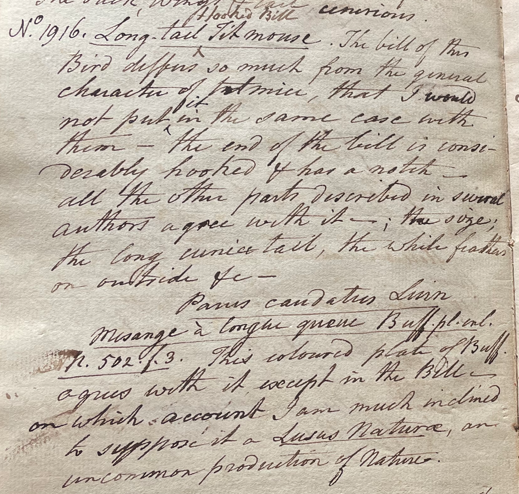
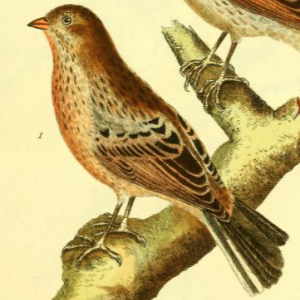
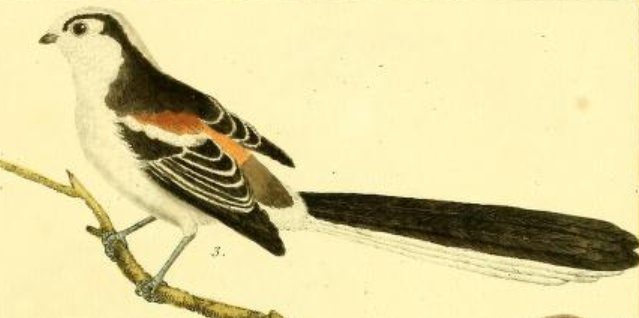
Charles Willson Peale (1741-1827) wrote, in his 37th Lecture (ca. 1799): "No. 1916. Long-tail Hooked Bill Titmouse. The bill of this Bird differs so much from the general character of titmice, that I would not put it in the same case with them. The end of the bill is considerably hooked & has a notch; all the other parts described in several authors agree with it—the size, the long cunic-tail, the white feathers on outside, &c. Parus caudatus Linn. Mesange à longue queue Buff. pl. enl. 502. f. 3. This coloured plate of Buff. agrees with it except in the Bill, on which account I am much enclined to suppose it a Luses naturae, an uncommon production of Nature." (Academy of Natural Sciences of Drexel University Archives, coll. 40)
On 15 August 1806, a "Long-tailed Titmouse" specimen donated Thomas Hall, a correspondent in London, was recorded in the Peale Museum Accessions Book (Historical Society of Pennsylvania, coll. 0481). This may have been the same specimen listed in a supplemental page of Peale's 37th Lecture, where Peale wrote: "No. 1917. Long-tailed Titmouse. Lath. II. 2. p. 550. Mesange à longue queue Buff. pl. enl. 502. f. 3. Parus caudatus Linn." (ANSP Archives, coll. 40)
Notes:
Thomas Hall (ca.1746-1813) was a natural history dealer and showman in London who, like Peale, assembled a collection of exotic taxidermy and natural oddities in his home, which he displayed to paying customers. Hall’s museum was known by the names “Curiosity House” and “Finsbury Museum”, and he distributed tokens advertising himself as “The first artist in Europe for preserving Birds, Beasts &c.” Today, many of these tokens are preserved in the British Museum. / https://www.britishmuseum.org/collection/term/BIOG145361
Peale proposed a specimen exchange with Hall, in a letter dated 28 April 1792: “I therefore make you the proposal of sending you all the Variety of this Country, for an Equal number of European [species] … which shall be preserved in the best manner (of which I now feel myself fully equal to) and sent and that I may be prepared for such an exchange I am now using every means in my power to Collect and preserve the Birds of the present season … I have not time to give you any description of such as I suppose are peculiar to this part of America, and I find that every year I discover some kinds that I had not known before, and from what I have read, I find that those who have attempted the Natural History of this Country [were] generally deficent of inteligence [sic].” (Miller 1988: 31–32, Selected Papers, Vol. 2, part 1, Yale University Press).
Peale announced in June 1792 that he was “busily employed in preserving the Birds of our Country [the United States] in order to furnish [himself] with such a number of duplicates as [would enable him] to make an extensive exchange” with Hall, and with institutions in Sweden and Holland (Miller 1988: 37). During his travels in London, Rubens Peale (1784-1865) wrote to his father on 1 June 1803: “I wish you to inform me in the next [letter] how you stand with Hall, recolleckting that I have had from him a considerable number of subjects in return from what I let him have.” (Miller 1988: 529)
The final specimen deposit from Hall was recorded in the Peale Museum Accessions Book on 17 August 1806 (Historical Society of Pennsylvania, coll. 0481).
Specimen Type:
Dead/preserved
Current Common Name:
Long-tailed Tit
Current Scientific Name
Aegithalidae | Aegithalos caudatus