Object Status:
Extant
Accession Date:
By 12 October 1792
Primary Source Reference:
Charles Willson Peale, letter to Thomas Hall of Moorfields, London, dated 12 October 1792; Selected Papers, 2, part 1: 42.
Additional Source Text:
Charles Willson Peale (1741-1827) sent "Cock & Hen Red winged black Birds" to Thomas Hall in London, on 12 October 1792, in exchange for European specimens (Miller 1988: 42, Selected Papers, Vol. 2, Part 2, Yale University Press).
On 30 April 1797, Peale sent a "Red winged stairling: [Catesby]" to Étienne Geoffrey Saint-Hilaire (1772-1844) at the Paris Museum (Miller 1988: 198).
On 1 June 1797, Peale sent another "Red-winged Starling [Cock]" to Hall (Miller 1988: 207).
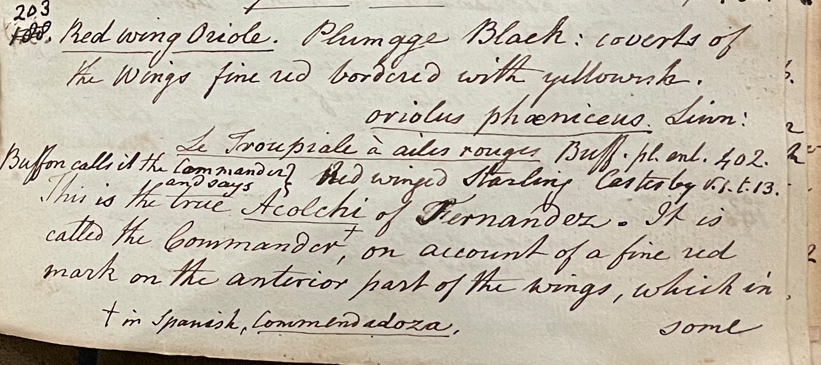
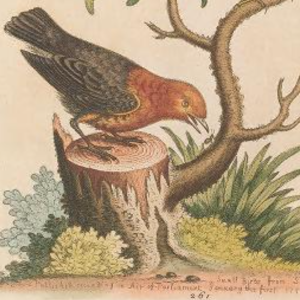
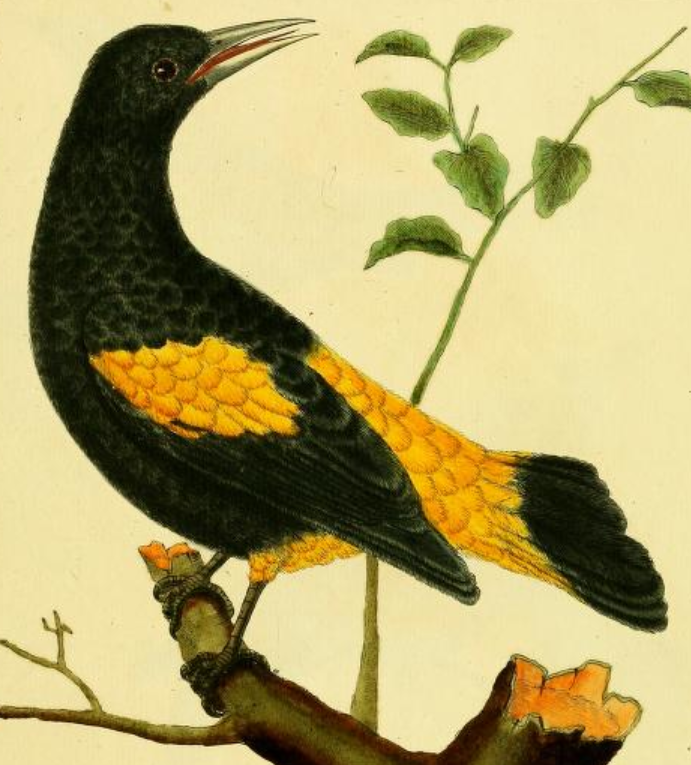
Peale wrote, in his 17th Lecture (ca. 1799): "No. 188. 203. Red wing Oriole. Plumage Black; coverts of the wings fine red bordered with yellowish. Oriolus phoeniceus Linn. Le Troupiale à ailes rouges. Buff. pl. enl. 402. Red winged Starling Catesby v. 1. t. 13." (Academy of Natural Sciences of Drexel University Archives, coll. 40)
Peale continued: "Buffon calls it the Commander, and says: "This is the true Acolchi of Fernandez. It is called the Commander, in Spanish, Commendadoza, on account of a fine red mark on the anterior part of the wings, which in some measure resembles the badge of the order of nighthood [sic]. The effect is here more striking, as it is thrown upon a ground of shining glossy black; for that is the general colour not only of the plumage, but of its Bill, feet, and nails." They are commonly called the Marsh Black bird, because they are always found about marshes, where they build their nests in low bushes in the month of May. Catesby observes that they make them woven togather among the reeds. They are found with some variety of colour on the wings which probably is only by the difference of age and season of the year. I have some which instead of the red have an orange colour." (ANSP Archives, coll. 40)
Peale continued: "189. 204. Female. The plumage is a mixture of grey and Brown, striped, particularly on the under parts; on the shoulders are some small specks of reddish colour, rather smaller than the male, and by those unacquainted with these birds would not be supposed [to be] pairs. Latham says their common name in America is Maize thief. We know that they are destructive to our corn in the fall of the year, but do not know them by that name. 196. 205. White Oriole. This is an uncommon production. The plumage generally white, but on the top of the head, cheeks and breasy a grey colour. The shoulders have a tinge of Aurora colour. The person who gave it to me called it a white Black bird. It is a variety of the preceeding; whether caused by age or disease, is not easy to determine." (ANSP Archives, coll. 40)
Peale wrote, in "A Walk Through the Philad[elphi]a Museum" (1805–1806): "There is a great difference of colour between the male & female of the Red winged oriole (oriolus phœniceus), commonly called the Marsh black bird, because they are commonly found about marshes. It is called Commander by the spaniards on account of the shoulders being Red edged with yellow. They are found in flocks from New york as far as new Spain, and some author said that they are found in Africa, but this is doubtful." (Historical Society of Pennsylvania, coll. 0481)
An undated list of 21 bird specimens in Peale's handwriting includes one "red-wing'd-black-bird" (American Philosophical Society Library, Mss.B.P31).
Alexander Wilson (1766-1813) described this species under the name "Red-winged Starling / Sturnus predatorius" in American Ornithology vol. 4 (Pl. 30), where "Peale's Museum, No. 1466, 1467" were cited, referring to the male and female, respectively (Wilson (1811: 30). / https://www.biodiversitylibrary.org/item/175531#page/38/mode/1up (text) / https://www.biodiversitylibrary.org/item/175531#page/39/mode/1up (plate)
Specimen Type:
Dead/preserved
Current Common Name:
Red-winged Blackbird
Current Scientific Name
Icteridae | Agelaius phœniceus