Object Status:
Extant
Accession Date:
By 1799
Primary Source Reference:
Charles Willson Peale, Lecture on Natural History 30. (ca. 1799). Academy of Natural Sciences of Drexel University Archives, coll. 40. / https://ansp.org/research/library/archives/0000-0099/coll0040/
Additional Source Text:
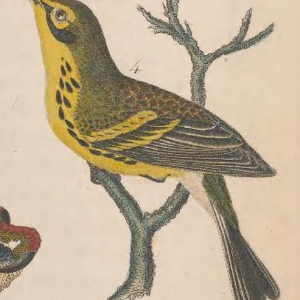
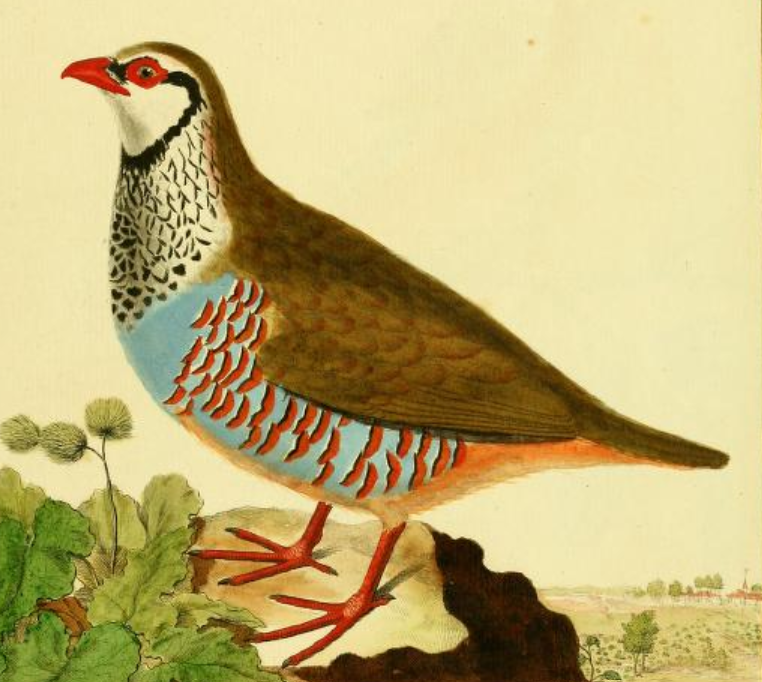
Charles Willson Peale (1741-1827) wrote, in his 30th Lecture (ca. 1799): "No. 1123. Red Partridge. It is found in most of the temperate and mountainous countries of Europe, Asia, and Africa. It is rare in the Netherlands, and in many parts of Bohemia, where the attempts to breed it have proved unsuccessful, though the pheasant thrives there. It is never seen in England, according to Buffon, but Latham says they are now and then to be met with. Tournefort talks of their becoming so tame in the Isle of Scio [Chios, Greece] that they may be driven to seek their food in the fields like so many sheep, and that each family can cause them to return to their respective masters with a whistle; and further observes, that they are so plenty in the Isle of [Nansio] as to be the pest of the inhabitants, who make it a rule, to this day, to collect as many eggs as possible every year, in order to lessen the breed, which in many seasons have totally eaten up the fruits of the harvest." (Academy of Natural Sciences of Drexel University Archives, coll. 40)
Peale continued: "These were originally from a single pair being carried to the Island, this above being so congenial to their nature, they bred so fast that the inhabitants were almost resolved to abandon their settlements. The bill and round the eyes red; the forehead is grey brown; the chin and throat white, encircled with black pointed up on each side to the eye; below this band, spotted with black and white joined by a rufous brown on the back & sides of the breast; the sides marked with [lunular] streaks of white, black and orange; the tail brown, composed of 16 feathers. The male only has the blunt knob or spur. Tetrao rufus Linn. Perdix rouge de France Buff. pl. enl. 150." (ANSP Archives, coll. 40)
Peale wrote, in "A Walk Through the Philad[elphi]a Museum" (1805–1806): "Partridges are distinguished by their orbits [?] being granulated: feet naked. [Their] feet are the long bones to which the toes are joined. here we find the barbary Partridge (T. Rufus) the European Partridge, and the Grey or Common Partridge, this also is found throughout Europe in the temperate parts. They are by Nature more gentle than the red; if not teazed soon becomes familiar. To save their brood they will fly off a short distance hanging their wings as if cripled, to allure the pursuit of them while the female glides through the grain or Grass with her little ones." (Historical Society of Pennsylvania, coll. 0481)
A mounted specimen of "Tetrao rufus (Red P)" from France was listed in "A Catalogue of Duplicate Specimens...", May 1822. [unpublished] American Philosophical Society Library (Mss.B.P31).
Specimen Type:
Dead/preserved
Current Common Name:
Red-legged Partridge
Current Scientific Name
Phasianidae | Alectoris rufa