Object Status:
Extant
Accession Date:
By 1793
Primary Source Reference:
Charles Willson Peale, letter to Thomas Hall of Moorfields, London, dated 1793; Selected Papers, 2, part 1: 46.
Additional Source Text:
Charles Willson Peale (1741-1827) sent a "Snow bird" to Thomas Hall in London, in early 1793, in exchange for European specimens (Miller 1988: 46, Selected Papers, Vol. 2, Part 2, Yale University Press).
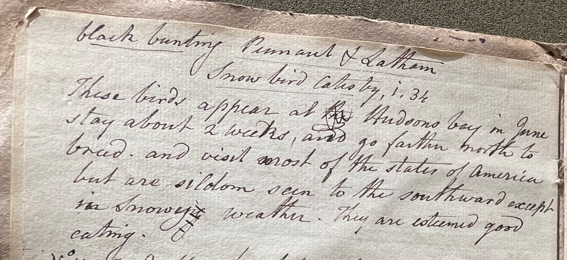
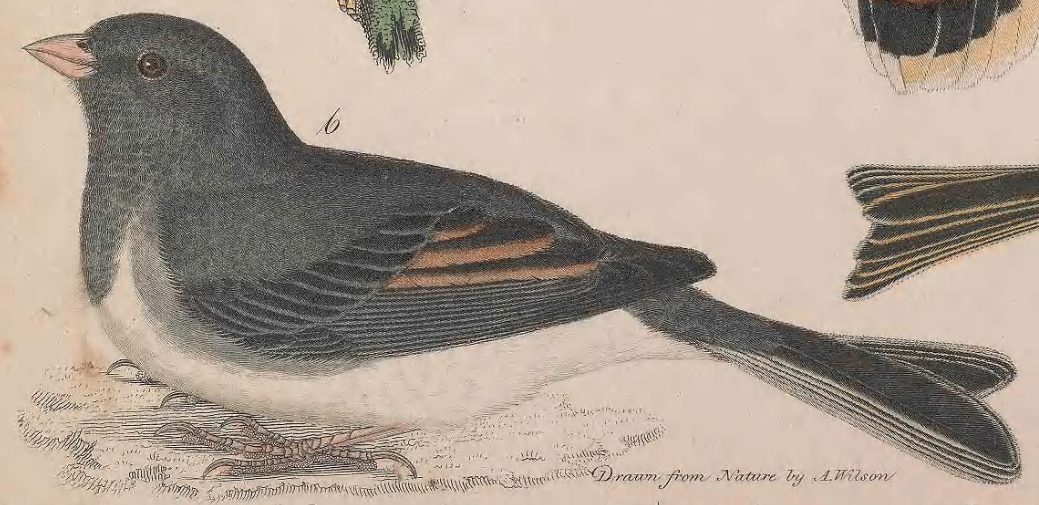
In his 33rd Lecture, Peale wrote: "No. 1472. Black bunting commonly called Snowbird. the head, back and wings sooty black, breast and under parts white. Emberiza hyemalis Linn. Black bunting Pennant & Latham. Snow bird Catesby, i. 34. These birds appear at Hudsons bay in June, stay about 2 weeks, and go farther north to breed, and visit most of the states of America but are seldom seen to the southward except in snowy weather. They are esteemed good eating." (Academy of Natural Sciences of Drexel University Archives, coll. 40)
Peale wrote, in "A Walk Through the Philad[elphi]a Museum" (1805–1806): "The Snow bird, as it is called because it visits us with the first Snows, is the black Bunting (E. hyemalis) said to go to the north of Hudsons bay to breed. What changes the plumage undergoes is deserving of Enquiry. at any rate we see no bird like its winter dress, in mid summer." (Historical Society of Pennsylvania, coll. 0481)
Alexander Wilson (1766-1813) described this species under the name "Snow-bird / Fringilla nivialis" in American Ornithology vol. 2 (Pl. 16), where "Peale's Museum No. 6532" was cited (Wilson 1810: 129). / https://www.biodiversitylibrary.org/item/175511#page/147/mode/1up (text) / https://www.biodiversitylibrary.org/item/175511#page/134/mode/1up (plate)
Specimen Type:
Dead/preserved
Current Common Name:
Dark-eyed Junco
Current Scientific Name
Passerellidae | Junco hyemalis