Object Status:
Extant
Accession Date:
By 1799
Primary Source Reference:
Charles Willson Peale, Lecture on Natural History 35. (ca. 1799). Academy of Natural Sciences of Drexel University Archives, coll. 40. / https://ansp.org/research/library/archives/0000-0099/coll0040/
Additional Source Text:
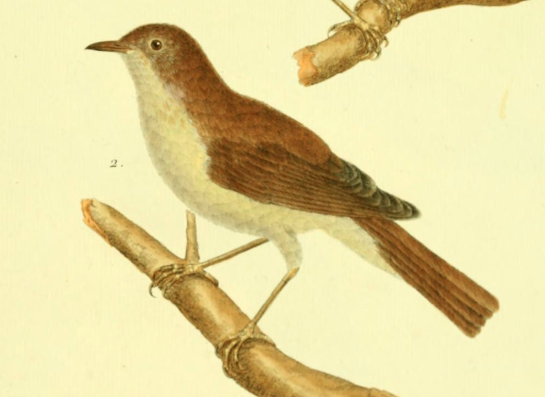
Charles Willson Peale (1741-1827) wrote, in his 35th Lecture (ca. 1799): "No. 1741. Nightinglale [sic]. This, though a plain bird, merits the first place in the warbler genus on account of its delightful song. This belongs to Europe & Asia. It is less than out mocking bird [Northern Mockingbird, Mimus polyglottos], in length about 6 Inches. The bill is brown; irides hazel; the head and back pale tawny, dashed with olive; tail deep tawny red; the breast and under parts pale ash colour; quills cinereous, margined with reddish brown. Motacilla luscinia Linn. Le Rossignol Buff. pl. enl. 615. Nightingale. Latham & Pennant. No. 1742. Female, much like the male. She makes her nest in some low bush, of dry leaves on the outside, lined with hair and down within, and lays 4 or 5 eggs of a greenish brown colour, such as the nest & eggs before us." (Academy of Natural Sciences of Drexel University Archives, coll. 40)
Peale continued: "Mr. Buffon says, 'To every person whose ear is not totally insensible to melody, the name of Nightinale must recall the charms of those soft evenings in spring, when the air is still and serene, and all nature seems to listen to the songster of the grove. Other Birds, the Larks, the canaries, the Chaffinches, the petty-chaps, the Linnets, the goldfinches, the blackbirds, the American Mocking bird, excel in the several parts which they perform; but the nightingale combines the whole, and joins sweetness of tone with variety and extent of execution." (ANSP Archives, coll. 40)
Peale continued: "Its notes assume each diversity of character, and receive every change of modulation; not a part is repeated without variation; and the attention is kept perpetually awake, and charmed by the endless flexibility of strains. The leader of the vernal chorus begins the prelude with a low and timid voice, and he prepared for the hymn to nature by essaying his powers and attuning his organs; by degrees, the sound opens and swells; it bursts with loud and vivid flashes; it flows with smooth volubility; it faints and murmurs; it shakes with rapid and violent articulation; the soft breathings of love and joy are poured from his inmost soul and every heart beats unison, and melts with delicious langour. But this continual richness might satiate the ear, which bestow dignity and elevation. The mild silence of evening heightens the general effect, and not a rival interrupts the solemn scene'." (ANSP Archives, coll. 40)
Peale continued: "The nightingale excels all birds in the softness and mellowness, and also in the duration of its warble, which sometimes lasts without interruption 20 minutes. Barrington reckons 16 distinct notes between the highest and lowest keys, and finds that its song fills a circle of a mile in diameter, which is equal to the power of the human voice. When the nightingale is confined, his wants are suppled and anticipated, and he enjoys the vernal mildness through the greater part of the year; everything concurs to foster his passion, and the melody of his song ceases only for a short interval. Such is the case with those which are caught after they are grown up; within a few hours they often resume their warble, in all its richness of expression; no longer is it limited by the transient seasons. But the love of liberty is not extinguished in their bosom; for the first, they can hardly support their forlorn condition; they must be pinioned and fed. However, their passion for warbling in the end surmounts every desponding recollection." (ANSP Archives, coll. 40)
Peale continued: "The song of other birds, the music of instruments, the accents of a sweet and sonorous voice, powerfully awaken their languid powers. They are eagerly attracted by sweet sounds, and seem particularly fond of duos; which shews that they are not insensible to the effects of harmony. But they are not silent auditors; they strike the unison, and strive to eclipse their rivals. It is said that a nightingale dropped dead at the feet of a person who sang; another fretted, swelling its throat, and murmured discontent, whenever a canary, which was beside it, began to chant, till at last, by its menances [sic], it silenced its competitor. Real superiority is not always exempt frm jealousy." (ANSP Archives, coll. 40)
Peale continued: "Mr. Buffon asks, may not this desire of excelling be the reason why they choose advantageous situations, and delight to sing to the returning echo? The nightingales differ much in the quality of their song; in some it is so inferior that they are reckoned not worth keeping. It is even said, their warble is not the same in every country; the bird-fanciers in England prefer the nightales of Surry to those of Middlesex, and goldfinches of Kent. This diversity of song has been properly compared to the different dialects of the same language. It may arise from accidental causes; a nightingale happens to hear the sweet music of some other birds, and, in the glow of emulation, improves his own; he communicates the melody to his young; and thus it is transmitted, with various alterations, through the succeeding races. [A note inserted here reads: 'Pliny states that the parent is careful in […] young]." (ANSP Archives, coll. 40)
Peale continued: "A musician, says Frisch, ought to study the song of the nightingale, and write it. This what the Jesuit Kircher formerly attempted, and which has been lately tried by Barrington. Yet the latter owns that he could not succeed; for though the notes were played by an excellent performer on the flute, they were no resemblance to the nightingale's warbler. Mr. Barrington suspects the difficulty to arise from the impossibility of marking the musical intervals. Their measures are so varied, their transitions so insensibly blended, the succession of their tones so wild and irregular, as to soar beyond every constraint of method; but still more difficult it would be to imitate with a dead instrument the expression of the nightingale, his tender sighs and his melting accents." (ANSP Archives, coll. 40)
Peale continued: "The animated organ of voice can alone aspire to the music of nature; and the rare accomplishment of a soft, clear, flexible, sonorous tone, of a delicate and discerning ear, and of an exquisite sensibility, will sometimes succeed. I knew (says Buffon) two persons, who, though they had not noted a single bar, imitated the whole extent of the nightingale's warble, and so accurately as to deceive the hearer. They were two men, who rather whistled than sung; the one whistled so softly, that it was impossible to perceive the motion of his lips; the other blew with more force, and his attitude was somewhat constrained, though his imitation was still perfect. / A few years ago, there was a man at London who attracted the nightingales with his song; insomuch that they alighted on him, and allowed themselves to be caught by the hand. [A note inserted here attributes these anecdotes to "Animal Register for 1764"]. / There are other curious accounts of the musick of this bird, & some very improbable [tales] told by Pliny, but we have already dwelt long enough on one article." (ANSP Archives, coll. 40)
Peale evidently had duplicate specimens because a note in his 1801 diary reads: "Cock Nightingale - given to Mr. Maccabbin of Annapolis, May 9 1799" (American Philosophical Society Library, Peale-Sellers Family Collection, Mss.B.P31).
Peale wrote, in "A Walk Through the Philad[elphi]a Museum" (1805–1806): "This plain brown bird merits the first place, as the most melodious songster. The Nightingale (Motacilla luscinia) belong to Europe & Asia. Mr. Buffon says: "to every person whose ear is not totally invisible to melody, the name of nightingale must recall the charms of those soft evenings in spring, when the air is still and serene, and all nature seems to listen to the songster of the grove." &c. see the article in my 35th lecture." (Historical Society of Pennsylvania, coll. 0481)
A mounted specimen of "Motacilla luscinia (Nightingale)" from Europe was listed in "A Catalogue of Duplicate Specimens...", May 1822. [unpublished] American Philosophical Society Library (Mss.B.P31).
Specimen Type:
Dead/preserved
Current Common Name:
Common Nightingale
Current Scientific Name
Muscicapidae | Luscinia megarhynchos