Object Status:
Extant
Accession Date:
By 1799
Primary Source Reference:
Charles Willson Peale, Lecture on Natural History 18. (ca. 1799). Academy of Natural Sciences of Drexel University Archives, coll. 40. / https://ansp.org/research/library/archives/0000-0099/coll0040/
Additional Source Text:
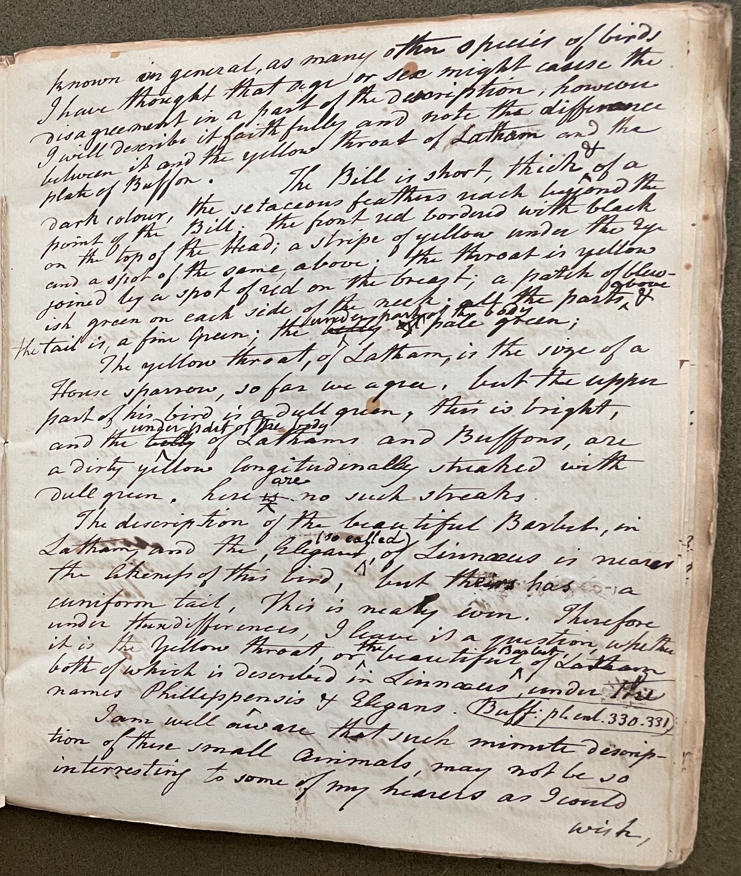
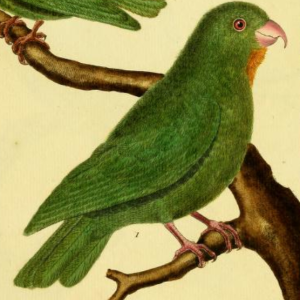
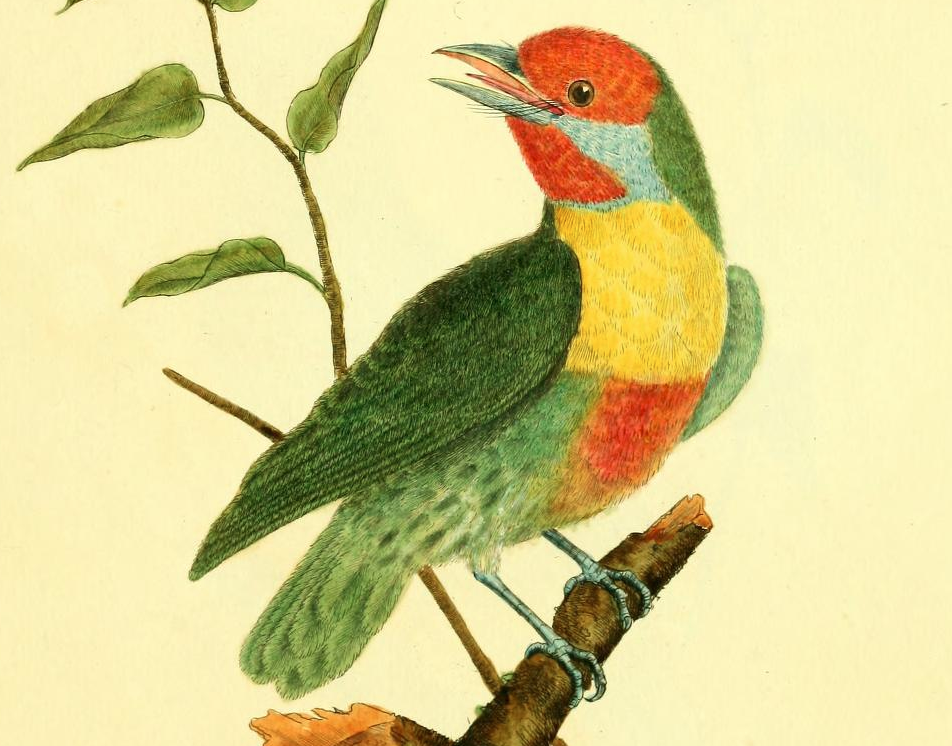
Charles Willson Peale (1741-1827) wrote, in his 18th Lecture (ca. 1799): "No. 178 251. Yellow throated Barbet. I have put this name to the bird before us, because of all those described in Buffon, Latham & some other Authors, it most resembles it, otherwise I must have said it was a non descript, but as these birds are not so well known in general, as many other species of birds, I have thought that age or sex might cause the disagreement in a part of the description, however. I will describe it faithfully and note the difference between it and the yellow throat of Latham, and the plate of Buffon. The Bill is short, thick & of a dark colour; the setaceous feathers reach beyond the point of the Bill; the front red bordered with black on the top of the Head; a stripe of yellow under the Eye and a spot of the same above; the throat is yellow joined by a spot of red on the breast; a patch of blueish green on each side of the neck; all the parts above & the tail is, a fine green; the belly is under parts of the body pale green." (Academy of Natural Sciences of Drexel University Archives, coll. 40)
Peale continued: "The yellow throat of Latham is the size of a House sparrow, so far we agree, but the upper part of his bird is a dull green. This [specimen] is bright, and the belly under part of the body of Lathams and Buffons, are a dirty yellow longitudinally streaked with dull green. Here are no such streaks. The description of the beautiful Barbet, in Latham, and the (so called) Elegant, of Linnaeus, is nearer the likeness of this bird, but theirs has a cuneiform tail. This is nearly even. Therefore under these differences, I leave it a question whether it is the yellow throat, or the beautiful Barbet of Latham, both of which is described in Linnaeus under the names Phillippensis & Elegans. Buff. pl. enl. 330. 331." (ANSP Archives, coll. 40)
Peale continued: "I am well aware that such minute description of these small Animals, may not be so interesting to some of my hearers as I could wish. However, I please myself in the Idea, that it will be considerable utility to others; because after a fimiliar knowledge is gained on a few, the desire of being acquainted with a greater number, will be a natural consequence, and, the result, promote more correct Ideas of Nature. This furnishing us with a sourse of delightful & instructive amusement; most powerly tending to make us feel, a due reverence for and adoration of the great Creator, because the more we see of the beauty, order, and wonderful variety of forms, each best fitted for the purposes of life and its reproduction, continually to our view, the greater must be our desire to gain a thorough knowledge of Natural History." (ANSP Archives, coll. 40)
In the same lecture, Peale wrote: "No. 254. yellow throated Barbet Lath.? Vol. 1. 2. p. 500. n. 7. Barbu des Philippines? Buff. pl. enl. 331. Buffons plate is considerably like it, except that that [sic] this have not the yellow round the Eye and on the throat. Bucco Philippinensis Linn.? This may be a variety of the [Green Barbet], not being able to find any so well to assimilate, I have put [it] under the above names, until further information is had." (ANSP Archives, coll. 40)
Peale (1805–1806) later wrote, in "A Walk Through the Philad[elphi]a Museum" (1805-1806): "Red crowed Barbet (B. Rubricapillus) of Ceylon." (Historical Society of Pennsylvania, coll. 0481)
Specimen Type:
Dead/preserved
Current Common Name:
Crimson-fronted Barbet
Current Scientific Name
Megalaimidae | Psilopogon rubricapillus