Object Status:
Extant
Accession Date:
By 1799
Primary Source Reference:
Charles Willson Peale, Lecture on Natural History 32. (ca. 1799). Academy of Natural Sciences of Drexel University Archives, coll. 40. / https://ansp.org/research/library/archives/0000-0099/coll0040/
Additional Source Text:
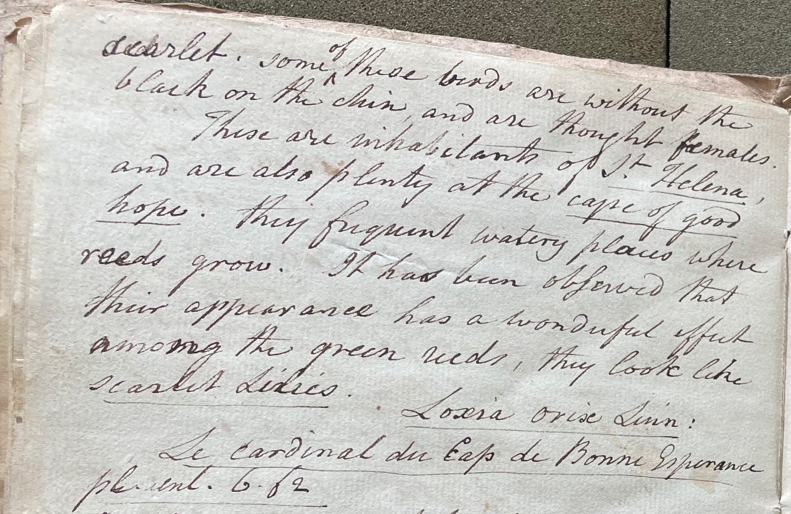
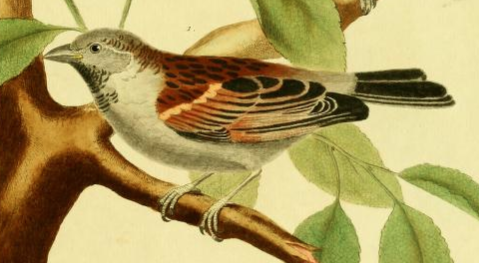
Charles Willson Peale (1741-1827) wrote, in his 32nd Lecture (ca. 1799): "No. 1415. Grenadier Grossbeak. The fore head & cheeks and chin Black; breast also; the wing brown with pale edges; the rest of the body a beautiful scarlet. Some of these birds are without the black on the chin, and are thought females. These are inhabitants ofSt. Helena, and are also plenty at the Cape of Good Hope. They frequent watery places where reeds grow. It has been observed that their appearance has a wonderful effect among the green reeds; they look like Scarlet Lilies. Loxia orix Linn. Le cardinal du Cap de Bonne Esperance. pl. enl. 6. f. 2." (Academy of Natural Sciences of Drexel University Archives, coll. 40)
Peale wrote, in "A Walk Through the Philad[elphi]a Museum" (1805–1806): "Africa & Assia possess a great variety, specified in these small birds before us, one of the largest and not the least brilliantly coloured is the Grenadier Gross Beak of Africa (L. orix)." (Historical Society of Pennsylvania, coll. 0481)
Specimen Type:
Dead/preserved
Current Common Name:
Southern Red Bishop
Current Scientific Name
Fringillidae | Euplectes orix