Object Status:
Extant
Accession Date:
By 1799
Primary Source Reference:
Charles Willson Peale, Lecture on Natural History 32. (ca. 1799). Academy of Natural Sciences of Drexel University Archives, coll. 40. / https://ansp.org/research/library/archives/0000-0099/coll0040/
Additional Source Text:
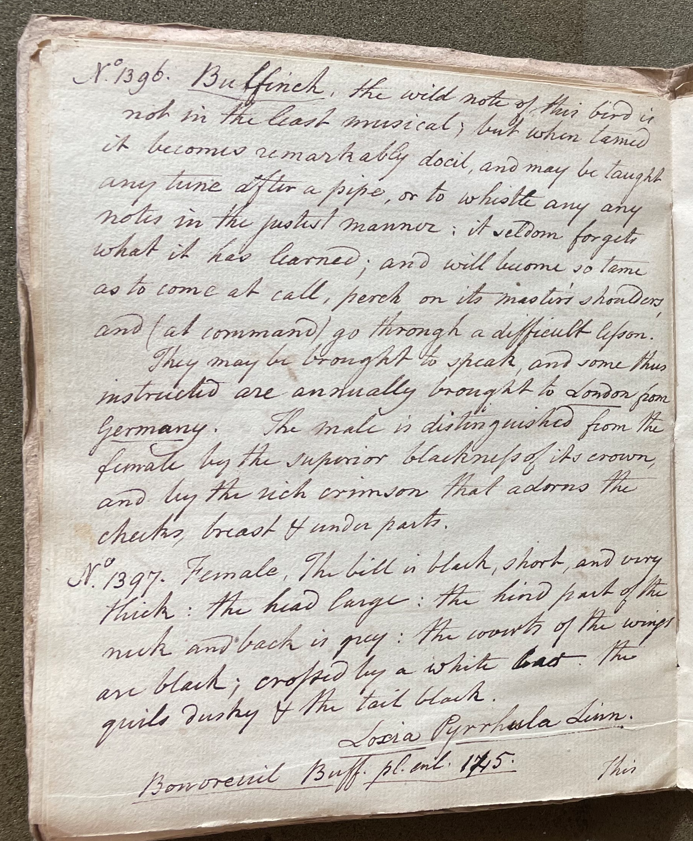
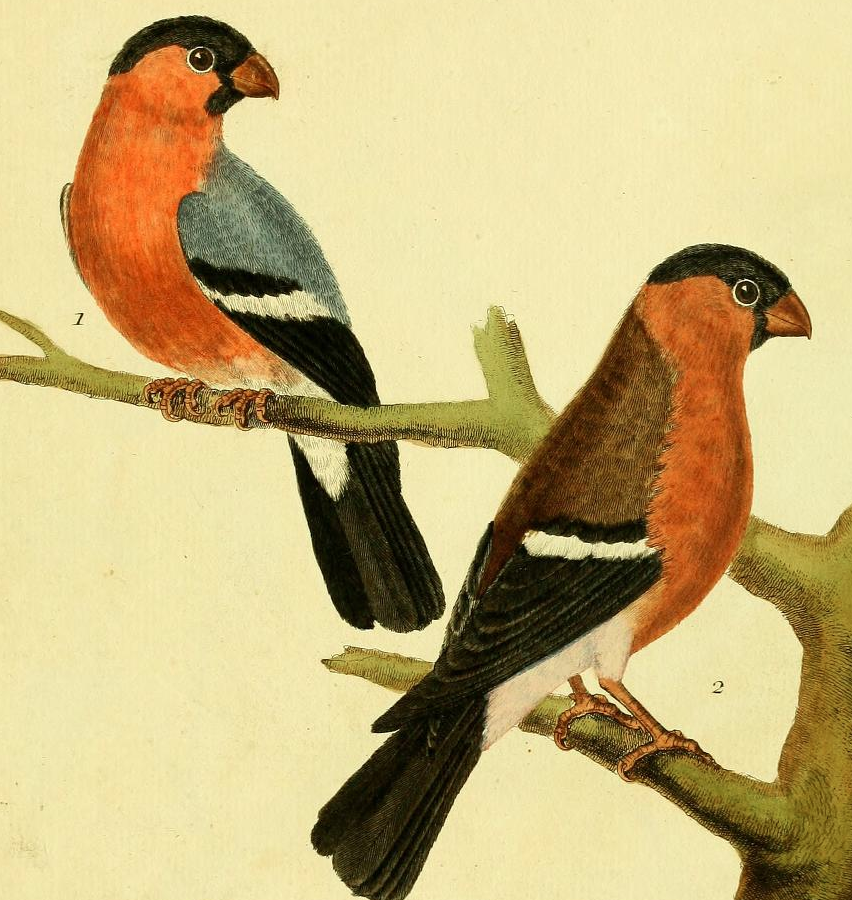
Charles Willson Peale (1741-1827) wrote, in his 32nd Lecture (ca. 1799): "No. 1396. Bullfinch. The wild note of this bird is not in the least museical, but when tamed it becomes remarkably docil, and may be taught any tune after a pipe, or to whistle any notes in the justest manner. It seldome forgets what it has learned, and will become so tame as to come at call, perch on its master's shoulders, and (at command) go through a difficult lesson. They may be brought to speak, and some thus instructed are annually brought to London from Germany." (Academy of Natural Sciences of Drexel University Archives, coll. 40)
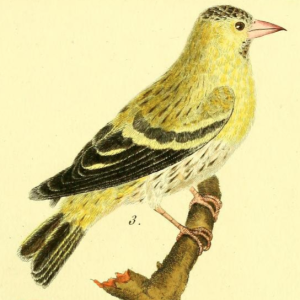
Peale continued: "The male is distinguished from the female by the superior blackness of its crown, and by the rich crimson that adorns the cheeks, breast & under parts. No. 1397. Female. The bill is black, short, and very thick; the head large; the hind part of the neck and back is grey; the coverts of the wings are black; crossed by a white bar; the quils dusky & the tail black. Loxia pyrrhula Linn. Bouvreuil Buff. pl. enl. 145. This species is common in most parts of the continent of Europe and throughout Russia and Sibiria, at which last place it is caught for the table. It is pretty common in England, and builds in the bushes, 5 or 6 feet from the ground. In winter it approaches gardens and orchards and has been generally stigmatized for making havock among the buds of trees." (ANSP Archives, coll. 40)
Peale continued: "From some late observations, however, it would appear that the object of these birds is not the bud, but the worm in the bud; and that this in conjunction with various other species of small birds, are the frequent mends of defending the embryo-fruits, and thence promoting their growth to maturity; for the warmth that swells the buds, not only hatches nidos (eggs) of unnumbered tribes of insects, whose parent flies by unerring instinct laid them there, but brings forward a numerous race already in the caterpillar state, that now issue from their concealments and make their excursion along the budding branches, and would probably destroy every hope of fruitage, but for those useful instruments for its preservation, whose young are principly fed, by eating caterpillars … 1426. Bullfinch, a variety having brighter colours than the other (recd. from France)." (ANSP Archives, coll. 40)
Peale wrote, in "A Walk Through the Philad[elphi]a Museum" (1805–1806): "The European Bullfinch (Pyrrhula) is a species that the female as well as the male may be taught musick, and by a regular education becomes greater adept than perhaps any other bird, and even be taught to speak little prasses [phrases], which it does with such an air of descernment and penetration, appearing as if animated with an inteligent principle." (Historical Society of Pennsylvania, coll. 0481)
Specimen Type:
Dead/preserved
Current Common Name:
Eurasian Bullfinch
Current Scientific Name
Fringillidae | Pyrrhula pyrrhula