Object Status:
Extant
Accession Date:
1 October 1807
Primary Source Reference:
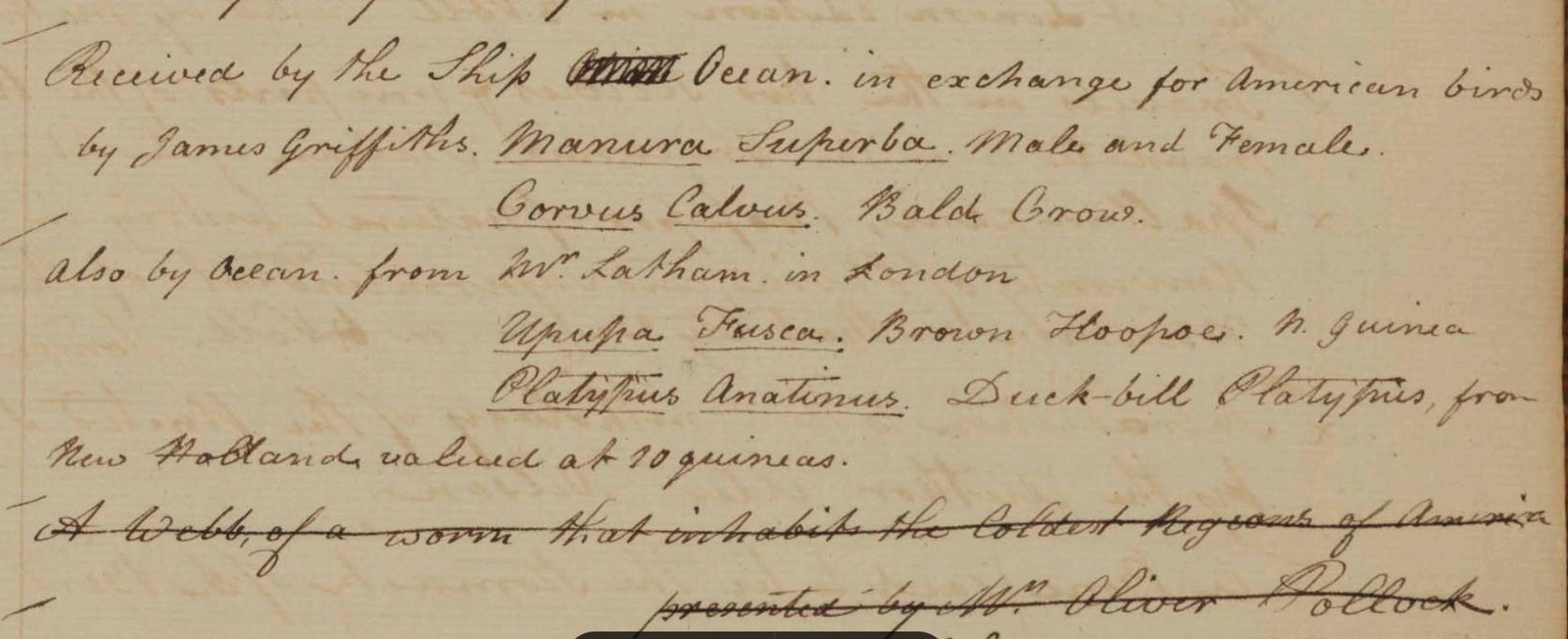
Peale Museum Accessions Book, 1 October 1807. Historical Society of Pennsylvania, coll. 0481.
Additional Source Text:
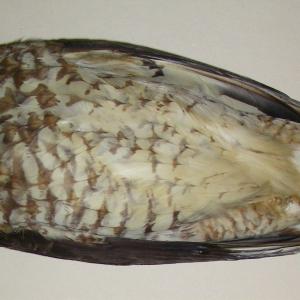
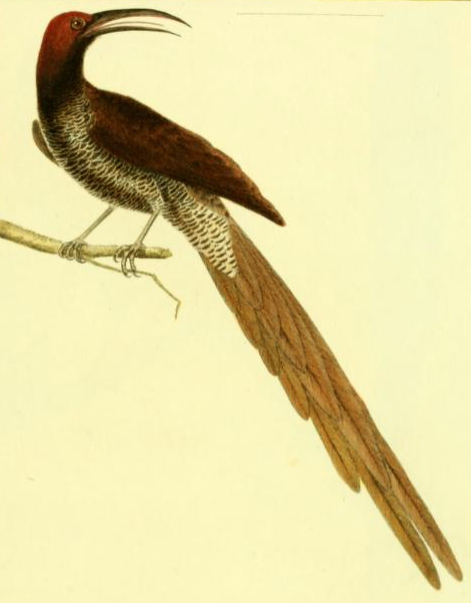
On 1 October 1807, a specimen of "Upupa Fusca. Brown Hoopoe. N. Guinea", donated by Mr. John Latham (1740-1837), of London, was entered in the Peale Museum Accessions Book, p. 25 (Historical Society of Pennsylvania, coll. 0481). This was presumably a female E. fastosus.
Notes:
John Latham (1740-1837) was a naturalist and physician, a frequent correspondent and donor to Peale's Museum, and author of the influential ornithological works A general synopsis of birds (1781-85, London: Benj. White) / https://www.biodiversitylibrary.org/bibliography/49894 / and Index ornithologicus... (1790) / https://www.biodiversitylibrary.org/bibliography/131313 Peale frequently consulted Latham's works when preparing his lectures and classifying his specimens, and Latham's (1790) taxonomy was the starting point for Alexander Wilson (1766-1813) in American Ornithology (see Wilson 1808: iii). / https://www.biodiversitylibrary.org/item/175530#page/18/mode/1up / Wilson's use of Latham's (1790) arrangement of the Linnaean system was not innovative, as claimed by Burtt and Davis (2013: 289, Alexander Wilson: The Scot Who Founded American Ornithology, Harvard University Press), but convenient; he simply had to copy the identifications from the curated display cases at the Peale Museum. This much is clear from Peale's description of the collection (as Wilson knew it) in a Guide to the Philadelphia Museum (1804), printed for museum patrons: "The Linnaean Classification is generally adopted throughout the Animal department ... [in the] Long Room / Linnaeus's classification of Birds, with the characters of each order and genus, is (for want of space to display it better) exhibited in a gilt frame at the entrance of the Long Room. All the birds are in glass cases, the insides of which are painted to represent appropriate scenery; Mountains, Plains, or Waters, the Birds being placed on branches or artificial rocks, &c. These cases, rising 12 feet from the floor, extend the whole length of this room, which is 100 feet, producing an uncommonly elegant display … in frames over each case, the genus is first noted, then their species and names in Latin, English, and French, referring to the numbers which are attached to each species. / There are now in this collection, perhaps all the birds belonging to the Middle, many of which likewise belong to the Northern and Southern States, and a considerable number from South America, Europe, Africa, Asia, New Holland, and the recently discovered islands of the South Seas. The number exceeds 760 [species] without the admission of any duplicates, contained in 140 cases" (Miller 1988: 761–762, Selected Papers, Vol. 2, part 2, Yale University Press).
Specimen Type:
Dead/preserved
Current Common Name:
Black Sicklebill
Current Scientific Name
Paradisaeidae | Epimachus fastosus