Object Status:
Unlocated
Accession Date:
23 March 1821
Primary Source Reference:
Peale Museum Accessions Book, 23 March 1821. Historical Society of Pennsylvania, coll. 0481.
Additional Source Text:
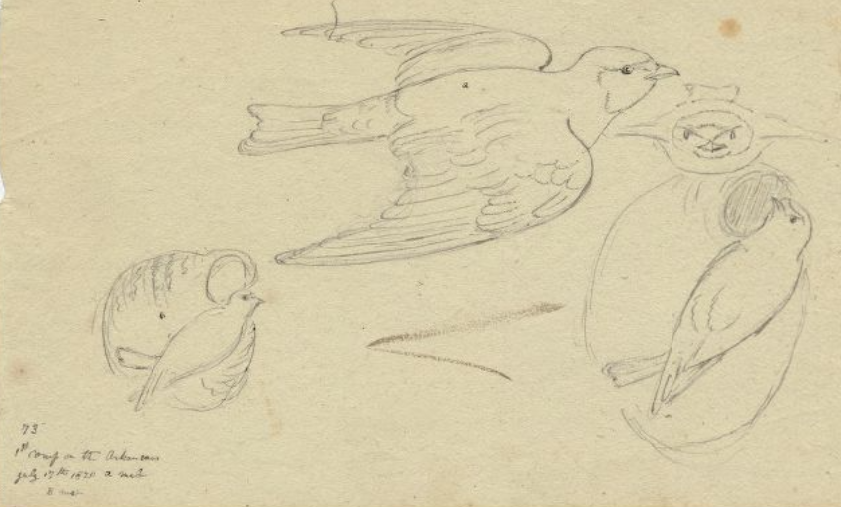
Titian Ramsay Peale (1799-1885) drew a male of this species during the Long Expedition on 17 July 1820, at the party's first camp on the Arkansas River, and a landscape view of nests on a cliffside (APS Library Mss.B.P.31.15d). He deposited specimens of "2 [Species] of Swallows" on 23 March 1821, as recorded in the Peale Museum Accessions Book (Historical Society of Pennsylvania, coll. 0481).
Thomas Say (1787-1834), in Edwin James, 1823, Account of an Expedition from Pittsburgh to the Rocky Mountains..., vol. 1 (Philadelphia), described the specimens as a new species (Hirundo lunifrons), which was later deemed a junior synonym of P. pyrrhonota (Vieillot, 1817, Nouv. Dict. Hist. Nat. nouv. éd.). / https://www.biodiversitylibrary.org/item/124315#page/59/mode/1up
Charles Lucien Bonaparte (1803–1857) described this species under the name "Fulvous or Cliff Swallow / Hirundo fulva" in his continuation of American Ornithology vol. 1 (1825, Pl. 7), where "Peale's Museum, No. 7624" was cited (Bonaparte 1825: 63): "This description is taken from our finest male, which is also represented in the plate." The figure in Bonaparte's plate was based on Titian's drawing, engraved by Alexander Lawson (ca.1772-1846). / https://search.library.wisc.edu/digital/AFKPEJIASN54OC8L/pages/AYSNZUTU…
On 15 Nov 1827, a donation of "Hirundo fulva (Cliff Swallows) … from Maine," presented by Mr. E. Abadie, was recorded in the Peale Museum Accessions Book (HSP, coll. 0481).
Notes:
After Peale's Museum closed, a portion of Peale's bird collection was purchased in 1850 by Moses Kimball (1809–95), who displayed it at his "Boston Museum". An advertisement in the Boston Transcript, printed 1 October 1850, stated that Kimball had acquired "One Half of the celebrated Peale's Philadelphia Museum". The other half of Peale's birds had been sold to the circus promoter P. T. Barnum (1810–91) and would be subsequently destroyed in a fire at his "American Museum" in New York City in July 1865. When the Boston Museum closed, Kimball's Peale remnants passed temporarily to the Boston Society of Natural History, who disposed of them to Charles J. Maynard (1845-1929), a local taxidermist. The specimens were stored in a barn in Massachusetts for several years, then eventually were deposited at the Museum of Comparative Zoology (MCZ), Harvard University. By the time the collection was catalogued by Walter Faxon (1848-1920) at MCZ, in 1914, in virtually every case the original mounts and labels had been disassociated from the specimens, and an untold number were lost. Walter Faxon, "Relics of Peale's Museum," Bulletin of the Museum of Comparative Zoology, 59, no. 3 (July 1915): 138, speculated about the provenance of MCZ 67865 (shown here), a data-deficient specimen once in the Boston Museum collection: "Mounted to simulate a flying bird, like Bonaparte's figure of "Hirundo fulva Vieill." … and probably the specimen drawn. According to Bonaparte the Cliff Swallow had not at that time advanced further east than western New York, and it is possible that his drawing was made from one of Say's types from the Long Expedition, which were in the Peale Museum." / https://www.biodiversitylibrary.org/page/6339801#page/188/mode/1up Here, for simplicity, we state that Titian R. Peale (1799-1885) deposited the Long Expedition specimens at Peale's Museum. However, it should be noted that the specimens did not belong to Titian, and were not his to give away. Officially, they were the property of the United States government, and as such were formally deposited by Major Stephen Harriman Long (1784-1864), who led the government-sponsored expedition. The Peale Museum Accessions Book, pp. 112-113 (Historical Society of Pennsylvania, coll. 0481) contains an "Invoice of Zoological Specimens and Drawings prepared by Titian Peale, Assistant Naturalist for the Exploring Expedition, and deposited in the Philadelphia Museum by Majr. S. H. Long, Maj. U.S. Engr. pursuant to instructions of the Secretary of War." At the conclusion of the invoice, "Rubens Peale [1784-1865], manager" signed the following statement: "Received, Philadelphia Museum, March 23d. 1821. of Majr. S. H. Long, the several articles, specified in the above Invoice, as a deposit for safe keeping, preservation and Exhibition; and I hereby promise, as agent for the Institution to hold the said articles subject to the orders of the War Department, thru the said Maj. Long." (HSP, coll. 0481)
Specimen Type:
Dead/preserved
Current Common Name:
Cliff Swallow
Current Scientific Name
Hirundinidae | Petrochelidon pyrrhonota
Repository:
Museum of Comparative Zoology, Harvard University (MCZ 67865)